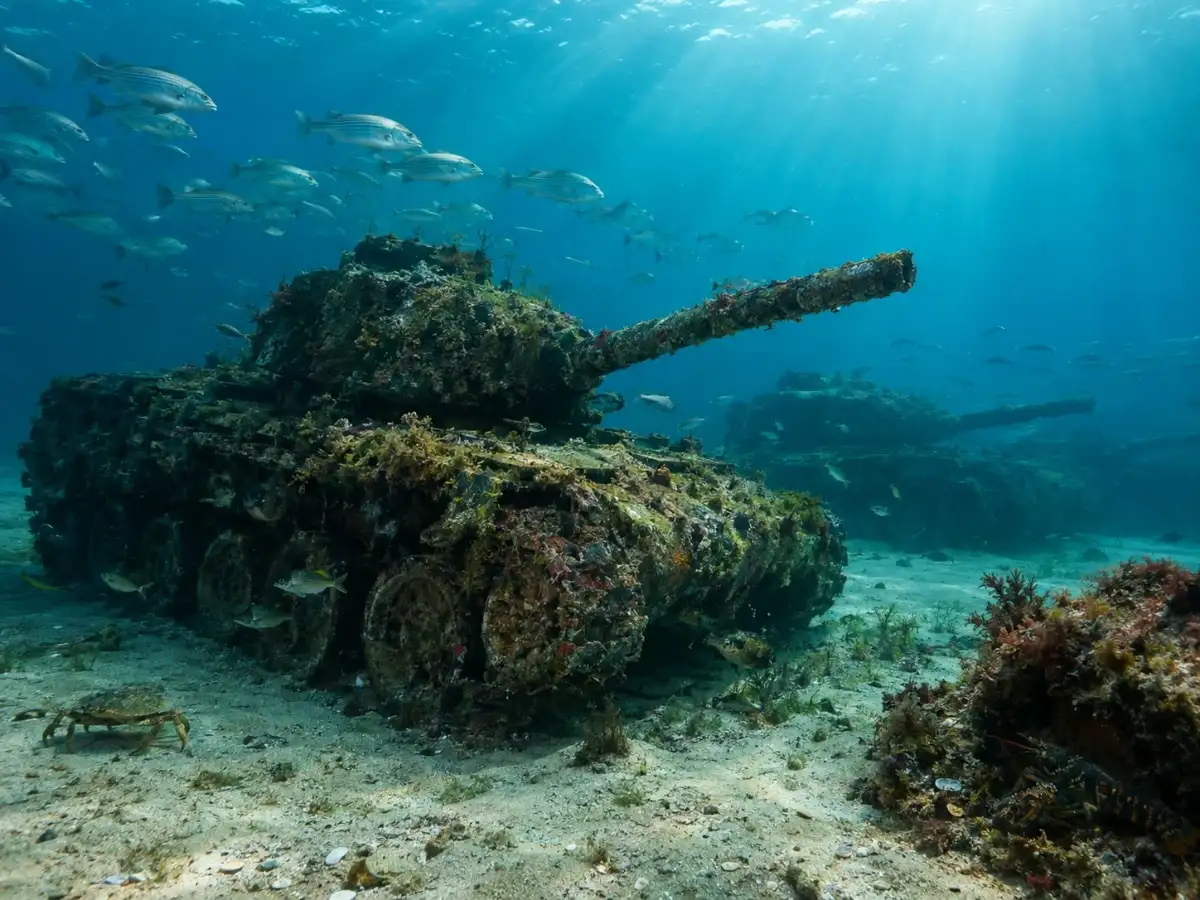
There is a graveyard of Cold War equipment, forgotten by most Americans, buried somewhere under 40 to 140 feet of Atlantic Ocean off the Jersey Shore. Between 1994 and 1997, the US Army and the New Jersey National Guard sank 397 obsolete tanks, armored personnel carriers, and crane vehicles into the ocean, on purpose. That is not an inadvertent war casualty, but a project deliberately designed as a fisheries project, known as Operation REEFEX.
The story is even more bizarre and, simultaneously, more wholesome: the tanks worked. According to New Jersey Division of Fish and Wildlife colonization studies referenced in the state's 2004 draft Artificial Reef Management Plan, biologists recorded an average of roughly 432,000 marine animals across 145 species, with a biomass of close to 128 pounds, per square metre of reef habitat surface, a figure drawn from small, specially built experimental habitats (wire boxes packed with fiberglass panels, whelk shells, and steel, concrete, rock, and tire test plates) that biologists placed on the sea floor at reef sites and later retrieved for lab analysis, not from material scraped directly off a tank's hull. It's a measure of what a square metre of colonized reef surface can hold, not a claim that every square metre of an actual tank was carrying that many animals.