Get all your news in one place.
100’s of premium titles.
One app.
Start reading
Space
Space
Science
Robert Lea

NASA X-ray instrument finds black holes act like 'cosmic seesaws' shaping the universe

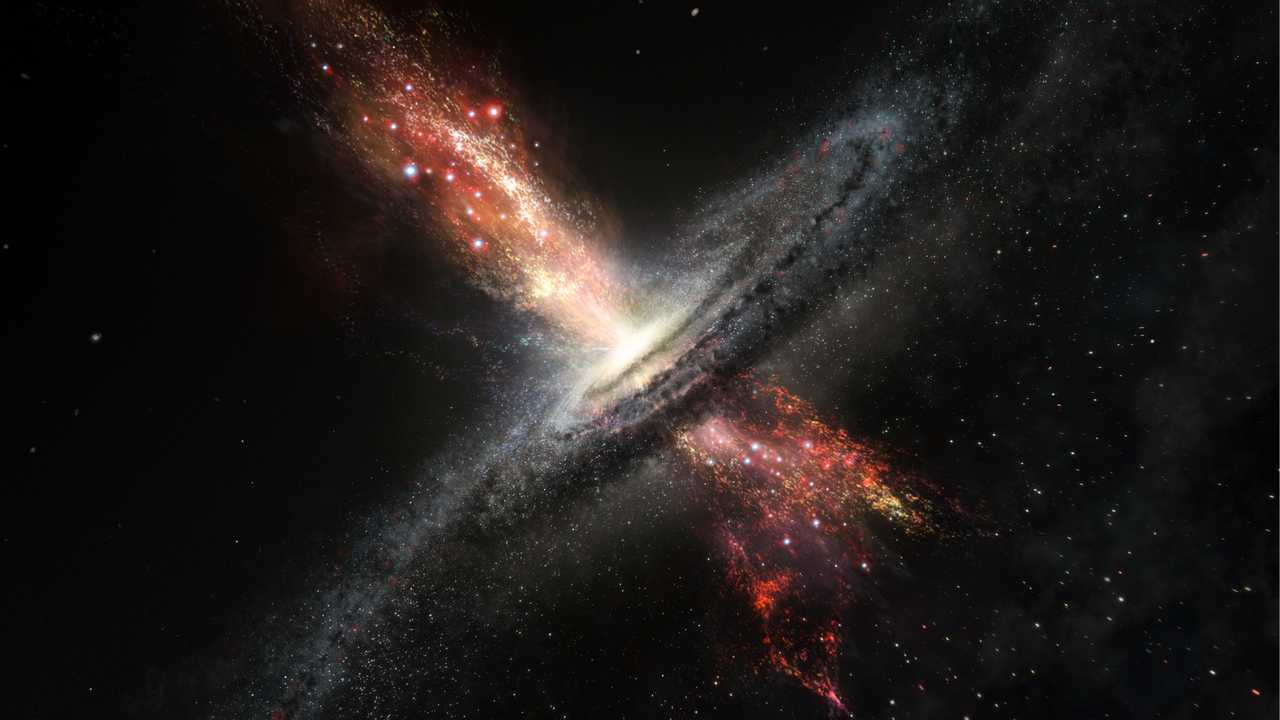
An illustration shows a black hole blowing out a powerful cosmic wind.

Turns out the expression "you can't have it all" also applies to black holes. Astronomers have discovered that although feeding black holes can produce powerful cosmic winds and blast out high-energy jets, they can't do both at the same time.

Instead, this new research suggests that black holes actually act like "cosmic seesaws," switching between these two distinct outflow modes. Not only does this discovery have implications for how black holes grow, but it could also help us better understand how they influence star formation, and thus how they shape their entire home galaxies.

"We're seeing what could be described as an energetic tug-of-war inside the black hole's accretion flow. When the black hole fires off a high-speed plasma jet, the X-ray wind dies down, and when the wind starts up again, the jet vanishes," team member Jiachen Jiang of the University of Warwick said in a statement. "This tells us something fundamental about how black holes regulate their energy output and interact with their surroundings."

Jiang and colleagues made this discovery while studying the system 4U 1630−472, which contains a black hole with around 10 times the mass of the sun that's actively stripping matter from a companion star. They studied this system with NASA's Neutron star Interior Composition Explorer (NICER) aboard the International Space Station (ISS) and the MeerKAT radio telescope across a period of three years.

The black hole's stolen matter forms a swirling plate of plasma around it called an accretion disk, which gradually feeds it. But not all of this ex-stellar material is destined to fall into the black hole; some is blasted away at near-light speed, while other material is blown away as black hole winds.

What the team found was this black hole never produced powerful winds and high-energy jets at the same time, even though the accretion disk and the matter stripped from the companion star restocking this disk stayed consistent.

"Our observations provide clear evidence that black hole binary systems switch between powerful jets and energetic winds — never producing both simultaneously — highlighting the complex interplay and competition between different forms of black hole outflows," team member Zuobin Zhang of the University of Oxford said in the statement.

An illustration of a black hole surrounded by an accretion disk and blasting out a high-energy jet (Image credit: NASA/JPL-Caltech)

The way outflow mechanisms seesawed for this black hole suggests a natural mechanism of self-regulation, and that jets and winds compete for the same matter. The researchers also found that though the type of outflow differed, the amount of energy and mass carried away remained consistent. That also implies a roughly steady total rate of outflow.

The team behind this research theorizes that the switch-in-outflow method doesn't hinge on how much matter is falling toward the black hole, but on the configuration of the magnetic fields within the accretion disk.

That means black holes don't just gobble up gas and dust in their host galaxies, but can also manage how this matter is spat back into their cosmic environment. As this gas and dust are the building blocks of new stars, this means these cosmic seesaws play a crucial role in regulating star formation and therefore the growth of galaxies.

The team's research was published on Jan. 5 in the journal Nature Astronomy.

Sign up to read this article
Read news from 100’s of titles, curated specifically for you.
Already a member? Sign in here
Related Stories
Top stories on inkl right now
Our Picks
Fourteen days free
Download the app
One app. One membership.
100+ trusted global sources.