Get all your news in one place.
100's of premium titles.
One app.
Start reading
The Conversation
The Conversation
James O'Donoghue, Research Associate Professor in Planetary Astronomy, Meteorology, University of Reading

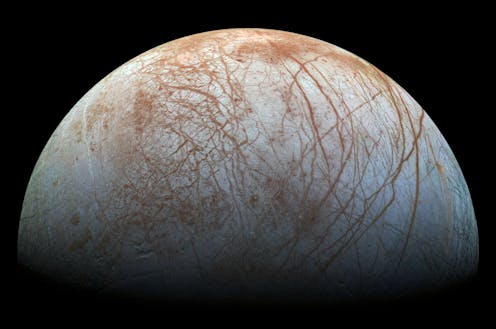
Nasa’s Europa Clipper spacecraft will investigate whether an icy moon of Jupiter can support alien life

NASA/JPL-Caltech/Seti Institute

Discovering extraterrestrial life would be one of the most profound scientific and philosophical revelations that our species has ever made. But such a big discovery won’t come easy. Our starting point is to first search other worlds for signs of habitability, that is, the potential for life to exist.

Nasa is doing just that: launching a spacecraft on October 10 to Europa, a moon of Jupiter holding twice the water of all Earth’s oceans combined. Europa’s ocean is between 60 and 150 kilometres deep and is hidden beneath an outer shell of ice that’s 15 to 25 kilometres thick. The evidence for an ocean began to mount from the late 1990s onwards.

Sign up to read this article
Read news from 100's of titles, curated specifically for you.
Already a member? Sign in here
Related Stories
Top stories on inkl right now
One subscription that gives you access to news from hundreds of sites
Already a member? Sign in here
Our Picks
Fourteen days free
Download the app
One app. One membership.
100+ trusted global sources.