
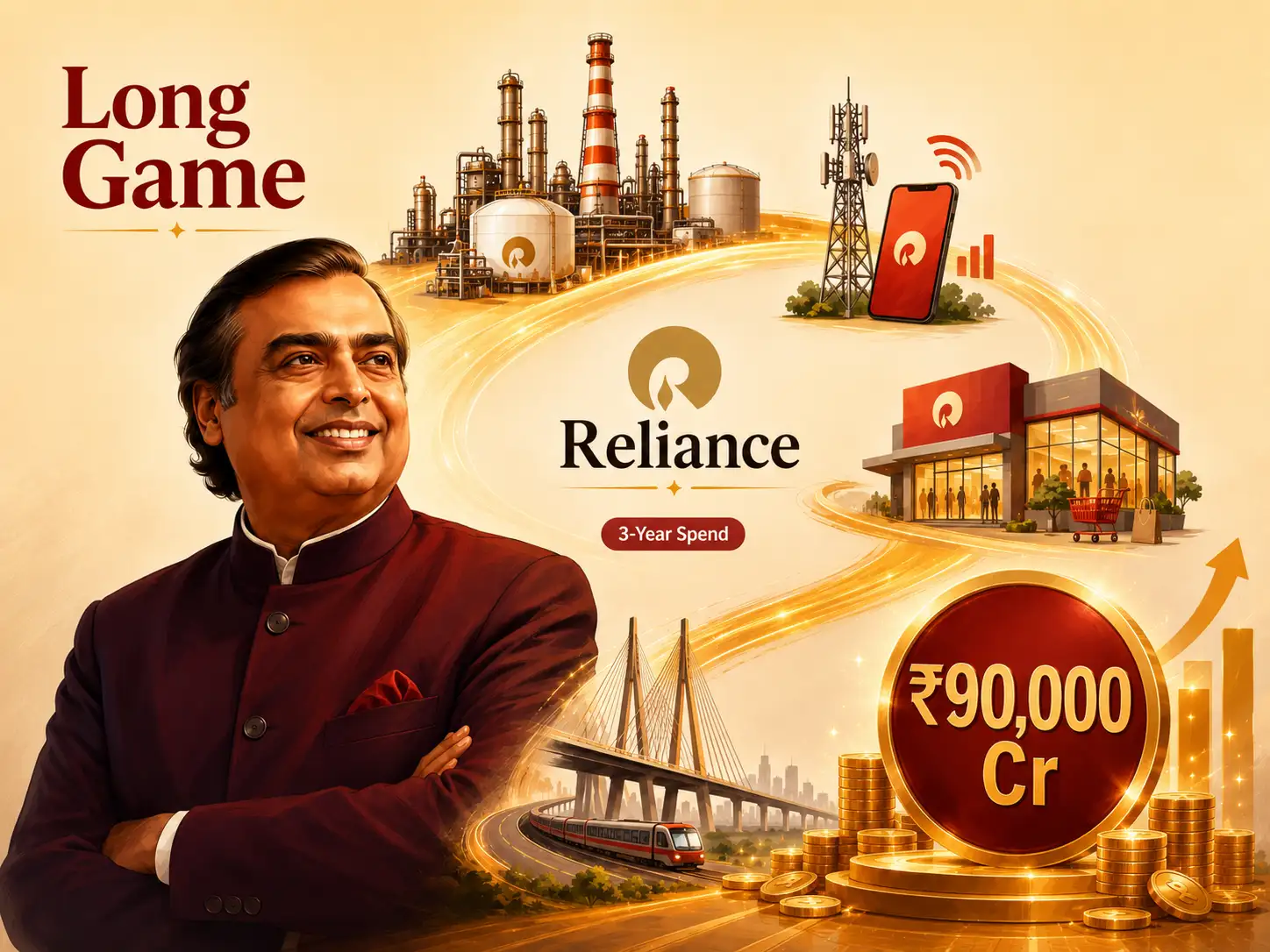
Billionaire Mukesh Ambani’s three-year investment binge may finally be approaching its payoff phase. Reliance Industries, which operated with materially negative free cash flow during the period, could generate about Rs 90,000 crore cumulatively over FY26-FY28 as peak capital expenditure recedes and a new earnings upcycle takes hold, according to brokerages.
The potential swing from consuming cash to generating it may prove more consequential for investors than Reliance’s Q1 earnings beat. It would mark the point at which billions of dollars invested across telecom, retail, petrochemicals, new energy and digital infrastructure begin translating into stronger cash flows and lower leverage.

“RIL has operated at materially negative free cash flow for the last three years,” JPMorgan’s analyst Sanjay Mookim said. As the investment drag fades, Reliance’s annual EBITDA run rate of about $20 billion should enable it to generate positive free cash flow despite elevated spending on new energy, retail and petrochemical expansion, it added.
Motilal Oswal also believes the peak of Reliance’s capex cycle is behind it. The brokerage estimates cumulative free cash flow of about Rs 90,000 crore over FY26-FY28, even as annual consolidated capex remains elevated at around Rs 1.3 lakh crore.
That cash generation could help reduce consolidated leverage to 0.7 times by FY28, according to Motilal. Reliance ended the June quarter with reported net debt of Rs 1.23 lakh crore, broadly stable sequentially despite investing Rs 38,700 crore during the three-month period.
Also Read | Rs 9,000 crore bet! Reliance Industries promoters increase stake by 0.5% in June quarter
RIL’s new earnings upcycle
Ambit Capital sees the cash-flow turn coinciding with a sharp acceleration in earnings.
“We believe that RIL is entering an earnings upcycle after years of investment strain,” Ambit said. The brokerage expects Reliance’s earnings per share to grow at a compound annual rate of 22% over FY26-FY29, compared with just 3% during FY23-FY26.
The first-quarter performance offered early evidence of that inflection. Reliance’s consolidated EBITDA rose 11% from a year earlier and 8% sequentially to Rs 47,500 crore, while adjusted profit attributable to shareholders increased 16% year-on-year and 23% sequentially to about Rs 20,900 crore.
The earnings beat was led by Reliance’s traditional energy businesses rather than its newer consumer engines. Oil-to-chemicals EBITDA jumped 17% sequentially and year-on-year to Rs 17,000 crore as elevated fuel cracks, stronger petrochemical margins and cheaper ethane feedstock outweighed lower refinery throughput, higher freight costs and domestic fuel-marketing losses.
JPMorgan estimated that fuel retailing caused a Rs 2,000-2,500 crore sequential swing in EBITDA during the quarter. Without those losses, it said, the O2C performance would have been “meaningfully higher.”
Morgan Stanley estimated Reliance’s refining margin at about $14.5 a barrel during the June quarter, 25% above the mid-cycle level. Based on prevailing industry spreads, margins were tracking closer to $22 a barrel, suggesting the energy business could retain momentum into the second quarter.
Also Read | Refining gains, clean energy push lift Reliance outlook despite retail drag
Jio could drive the next profit leg
While energy is providing the immediate earnings boost, Motilal expects digital services to contribute about 85% of Reliance’s incremental consolidated EBITDA over FY26-FY28.
Jio added 8.9 million subscribers during the quarter, taking its total base to 533.3 million, while average revenue per user increased to Rs 215.6. Motilal expects Jio’s revenue, EBITDA and profit to grow at compound annual rates of about 14%, 17% and 25%, respectively, helped by tariff increases and growth in home broadband and enterprise services.
Ambit expects Jio to lead an industry-wide 15% tariff increase in December 2026 after its anticipated initial public offering. The brokerage sees the listing as more than a conventional value-unlocking event.
“JPL’s listing and ensuing monetization via mobile services tariff hikes will validate RIL’s large-scale platform investing model, enabling the latter to attract more capital for new businesses like data centers, deep-tech and new energy,” Ambit said.
The listing could also allow Reliance to tap low-cost global capital for its next round of investments, reducing pressure on the parent company’s balance sheet.
The cash flow turn still faces a retail test
Reliance’s transition to sustainably positive free cash flow is not assured. Spending is shifting rather than disappearing, with lower telecom investment being offset by new-energy factories, artificial-intelligence infrastructure, data centres and quick commerce.
Reliance Retail’s June-quarter performance demonstrated that trade-off. JioMart’s average daily grocery orders surged 116% from a year earlier, but retail operating EBITDA fell about 2% as hyperlocal delivery and digital-commerce investments squeezed margins.
Goldman Sachs expects that pressure to persist for another three to four quarters. Reliance plans to expand dark stores, improve delivery speeds and raise product availability before seeking stronger profitability through larger basket sizes, private labels and greater order density.
Finance costs at the consolidated level also jumped 27% sequentially, partly reflecting the full capitalisation of 5G assets. Motilal cut its FY27-FY28 profit estimates for Reliance Retail by 8-9% because of higher depreciation and interest costs.
The brokerage has not factored in any meaningful near-term earnings contribution from Reliance’s new-energy, AI, data-centre or FMCG ventures. That makes the projected Rs 90,000 crore of cash generation dependent largely on existing businesses delivering while the next generation of investments is still being built.
Reliance’s latest quarter has opened the door to a cash flow turnaround, but the strategic pivot is not complete. Energy margins are supplying the immediate lift, Jio is positioned as the medium-term earnings engine and new energy remains the longer-dated option. For investors, the next phase will be less about how much Ambani is willing to invest and more about how quickly those investments start returning cash.
(Disclaimer: Recommendations, suggestions, views and opinions given by the experts are their own. These do not represent the views of The Economic Times)







