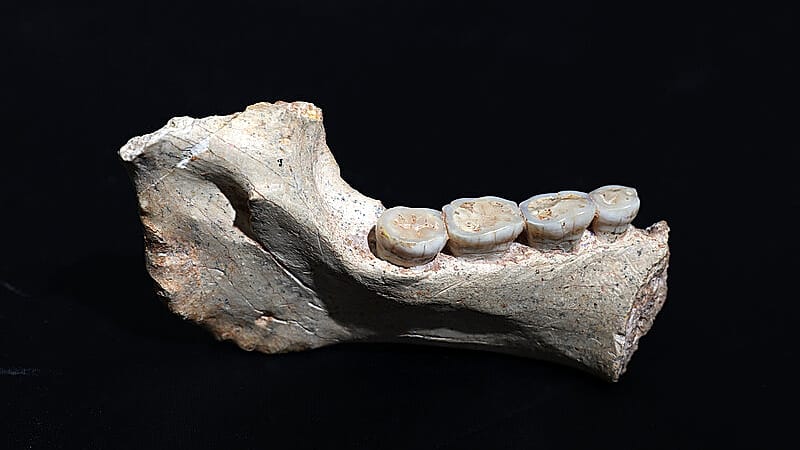
For a long time, scientists have puzzled over the origins of the human species. It is unclear from which common ancestor modern humans, Neanderthals and Denisovans all descend.
According to earlier estimates, this ancestor lived around 750,000 years ago but now new analysis of fossil finds in Morocco is providing fresh insights into our oldest ancestors.
Jean-Jacques Hublin is one of the most prominent researchers on early humans. The French anthropologist is a professor at Germany's Max Planck Institute for Evolutionary Anthropology in Leipzig, where he heads the Department of Human Evolution.
In the current issue of the science journal "Nature", he and an international research team report on a total of 21 fossilised human bones discovered in a cave in the Northern African state.
Hublin has come across hominin fossils that lived at exactly the time and in precisely the place where the emergence of Homo sapiens began: around 800,000 years ago in Africa.
"A plausible forerunner of Homo sapiens," says Hublin. In other words, these could be early humans from whom all people alive today are descended.
The recently published fossils come from Thomas-Quarry-I, an excavation site in the south-west of Casablanca. Archaeologists have found found stone tools and bones of early humans. They've been conducting research there since the late 1980s.
Reversal of the Earth's magnetic field

The archaeologists there asked Hublin for support with their first fossil finds about 30 years ago.
The Frenchman already suspected at the time that the finds had to be at least half a million years old and dated to the period when Homo erectus was evolving towards modern humans. But back then, the means to determine their exact age were lacking.
Until now. Serena Perini, a researcher at the University of Milan, based her analysis on the fact that, when the fossils were deposited, the Earth's magnetic field had been recorded in the sediment.

Over the course of the Earth's history, the Earth's magnetic field repeatedly reverses its polarity. These palaeomagnetic reversals occur worldwide and, on a geological timescale, happen virtually instantaneously, leaving a clear signal in sediments.
Perini's investigation using magnetostratigraphic analyses showed that the magnetic field reversed precisely at the time when the hominins lived there, an event that geologists can date with great precision. This allowed Hublin and his colleagues to fix the age of the fossils found in Casablanca at about 773,000 years.

According to Hublin, the bones come from at least three individuals: two adults and a baby. Bite marks on a femur show that a predator gnawed on it. "Probably a hyena," Hublin suspects. It appears that the cave where the fossils were found also served as a den for predators.
The finds show some similarities with the southern European Homo antecessor, indicating a close relationship between the two species. At the same time, features can be seen in the teeth that already point towards the later Homo sapiens. Around 30 years ago, researchers found remains of Homo antecessor in the Gran Dolina cave at Atapuerca, Spain.
It is now clear: the common ancestor of all three human groups lived significantly earlier than previously assumed, and the split did indeed take place in Africa. In Eurasia, Neanderthals and Denisovans evolved from his descendants via Homo antecessor, while the fossils from Morocco apparently belong to the line of descendants from which Homo sapiens eventually emerged.
Hublin and his colleagues consider it highly likely that at the root of these two lineages stands the species Homo erectus, the first Homo species to migrate out of Africa.
So the story of our species begins in Africa, but it spreads far beyond. According to Hublin, the early humans in Spain and Morocco did share common ancestors, but each branch went its own way. Around 800,000 years ago, part of the African Homo population migrated to Europe via the Middle East. Some of these early travellers reached the Iberian Peninsula, where they evolved independently.
The fossils from Casablanca tell the story of those who stayed in Africa. From this line, the modern Homo sapiens emerged around half a million years later. But exactly how this development unfolded remains in the dark: for the crucial period between 800,000 and 300,000 years ago, there are hardly any fossils that could shed light on it.
One thing, however, is certain: the emergence of Homo sapiens was not a straight path.