Get all your news in one place.
100’s of premium titles.
One app.
Start reading
The Conversation
The Conversation
Omololu Akin-Ojo, Senior Lecturer, University of Ibadan

Curious Kids: What is the smallest thing in the universe?

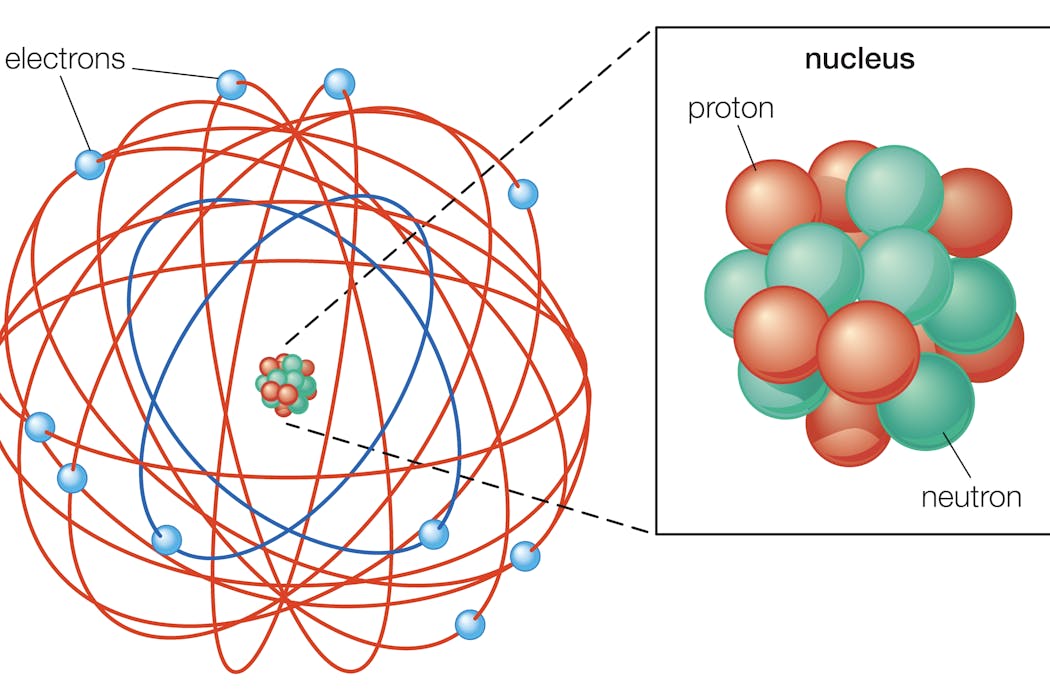
The Rutherford Atomic Model of a neon atom, showing the atom as similar to a solar system, with electrons orbiting a nucleus Encyclopaedia Britannica/UIG Via Getty Images

Curious Kids is a series for children in which we ask experts to answer questions from kids.

What is the smallest thing in the universe that actually exists? – Mimi, 12, Abeokuta, Nigeria

To find an answer, we asked physicist Omololu Akin-Ojo, who teaches this subject. A physicist is someone who studies physics. Physics is the science of energy, forces and particles. We study physics in order to be able to manipulate energy, forces and particles for our benefit. For example, to create electricity or motion to move a car.


So, what’s the smallest thing in the universe?

Thank you for your question.

Take a piece of anything, cut it into tiny pieces, cut the tiny pieces into tinier pieces (at this point you might need a magnifying glass or microscope to see what you are cutting), and continue to cut them into yet tinier pieces. After a point, you will not be able to see the particles, even with microscopes. Suppose we can continue this process until we get to a point where we cannot cut the tiny pieces into tinier pieces any longer.

Then we have reached the level of the atom. An atom is so small you can’t see it, but atoms are everywhere.

To start with, what is an atom?

The word “atom” is from the Greek word atomos, which means “uncuttable”. This is the smallest particle in the universe that behaves “normally”. Normal behaviour for a particular atom means that it is neutral (not electrically attracted to other particles) and still retains chemical properties from the substance from which it was cut.

However, scientists have found that the atom is made up of even tinier particles: electrons and the nucleus.

The electron is one of the tiniest particles that exists.

Inside the nucleus, we have protons and neutrons and inside these there are quarks. Quarks are as tiny as electrons. When atoms break up, other particles, called neutrinos, may be released. Although they are not tinier than electrons, neutrinos might weigh less than electrons – we are not certain.

Scientists have also been able to smash particles together by giving them a lot of energy and making them collide with one another. When particles smash into each other, sometimes we get other particles that are as tiny as electrons but weigh more than electrons. Their names are muons, tauons and pions. We cannot see them with our naked eyes, but scientists have been able to create environments such that when these particles move in them, we can see their paths.

So, Mimi, the electron is the tiniest particle. Then there are neutrinos, which are as small (but may or may not weigh more). Then we have quarks (which are found inside protons or neutrons) and also we have muons, tauons and pions, which are as small as electrons but weigh more.

Everything in the world is made up of all these tiny pieces. They’re everywhere.

The Conversation

Omololu Akin-Ojo does not work for, consult, own shares in or receive funding from any company or organisation that would benefit from this article, and has disclosed no relevant affiliations beyond their academic appointment.

This article was originally published on The Conversation. Read the original article.

Sign up to read this article
Read news from 100’s of titles, curated specifically for you.
Already a member? Sign in here
Related Stories
Top stories on inkl right now
Our Picks
Fourteen days free
Download the app
One app. One membership.
100+ trusted global sources.