Get all your news in one place.
100's of premium titles.
One app.
Start reading
The Conversation
The Conversation
Harriet Fletcher, Senior Lecturer in Media and Communication, Anglia Ruskin University

Monroe at 100: Marilyn and the cult of the blonde

Before beloved modern classics such as Legally Blonde and Barbie, there was Gentlemen Prefer Blondes and How to Marry a Millionaire – two 1953 films that helped shape the blonde cinematic archetype, cementing Marilyn Monroe’s status as the most iconic blonde in Hollywood history.

In British Blonde, art historian Lynda Nead traces blondeness from religious hagiography to its appropriation by 20th-century consumer culture. Blondeness also came to symbolise whiteness and racial superiority, a racist ideal that gained traction in the 1950s and 1960s. During this period, ads for blonde hair dye proliferated, using promises of glamour to lure consumers with the Hollywood allure of stars, including Monroe.

Golden age Hollywood had no shortage of iconic blondes prior to Marilyn Monroe. In the 1930s and 1940s, stars such as Jean Harlow, Veronica Lake and Rita Hayworth were celebrated for their beauty, talent and magnetic screen presence. Monroe also had notable contemporaries. In 1950s tabloids she was dubbed a core member of The Three Ms – a trio of blonde actresses that included herself, Jayne Mansfield and Mamie Van Doren.

What makes Monroe so special? She embodied what it meant to be desirable in the 1950s, according to film scholar Richard Dyer. It wasn’t just that Monroe was a beautiful blonde, but that her image as a movie star spoke to the particular ways that sexuality was thought of and felt in the period.

Part of this was her status as a pin-up. When her film career began to take off in the 1950s, she soon became a popular sex symbol after nude photographs taken during her early modelling days in the 1940s were published.

This “nude calendar scandal” added a new dimension to her star image that provoked public interest. So much so that in 1953, she was the cover girl for the first edition of Playboy and some of these earlier nude photographs were featured as the centrefold – without her consent. This scandal cemented Monroe’s status as a blonde bombshell: a bona fide sex symbol for a broadly conservative 1950s American society that was becoming increasingly interested in sexuality on screen.

Blondes in pop art

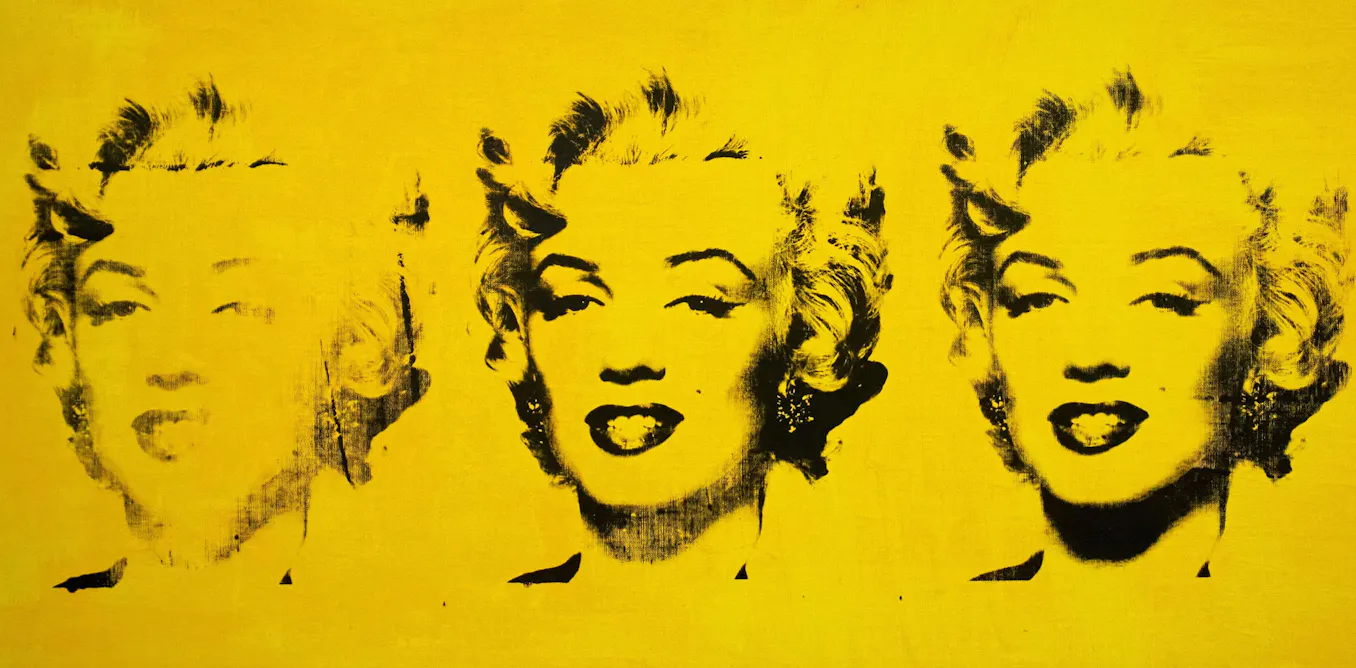
After her untimely death in 1962, Monroe’s image was reproduced in pop art. The most famous of these works is undoubtedly Andy Warhol’s Marilyns.

As I have argued in my book Gothic Celebrity, these images both memorialise the star and interrogate the spectacle of celebrity death in American culture. Later, they would also inspire another of Warhol’s iconic blonde portraits: Blondie’s Debbie Harry, who was often referred to as the Marilyn Monroe of the 1970s and 80s punk and new wave era.

Warhol’s Marilyns have significantly influenced the work of later artists. In the 1980s, Keith Haring’s Marilyn Monroe reimagined the classic publicity shot that first inspired Warhol’s portrait of the actress.

In the 2000s, Banksy added a modern twist by depicting British supermodel Kate Moss in the style of Warhol’s Marilyns, proving that the cult of the blonde continues to gain momentum moving into the 21st century.

Marilyn Monroe and fame-bridging

Warhol’s art was key to establishing Monroe’s cultural afterlife. The Marilyns ensured that her image would still be recognised by future generations, not just as a Hollywood star but as the ultimate blonde icon of the 20th century.

Musicians have contributed to this too. Madonna famously referenced Monroe in her music video for Material Girl back in 1985 when she recreated the Diamonds Are A Girl’s Best Friend musical number from Gentlemen Prefer Blondes.

For celebrity studies scholars Brian Donovan and Elyse Neumann, this is known as fame-bridging – when a public figure tries to attain celebrity status by drawing from the style and cultural memory of a more well-known star. In referencing Monroe, Madonna positions herself as the new blonde icon: a provocative star who epitomised sexuality and female empowerment in the 1980s. Her Blond Ambition World Tour in 1990 further reinforced blondeness as key to her star image.

More recently, Sabrina Carpenter’s Monroe-coded platinum blonde curls and pin-up-inspired outfits demonstrate another example of frame-bridging. As a former child star with Disney Channel roots, Carpenter is rebranding herself as a pop star through the glamour, sexiness and hyperfemininity of blonde icons. At this year’s Met Gaga, she even performed wearing a dress from Versace’s 1991 Pop Art collection adorned with Warhol’s Marilyns.

Blonde bombshells in celebrity culture

Decades after Monroe, blondes have continued to provoke fascination in celebrity culture. Pamela Anderson and Paris Hilton were latter-day Monroe figures for the 1990s and noughties respectively. Both were famed for their femininity and sex appeal, but also fell victim to the intrusive tabloid culture of the period.

Like Monroe’s own nude calendar scandal, Anderson and Hilton had private sex tapes leaked without their consent. Both have since talked about these traumatic events in their documentaries Pamela, a Love Story and This is Paris. The blonde bombshell, her image and her body are often subjected to scrutiny and sexual objectification in the public gaze.

We can also see this working with the American actress and blonde bombshell du jour Sydney Sweeney. The star has provoked attention and controversy for several reasons, from her looks and outfits to her promotional campaigns and political values. The question of what Sweeney represents ideologically, her level of political awareness, and even her awareness of her own sex appeal, has been fiercely discussed.

The blonde archetype that Monroe represented back in the 1950s has only continued to expand and evolve, revealing itself as a deeply complex and endlessly fascinating figure in pop culture.

This article was originally published on The Conversation. Read the original article.

Sign up to read this article
Read news from 100's of titles, curated specifically for you.
Already a member? Sign in here
Related Stories
Top stories on inkl right now
One subscription that gives you access to news from hundreds of sites
Already a member? Sign in here
Our Picks
Fourteen days free
Download the app
One app. One membership.
100+ trusted global sources.