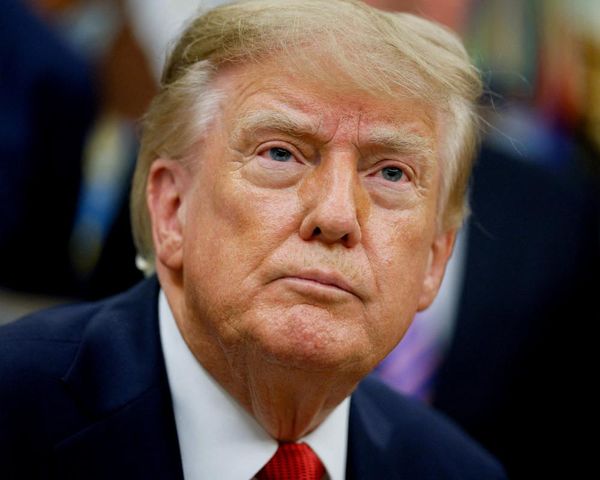
Trump once again speculated about Iran’s new supreme leader, Mojtaba Khamenei, who hasn’t been seen or heard from in public since he was selected earlier this month. He was injured in the US-Israeli air strikes on Tehran that assassinated his father, the late ayatollah Ali Khamenei, on 28 February.
The US president told the crowd in Miami:
Their leaders are dead. Their supreme leader [Ali Khamenei] is no longer supreme. And the son [Mojtaba] is either dead or in very bad shape, because nobody’s seen or heard from him.
“This isthe only country where nobody wants to lead,” he added, asking for a show of hands for who in the audience would like to lead Iran.
Iran has to 'open up strait of Trump - I mean, Hormuz', says US president
Trump said the US and Iran are “negotiating now” and that it “would be great if we could do something”.
He then called on Iran “to open up the strait of Trump - I mean, Hormuz”.
The fake news will say ‘he accidentally said’ - no, there’s no accidents with me. Not too many.
He then goes on a tangent about the Gulf of Mexico.
Updated
Trump claims Tehran 'on the run' and 'wants to make a deal'
Trump claimed Tehran was “on the run”, telling the event:
For 47 years Iran has been known as the bully of the Middle East but they are not the bully any longer - they’re on the run.
He added:
Tonight, we’re closer than ever to the rise of the Middle East that is finally free at last from Iranian terror, aggression and nuclear blackmail.
“I just looked - we had another big day,” he added, after his usual touting the power of the US military and the “decimation” of Iran’s capabilities.
They are being decimated. We are talking now, they want to make a deal.
Updated
A short while ago, Donald Trump began his remarks at the Future Investment Initiative event in Miami.
I’ll bring you all the key lines shortly.
Houthis say 'finger is on the trigger' to intervene in war if allies of US and Israel join in
In a televised speech, spokesperson for the Iran-aligned Houthis, Yahya Saree, has said the group’s finger is on the “trigger for direct military intervention” if certain conditions are met.
Unlike Hezbollah, another regional proxy organisation backed by Iran, which operates out of Lebanon, the Houthi’s, based in Yemen, have so far held out on inserting themselves into the conflict, which began when the US and Israel attacked Tehran on 28 February.
In his speech, Saree called for the US and Israel to respond to international diplomatic efforts to stop the war against Iran and “the countries of the axis of resistance”, including Lebanon. He said:
This aggression is unjust, oppressive, and unwarranted, harming global and regional stability and security, and damaging the global economy.
Saree said the Houthis would intervene militarily if:
New countries join the US and Israel in their war against Iran
The Red Sea is used to target Iran or any Muslim country
The war continues to escalate against Iran and the “axis of resistance”
Saree also warned against “any unjust measures aimed at tightening the siege on the Yemeni people”.
Updated
Witkoff also said that the United States expects an answer to its 15-point plan to end the war.
Trump, he continued, wants a peace agreement, but believes in “peace through strength”.
Without pressure, you never get anybody to the table.
The US wants to resolve the conflict with a diplomatic solution based on “no [nuclear] enrichment”, Witkoff said, and believes that there should be “no North Korea in the Middle East”.
We can’t have a second coming of North Korea in the Middle East. It’s totally destabilising to that region and to the world.
US 'hopeful' of holding meetings with Iran this week, says Witkoff
Donald Trump’s special envoy Steve Witkoff has the United States is hopeful that there could be meetings with Iran as soon as this week.
Speaking in at event in Miami, Witkoff said:
We think there will be meetings this week. We’re certainly hopeful for it.
Trump’s extension of his pause on US strikes on Iranian energy infrastructure is seen as “a real positive” by Washington, Witkoff said.
Amid conflicting reports over the nature of communication taking place between Washington and Tehran, Witkoff claimed it was “clear” that the US and Iran are negotiating and that some ships are now passing through the strait of Hormuz.
We may have a different definition of negotiating than they do.
US market selloff continues as Iran war sends consumer sentiment plummeting
The US stock market opened on Friday with a selloff that briefly sent the Dow into correction territory as a new survey showed US consumer sentiment plummeted in March.
Within an hour into trading on Friday, the Dow fell more than 400 points, briefly pushing the index into correction territory. Oil prices continued to climb, with Brent crude, the global benchmark, hitting $110 a gallon.
US stocks on Thursday saw their biggest drop since the start of the US-Israel war on Iran. At closing, the tech-heavy Nasdaq index entered a correction, which occurs when an index falls 10% below its peak.
Markets are still on edge despite Donald Trump’s announcement late on Thursday that he will extend a pause on Iranian energy strikes. Trump has insisted that oil prices and the stock market will settle once the conflict ends, but it is unclear whether markets will believe him.
The US president is also losing trust among consumers. US consumer sentiment dropped across age, political party and income levels in March, according to a new survey from the University of Michigan released on Friday that paints a bleak picture of how Americans are dealing with the economic fallout of the Iran war.
The survey found consumer sentiment fell 6% this month – its lowest level since December 2025. Consumers on the middle to higher end of income and stock wealth experienced “particularly large drops in sentiment”, according to the survey, which was conducted between 17 February and 23 March.
Inflation expectations for the year climbed this month from 3.4% to 3.8%, the largest one-month increase since last April, when Trump announced his plan for tariffs.
The short-term economic expectations of consumers plunged 14%, though long-term expectations saw less sharp declines.
“These patterns suggest that, at this time, consumers may not expect recent negative developments to persist far into the future,” Joanne Hsu, the director of the Surveys of Consumers, said in a statement. “These views are subject to change, however, if the Iran conflict becomes protracted or if higher energy prices pass through to overall inflation.”
More on this story here:
Cargo volumes have fallen by roughly 50% since the war began at Umm Qasr, Iraq’s primary deep-water sea port, according to local port officials.
Port director Mohammed Taher Fadhil told the Associated Press on Friday that traditional shipping routes are no longer viable and that with direct access blocked via the strait of Hormuz, shipping companies are resorting to costly and time-consuming alternatives.
Large mother ships are now rerouted to Khor Fakkan Port, located along the Gulf of Oman. From there, cargo is offloaded and transported overland by truck to Sharjah before being reloaded onto smaller vessels bound for Umm Qasr.
This multi-step process has significantly increased both delivery times and transportation costs, he said.
Tehran will 'facilitate and expedite' humanitarian aid through strait of Hormuz, says UN ambassador
Iran will “facilitate and expedite” humanitarian aid passing through the strait of Hormuz, its UN ambassador in Geneva has said.
Ali Bahreini said Tehran had accepted a request from the United Nations to safely allow aid and agricultural shipments through the waterway.
“This measure reflects Iran’s continued commitment to supporting humanitarian efforts and ensuring that essential aid reaches those in need without delay,” Bahreini said on X, hours after the UN announced a task force to address the ripple effects the war has had on aid delivery.
What is Netanyahu's endgame in the Iran war? - podcast
Could Israeli public support for the war in Iran give Benjamin Netanyahu a boost before this year’s elections? The vote will be the first chance for Israelis to have a say on their government since the Hamas attacks on 7 October 2023.
In today’s edition of The Latest podcast, Lucy Hough speaks to the Guardian’s chief Middle East correspondent, Emma Graham-Harrison.
Updated
Iran warns of 'heavy price' for plant strikes as Trump 'contradicts' his own deadline
Iran’s foreign minister Abbas Araghchi has said that Friday’s strikes contradicted Donald Trump’s pledge to postpone attacking Iran’s energy infrastructure for 10 days after he claimed talks were “going well” – and that Tehran would exact a “heavy price” for the attacks.
In a post on X, Araghchi that Israel “has hit 2 of Iran’s largest steel factories, a power plant and civilian nuclear sites among other infrastructure”.
“Israel claims it acted in coordination with the US,” Araghchi said, adding that the attack “contradicts POTUS extended deadline for diplomacy”.
Iran will “exact HEAVY price”, he said.
As we’ve been reporting, US-Israeli strikes hit two nuclear-related facilities on Friday - the Khondab heavy-water plant near Arak and the uranium production facility in Ardakan, Yazd Province – and major steel plants in Khuzestan and Mobarakeh. Iran’s atomic energy organisation said the strikes “did not result in the release of any radioactive material”.
Less than 24 hours ago, Trump extended his pause on attacking Iran’s power grid, pushing back his deadline – again – for Iran to reopen the strait of Hormuz by another 10 days.
The US president claimed the delay was “per [an] Iranian government request” and also claimed that talks between the US and Iran about ending the war were “ongoing and ... going very well”.
Updated
The day so far
The United States expects to end its operation in Iran in “weeks, not months”, secretary of state Marco Rubio said. Following a meeting of G7 foreign ministers in France, Rubio also said Iran may decide to set up a tolling system for ships crossing the strait of Hormuz - and that he had won support from his G7 colleagues to oppose any attempts to do so.
The strait of Hormuz is “closed”, Iran’s Revolutionary Guards said, adding that they had turned back three ships trying to transit the strait. The route – critical for oil and gas shipping and for the global economy – is closed to vessels travelling to and from ports linked to its “enemies”, it said, warning of “harsh measures”.
Israel confirmed that it attacked Iran’s Arak heavy-water plant and a uranium processing plant in central Iran on Friday. Iran’s atomic energy organisation said the strike on the plant “did not result in the release of any radioactive material”. The heavy water plant in Arak was targeted by Israeli strikes during the 12-day war last June, during which the US also carried out bombings.
Israel’s attacks on Lebanon have displaced more than 370,000 children, according to Unicef, as well as leaving at least 121 dead and 399 injured. It comes after Israel announced plans to establish a so-called “security zone” up to the Litani River in southern Lebanon, prompting fears of a protracted occupation of the region. Indeed, defence minister Israel Katz said that hundreds of thousands of Shi’ites will not return south of the Litani until security is ensured for northern Israel. A UNHCR official estimated on Friday that about 150,000 people are isolated in Lebanon after Israel’s systematic destruction of bridges.
The United States can only determine with certainty that it has destroyed about a third of Iran’s vast missile arsenal, US intelligence sources told Reuters, despite Donald Trump’s claims that Tehran only has “a few rockets left”. The assessment, shows that while most of Iran’s missiles are either destroyed or inaccessible, Tehran still has a significant missile inventory and may be able to recover some buried or damaged missiles once fighting stops.
US-Israeli strikes have caused damage to 120 museums and historic buildings since the war began, the head of Tehran city council’s cultural heritage committee said in a report from AFP. He was quoted by state TV as naming UNESCO-listed Golestan Palace along with other sites damaged in the war, including Saadabad Palace, the Marble Palace and Teymourtash house, also known as the War Museum.
Updated
Israel’s military said it had struck a heavy water reactor and a uranium processing plant in central Iran on Friday.
“A short while ago, the Israeli Air Force... struck the heavy water plant in Arak, central Iran,” the military said in a statement carried by Agence France-Presse, describing the site as a “key plutonium production site for nuclear weapons”.
Iranian media had earlier reported that US-Israeli strikes hit the Khondab heavy water complex, saying they caused no casualties or radiation leak from the site.
Work on the reactor began in the 2000s but was stopped under the 2015 nuclear deal, which Donald Trump abandoned in 2018. The core of the reactor was removed and concrete was poured into it, rendering it inoperative.
The research reactor was officially intended to produce plutonium for medical research and the site includes a production plant for heavy water.
The Israeli military also said it struck a uranium processing site in central Iran’s Yazd on Friday, AFP writes. “A short while ago, the Israeli Air Force... struck a uranium extraction plant located in Yazd, central Iran,” the military said in a statement, describing the site as a “unique facility in Iran used for the production of raw materials required for the uranium enrichment process”.
Iran’s atomic energy organisation said the strike on the plant “did not result in the release of any radioactive material”.
The heavy water plant in Arak was targeted by Israeli strikes during the 12-day war last June, during which the US also carried out bombings.
The International Atomic Energy Agency (IAEA) says the site was “damaged” during the attacks and “is assessed not to have been fully operational since that time”. But the agency said it has not had access to the site since May 2025.
G7 to support US in opposing Iranian toll plan for strait of Hormuz, says Rubio
Rubio also said that he had won support from his G7 colleagues to oppose Iran’s attempts to impose a toll on ships crossing the strait of Hormuz, Agence France-Presse reports.
“Not only is this illegal, it’s unacceptable, it’s dangerous to the world, and it’s important that the world have a plan to confront it,” Rubio said.
Updated
Meanwhile, US secretary of state Marco Rubio said that Iran had not responded to a plan to end the war but had sent “messages” showing an interest in diplomacy.
“We haven’t gotten it yet,” Rubio told reporters in Paris after G7 talks.
“We’ve had an exchange of messages and indications from the Iranian system – whatever’s left of it – about a willingness to talk about certain things.”
The US-Israeli war against Iran is unlikely to lead to “regime change”, German chancellor Friedrich Merz said Friday, as the month-long conflict showed no signs of abating.
“Is regime change really the goal?” he said at a forum in Frankfurt organised by the FAZ newspaper.
“If that’s the goal, I don’t think you’ll achieve it. It’s mostly gone wrong” in past conflicts, he said, pointing to the Afghanistan war.
US expects Iran operation to conclude in 'weeks, not months', says Rubio
Secretary of state Marco Rubio said on Friday the US expects its operation in Iran to conclude in “weeks, not months” after he met with G7 foreign ministers in France.
Rubio also said Iran may decide to set up a tolling system for the strait of Hormuz.
Updated
An Iran-linked hacker group has accessed an email account of FBI director Kash Patel and published personal photos and other material online, US media reported Friday.
CNN and other US media outlets, citing sources familiar with the breach, said the hack of Patel’s email was claimed by the Handala Hack Team, a pro-Iranian hacktivist group.
According to CNN, the stolen emails include personal, business and travel correspondence and appear to date from 2011 to 2022, prior to Patel being named FBI director by President Donald Trump.
More than 300 US troops have been wounded since the start of the Iran war on 28 February, US Central Command said on Friday.
“Since the start of Operation Epic Fury, approximately 303 US service members have been wounded. The vast majority of these injuries have been minor, and 273 troops have returned to duty,” US Navy captain Tim Hawkins said.
A US official who asked not to be identified told AFP that 10 troops remain seriously wounded.
A further 13 troops have been killed in the war, according to the latest figures, with seven killed in the Gulf and six in Iraq.
US-Israeli strikes hit uranium processing plan, says Iranian atomic energy organisation
US-Israeli strikes hit a uranium processing facility in central Iran on Friday, the country’s atomic energy organisation said.
“The plant in Ardakan, located in Yazd Province, was targeted minutes ago in an attack by the American-Zionist enemy,” it said on its Telegram channel, adding the attack “did not result in the release of any radioactive material.”
US-Israeli strikes hit a heavy water reactor in central Iran, Iranian media reported on Friday.
“The Khondab Heavy Water Complex was targeted in two stages by aggression from the American and Zionist enemy,” said Fars news agency, citing Hassan Ghamari, an official in the central Markazi province.
Fars and other media said there were no casualties or radiation leak from the site.
Intelligence agencies in Europe believe Russia is in the final stages of preparing to supply supply drones to Iran for use in its war with the US and Israel, according to a senior European official.
Russia has already been providing intelligence sharing with Tehran to help it target US forces in the region, the official said, but the upcoming delivery of explosive-laden drones would mark the first evidence of lethal support since the start of the war.
The official, who spoke on condition of anonymity, declined to provide details on the scale of any deliveries, but confirmed an article by the Financial Times that said “western intelligence reports” found Russia was close to completing a phased shipment of drones, medicine and food to Iran.
Iranian and Russian officials began secretly discussing drone deliveries days after Israel and the US attacked Tehran in late February, the news website said, citing officials briefed on the intelligence. It said drone deliveries could be completed by the middle of next week.
Responding to the claim of Moscow sending drones to Iran, Kremlin spokesperson Dmitry Peskov was quoted as saying: “There are a lot of fakes going around right now. One thing is true – we are continuing our dialogue with the Iranian leadership.”
Russia and Iran signed a strategic partnership agreement last year and Moscow has sent more than 13 tonnes of medicine to Iran through Azerbaijan.
Iran would be “well advised” to negotiate with the United States after almost a month of the US-Israeli war against the Islamic republic, Germany’s foreign minister said Friday.
“The Iranian regime would be well advised to enter into serious negotiations with the United States now,” Johann Wadephul said, after meeting G7 counterparts in France, including US secretary of state Marco Rubio.
“There are initial indications that such talks should be taking place,” he added, without giving further details.
EU energy ministers to hold extraordinary videocall on Iran war
European Union countries’ energy ministers will hold an extraordinary videocall on Tuesday, on the Iran war’s impact on European energy security of supply, a spokesperson for Cyprus’ EU presidency said on Friday.
Cyprus holds the EU’s rotating presidency and chairs meetings of EU countries.
A senior Iraqi Kurdistan official said the United States is not arming Iranian Kurdish opposition groups exiled in his autonomous region, reiterating his government opposes any involvement by these groups in the Middle East war.
“We have not seen any attempts by the United States, any branch of the United States, to arm Iranian opposition groups in Kurdistan,” deputy prime minister of the autonomous northern region, Qubad Talabani, told AFP in an interview on Thursday.
Regional authorities told the groups it would be “very unwise” for them to take part from Iraqi Kurdistan, he said, adding: “We would not allow that to happen from here”.
From Wall Street to the White House, the dish everyone’s talking about this week is the Persian Taco. It’s what’s served when Trump chickens out in Iran.
In the early hours of Monday morning, witnessing oil prices surge, stock futures plummet and bond yields climb due to his threat to pummel Iran’s civilian power infrastructure, the president hurriedly walked it back, announcing he would put off the bombing because talks with Iran were actually going great. After the bombast and bloodshed, it was time for Taco (Trump Always Chickens Out)
Read Eduardo Porter’s analysis of the war’s impact on the US economy here:
Updated
Airlines cancel more flights amid US-Israel Iran conflict
Global air travel remains severely disrupted, with many people still unable to fly as planned to destinations after the Iran war forced the closure of major hubs, including Dubai, Doha and Abu Dhabi.
The low-cost airline Wizz Air has suspended flights to Israel until 29 March, and to Dubai, Abu Dhabi, Amman and Jeddah from mainland European destinations until mid-September.
The price of jet fuel has doubled since the start of the war, according to the International Air Transport Association,
United Airlines announced last Friday it would have to cut flights due to the surging cost of fuel.
“The reality is, jet fuel prices have more than doubled in the last three weeks. If prices stayed at this level, it would mean an extra $11bn in annual expense just for jet fuel,” Scott Kirby, the CEO of United, said in a statement. “For perspective, in United’s best year ever, we made less than $5bn.”
The average airfare for most airlines – spanning both domestic and international trips, as well as tickets bought last-minute and in advance – was up compared with the same period last year, according to an analysis at Deutsche Bank.
US can only confirm about a third of Iran’s missile arsenal destroyed, sources say
Reuters report that the United States can only determine with certainty that it has destroyed about a third of Iran’s vast missile arsenal, according to US intelligence sources.
The status of around another third is less clear but bombings likely damaged, destroyed or buried those missiles in underground tunnels and bunkers, the sources said.
One of the sources said the intelligence was similar for Iran’s drone capability, saying there was some degree of certainty about a third having been destroyed.
The assessment, shows that while most of Iran’s missiles are either destroyed or inaccessible, Tehran still has a significant missile inventory and may be able to recover some buried or damaged missiles once fighting stops.
Donald Trump’s had said on Thursday that Iran had “very few rockets left”.
Updated
Japan to boost coal-fired power as war causes energy turmoil
Japan’s government plans to temporarily lift restrictions on coal-fired power plants as it seeks to ease an energy crunch caused by the Middle East war, AFP reports.
Officials presented the plan at a meeting of a panel of experts, who approved the proposal, the industry ministry said on its website.
“Given the current situation in the Middle East affecting fuel prices, we believe that uncertainty regarding future LNG procurement is increasing,” an industry ministry official said at the meeting, which was broadcast online.
“We think it will be necessary, by increasing the operation of coal-fired power plants, to... ensure the reliability of stable supply,” he said.
Power suppliers have previously been required to keep the operating rate of coal-fired thermal power stations that emit large amounts of carbon dioxide at or below 50 percent.
But the government now intends to allow the full operation of older, less efficient coal-fired plants, for a year from the new fiscal year starting April, according to the plan presented at the meeting.
It comes after Vietnam’s (4.16) trade ministry said this morning it had temporarily waived an environmental tax on fuel to cut soaring prices by more than a quarter.
Rania Jaber told her husband that if God blessed them with a daughter, she would be named Narjis, Arabic for daffodil. After having twin boys, Jaber wanted a little girl she could dress up.
Jaber got her girl and made good on her promise: Narjis was born in 2020. Her mother was delighted to find that just like her namesake flower, her daughter’s hair was light. Narjis seemed “wise beyond her years”, Jaber said, recalling how her daughter would comfort her whenever she would cry.
As Jaber rushed to pack her daughter and two sons into the car on 2 March as she fled Israeli bombs, Narjis comforted her once again. “Mama, you’re my life. Don’t cry, I love you so much,” Narjis told her mother as stress began to overwhelm her.
It was one of the last things Jaber remembers her daughter saying. A few hours later, Israel dropped a bomb on their family home in Maifadoun, south Lebanon, killing six-year-old Narjis and her aunt.
“I keep replaying it. How our lives were torn apart. She was like a blossom. This girl … Oh my heart is breaking. I still can’t believe my daughter is gone,” Jaber said through sobs. The 34-year-old mother and her two 10-year-old sons, Abbas and Ali, were trapped under the rubble after the airstrike but survived with mild injuries.
Jaber has no shortage of pictures of her daughter: Narjis always has a wide smile, wearing the many dresses her parents bought for her, posing in her classroom with a papier-mache apple bearing a capital “A” held proudly in her hands. “She wanted to be a doctor,” Jaber said.
Iran guards say strait of Hormuz 'closed' to hostile shipping
Iran’s Revolutionary Guards said that they had turned back three ships trying to transit the strait of Hormuz, adding the route was closed to vessels travelling to and from ports linked to its “enemies”.
“This morning, following the lies of the corrupt US president claiming that the strait of Hormuz was open, three container ships of different nationalities... were turned back after a warning from the IRGC Navy,” the Guards said on their Sepah News website.
“The movement of any vessel ‘to and from’ ports of origin belonging to allies and supporters of the Zionist-American enemies, to any destination and through any corridor, is prohibited,” it added.
German foreign minister Johann Wadephul on Friday accused Russia of helping Iran identify potential strike targets, saying president Vladimir Putin was hoping to use the Iran war as a distraction from his attack on Ukraine.
Speaking to reporters at a G7 meeting in France, Wadephul also said he had spoken to US secretary of state Marcio Rubio to outline Germany’s position, that it was willing to help play a role in the strait of Hormuz after hostilities end.
“Putin cynically hopes that the escalation in the Middle East will divert our attention from his crimes in Ukraine,” Wadephul said. “This calculation must not succeed. We see very clearly how closely the two conflicts are intertwined. Russia is evidently supporting Iran with information about potential targets.”
A war of regression: how Trump bombed the US into a worse position with Iran
Four weeks into a war that was going to take four days, and that has so far cost the US about $30-40bn and Israel $300m (£225m) a day, America is further away from a diplomatic agreement with Iran than it was in May 2025.
Not only has the war failed to persuade Iran to agree to dismantle its nuclear programme in the comprehensive and irreversible way America demanded in a 15-point paper that it tabled on 23 May last year, the US is now having to negotiate to reopen the strait of Hormuz, a strategic waterway that has been open ever since the invention of the dhow (with a short exception of a tanker war in the 1980s between Iran and Iraq).
Read Patrick Wintour’s analysis here:
Patrick Wintour is diplomatic editor for the Guardian
Israel to ‘intensify’ strikes on Iran to stop missile fire, warns defence minister
Israel are to step up strikes against Iran as a result of its continued missile fire, says Israel Katz, warning the Islamic republic would pay a “heavy price”.
“Despite the warnings, the firing continues – consequently, IDF strikes in Iran will intensify and expand to other targets in sectors that help the regime develop and use military means against Israeli civilians. They will pay a heavy price, an increasingly heavy one, for this war crime,” Katz said in a video released by his office.
According to Reuters, more than 1,900 people have been killed and at least 20,000 injured in Iran since the start of U.S. and Israeli attacks, said Maria Martinez of the International Federation of Red Cross and Red Crescent Societies (IFRC) on Friday, citing figures provided by the Iranian Red Crescent.
Martinez said the Iranian Red Crescent continues to serve as the only nationwide humanitarian organization operating across the country amidst the escalating conflict.
Israeli opposition leader Yair Lapid warned last night his country’s government for the first time that the war was taking too high a toll.
“The IDF is stretched to the limit and beyond. The government is leaving the army wounded out on the battlefield,” Lapid said, echoing a warning delivered a day earlier by military chief Lieutenant General Eyal Zamir.
“The government is sending the army into a multi-front war without a strategy, without the necessary means, and with far too few soldiers,” Lapid said.
More than over 370,000 children displaced in Lebanon and 121 killed, UNICEF says
More than 370,000 children have been forced from their homes in Lebanon amid Israel’s offensive against Hezbollah, according to Reuters, with at least 121 children killed and 399 injured, UNICEF’s representative in Lebanon, Marcoluigi Corsi, said on Friday.
Israel’s defence minister, Israel Katz, has said his country intends to create a “security zone” up to the Litani River, which meets the sea about 30 km (19 miles) north of the border with Israel. He has said hundreds of thousands of Shi’ites will not return south of the Litani until security is ensured for northern Israel.
A UNHCR official estimates that about 150,000 people are isolated in Lebanon after the destruction of bridges.
An official told Reuters: “We have seen increasingly worrying rhetoric concerning activities in southern Lebanon by the Israeli army and authorities.
“What we really need is for Lebanon’s territorial integrity and sovereignty to be fully respected.”
Updated
UN report calls on Syria to investigate abuses during deadly clashes with Druze last year
A UN inquiry says Syria shows no sign it has investigated alleged abuses by its forces during deadly sectarian clashes in Sweida province. The U.N. commission says at least 1,700 people died, mostly from the Druze minority, while about 200,000 were displaced.
UN investigators interviewed more than 400 survivors, officials, and alleged perpetrators. The report described looting, arson, killings, and abductions during a government-led advance, according to AP.
The report says tribal fighters targeted homes across dozens of villages. It also documents retaliatory attacks on Bedouin civilians. Hospitals overflowed as bodies piled up.
Hostilities are eroding the foundations of civilian life, ICRC says
A devastating pattern of warfare is eroding the foundations of civilian life in the Middle East, the International Committee of the Red Cross have said.
One month of hostilities has upended the lives of millions and sent shockwaves far beyond the region at a scale and speed that threatens to overwhelm the humanitarian response.
In just four weeks, thousands have lost their lives, including first responders and humanitarian workers. Hundreds of thousands have been uprooted. Essential infrastructure critical for the supply of energy, water and health care has been damaged or destroyed. The use of heavy explosive weapons with wide area impact in urban settings has caused suffering and fear on a dramatic scale.
The way hostilities have been waged has exacerbated the detrimental impact. Without respect for the rules of war, civilians will continue to suffer profound consequences that could outlast the current conflict.”
Diary of Iranian president’s son reflects hopes and fears of ordinary citizens
An Iranian keeping a diary expressing his doubts about the war’s outcome, even shedding a tear over its impact on his grandmother, might not seem extraordinary but for the fact the diarist is the son of the president.
Apart from fierce loyalty to his father, Masoud Pezeshkian, the former heart surgeon elected to the presidency in 2024 who he says he has not seen since the war started, Yousef Pezeshkian’s daily reflections on social media chart how the war effort is going, its impact on ordinary Iranians and how he believes the fight could be made more effective.
The 45-year-old assistant professor in physics reveals no official state secrets, says he has none, and questions the value of knowing some information 48 hours before others. He instead hears what is happening from television or social media.
Read Patrick Wintour’s piece here.
Patrick Wintour is diplomatic editor for the Guardian
Europeans to press Rubio over Russian support for Iran at G7 meeting
Back to G7 now, and Reuters is reporting that the UK are “deeply concerned” about Russia-Iran links.
European powers accused Russia of helping Iran target U.S. forces in the Middle East war and said they would raise the issue in today’s meeting in France.
The ministers are also expected to discuss the strait of Hormuz, the critical Gulf waterway for the transport of oil and gas which Iran has effectively blocked, spiking energy prices and roiling financial markets.
Two western security sources and a regional official close to Tehran told Reuters that Moscow has been providing satellite imagery to Tehran and also helped Iran upgrade its drones to emulate the equivalent versions used by Russia against Ukraine.
“We’re deeply concerned about the links between Russia and Iran that have been longstanding in terms of shared capabilities - for example, drones provided to Russia by Iran that have been involved in the conflict in Ukraine,” British foreign minister Yvette Cooper said.
“We have also seen support from Russia provided to Iran in the Middle East conflict,” Cooper told reporters at the meeting in Vaux-de-Cernay abbey near Paris. “As G7 countries, we have a shared interest in coming together to discuss these issues.”
Updated
Shipping to and from ports of US-Israeli allies still prohibited, says IRGC
Iran’s Islamic Revolutionary Guard Corps said on Friday that shipping “to and from ports of allies and supporters of the Israeli-American enemies” is prohibited through any corridor or to any destination, Iranian state media reported.
The IRGC added that the Strait of Hormuz is closed and any transit through the waterway will face “harsh measures”, according to Reuters.
Three container ships of various nationalities were turned back from the Strait of Hormuz after warnings from the IRGC revolutionary guards’ navy, media also reported.
US-Israeli strikes damage more than 100 museums and historic buildings, says Iran
Israeli strikes have caused damage to 120 museums and historic buildings, says Iran
US and Israeli strikes on Iran have damaged at least 120 museums and cultural and historic sites across the country since the start of the war, the head of Tehran city council’s cultural heritage committee said in a report from AFP.
“At least 120 museums, historical buildings and cultural sites across various provinces were directly targeted and sustained serious structural damage,” said Ahmad Alavi.
He was quoted by state TV as naming UNESCO-listed Golestan Palace along with other sites damaged in the war, including Saadabad Palace, the Marble Palace and Teymourtash house, also known as the War Museum.
Marco Rubio in France for G7 after Trump insults allies
Marco Rubio is in France meeting his G7 foreign minister counterparts today after President Donald Trump attacked NATO countries over a reluctance or refusal to take part in the Iran war, a conflict that some of America’s closest allies have met with deep skepticism.
On his arrival at the meeting venue at a historic 12-century abbey in Vaux-de-Cerney outside of Paris, Rubio posed for a group photo with his fellow foreign ministers but none of them spoke, according to AP.
Rubio left Washington for the G7 meeting just hours after Trump complained bitterly about NATO countries not stepping up to help the U.S. and Israel in the Iran war.
“We are very disappointed with NATO because NATO has done absolutely nothing,” Trump said.
Updated
Iran’s black rain is latest grim example of weather in war zones
Black rain fell in Iran earlier this month, a grim phenomenon seen previously in other war zones.
Strikes on oil facilities burned thousands of tons of stored fuel. Unlike the clean controlled combustion inside an engine, uncontrolled burning leaves many particles of unburned fuel, producing a pall of toxic smoke over affected areas.
The particulate matter rises on the hot updraft from the fire and effectively seeds rainclouds, with the particles forming nuclei for raindrops. The resulting dirty rainfall helps clean the air, but potentially harmful pollutants may end up in drinking water.
Similar black rain occurred after oil wells in Kuwait were set ablaze during the 1991 Gulf war.
David Hambling is a journalist, specialising mainly in science, technology and strange phenomena.
Updated
Saudi Arabia urging US to keep up Iran attacks, intelligence source confirms
Saudi Arabia has urged the US to ramp up attacks on Iran, a Saudi intelligence source has confirmed, while it is weighing a decision on whether to join the fight directly.
The Saudi source confirmed reporting in the New York Times, which said the kingdom’s de facto leader, Crown Prince Mohammed bin Salman, has urged Donald Trump not to cut short his war against Iran, and that the US-Israeli campaign represented a “historic opportunity” to remake the Middle East.
The intelligence source said Riyadh was not just calling for the military campaign to be continued, but to be intensified. Trump appeared to confirm the report about the crown prince’s role, telling journalists on Tuesday: “Yeah, he’s a warrior. He’s fighting with us.”
There are no reports of active Saudi military involvement in the nearly four-week-old war so far, but a Saudi political analyst said the kingdom was likely to take that step if current peace efforts led by Pakistan failed.
Julian Borger is the Guardian’s senior international correspondent and Aram Roston is senior political enterprise reporter for the Guardian US.
US troops using Persian Gulf citizens as human shields, says Iranian foreign minister
Local people in Persian Gulf states are being used as human shields during the US-Israeli war on Iran, the Iranian foreign minister has said, according to the semi-official Tasnim News Agency.
From outset of this war, US soldiers fled military bases in GCC to hide in hotels and offices. They use GCC [Gulf Cooperation Council] citizens as human shield.
Hotels in US deny bookings to officers who may endanger customers. GCC hotels should do same.”
Abbas Araghchi said in a post on his X account on Thursday.
Updated
Pakistan’s emerging role as broker in US-Iran peace talks
Pakistan’s prime minister, Shehbaz Sharif, said on Tuesday his country is ready to “facilitate meaningful and conclusive talks” to end the war in the Middle East amid attempts to push Islamabad as a possible venue for negotiations between the US and Iran.
The White House confirmed that Pakistan’s army chief, Asim Munir, had a call with Donald Trump last weekend to discuss the conflict.
Qatar, Turkey and Egypt have been touted as potential venues for talks, but reportedly Tehran’s preference is Islamabad.
Read more about Pakistan and the role of JD Vance in Hannah Ellis-Peterson and Shah Meer Baloch’s report
Updated
Israeli military says it carried out 'wide-scale' strikes on Tehran
Israel’s military said it carried out strikes on targets in Tehran early on Friday, according to AFP.
A brief military statement said Israeli forces “completed a wide-scale wave of strikes targeting infrastructure of the Iranian terror regime in the heart of Tehran”.
The military said in a separate statement that it had also struck “ballistic missiles and aerial defense systems production sites across Iran”.
It reported hitting missile launchers and storage sites in western Iran, as well as missile production sites in the capital.
Donald Trump has in recent days repeatedly claimed progress in talks with Iran, even as Tehran denied any formal negotiations were taking place.
Updated
Interim summary
In case you’re just tuning in to today’s live coverage of the US-Israel war on Iran, here’s a snapshot of the latest. It’s 10.30am in Tehran, 9am in Tel Aviv and Beirut and 3am in Washington DC.
Donald Trump said he would extend – again – his pause on his threat to attack Iran’s energy infrastructure for 10 days until 6 April, claiming that the request came from Tehran and that talks were going “very well”. The US president threatened last Saturday he would destroy Iranian power plants if Tehran did not reopen the strait of Hormuz. Then, on Monday, he postponed his threat for five days (until Friday), citing “very good and productive conversations” with Iran on ending the war – which Tehran dismissed as “fake news” designed to “manipulate” the oil markets. Now, he’s pushing that deadline back again.
The price of Brent crude oil dropped after Trump’s latest announcement, but stock markets fell sharply in the US and Europe on Thursday and followed suit in Asia on Friday as investors worried about the war dragging on.
The Pentagon is looking at sending up to 10,000 additional ground troops to the Middle East to give Trump more military options even as he weighs peace talks with Tehran, the Wall Street Journal reported, quoting defence department officials.
Lebanese media said an Israeli strike hit Beirut’s southern suburbs early on Friday. Several explosions were heard from the Hezbollah stronghold and smoke was later billowing from the area. Israel has previously issued sweeping evacuation warnings for the area but provided no specific warning in advance of Friday’s strike, AFP said. It was unclear if there were any casualties.
Yemen’s Houthis said there was “no cause for concern”, Lloyd’s List reported, amid fears that if Trump follows through on threats to seize Iran’s Kharg Island, Tehran may ask them to attack shipping in the Red Sea.
A Thai-flagged cargo ship that was hit by unknown projectiles in the strait of Hormuz earlier this month has run aground off Iran’s Qeshm Island, Iran’s semi-official Tasnim news agency said on Friday.
India has slashed taxes on diesel and petrol, the government announced, amid the war’s continued disruption of global energy supplies.
The United Arab Emirates has told allies that it would participate in a multinational maritime task force intended to reopen the strait of Hormuz as it lobbies to form a coalition to ensure shipping can pass through the vital waterway, the Financial Times reported.
The Israel Defence Forces’ chief of staff has warned that the military will “collapse in on itself” as it faces increasing demands and a growing manpower shortage while fighting on multiple fronts, according to Israeli media reports.
Vietnam’s trade ministry says it has temporarily waived an environmental tax on fuel to cut soaring prices by more than a quarter.
Updated
Kuwait’s Shuwaikh port has been hit by drones that caused material damage, the Gulf state’s ports authority said on Friday, cited by Reuters.
No injuries were reported, it said.
US and Iran plan to meet soon in Pakistan, says German minister
Germany’s foreign minister is saying the US and Iran have had indirect negotiations and that representatives from both sides plan to meet shortly in Pakistan.
“Based on my information there have been indirect contacts, and preparations have been made to meet directly. That would be very soon in Pakistan, apparently,” Johann Wadephul told Deutschlandfunk radio on Friday, cited by Reuters.
The report could not be independently confirmed.
Updated
Here are some of the latest images coming in from the Middle East as the US-Israel war on Iran continues in its fourth week.
Updated
More now on India slashing taxes on diesel and petrol amid the global disruption in energy supplies: finance minister Nirmala Sitharaman said the move would “provide protection to consumers from rise in prices”.
The country is one of the world’s largest crude oil importers and relies on foreign suppliers for more than 85% of its oil needs, with Russia being the biggest supplier.
Sitharaman said that “in view of the West Asia crisis” – referring to the Middle East war – taxes on petrol and diesel had been slashed by 10 rupees ($0.11) a litre, AFP reports.
She also announced charges on exports of diesel and aviation turbine fuel at 21.5 rupees ($0.23) and 29.5 rupees ($0.31) a litre.
“This will ensure adequate availability of these products for domestic consumption,” she said.
India insists it has adequate supplies, with the oil ministry saying it has “nearly two months of steady supply available for every Indian citizen regardless of what happens globally”.
But despite the repeated assurances, panicking citizens have triggered long queues at filling stations.
Updated
UAE pushing for international force to reopen strait of Hormuz – report
The United Arab Emirates has told allies that it would participate in a multinational maritime task force intended to reopen the strait of Hormuz as it lobbies to form a coalition to ensure shipping can is pass through the vital waterway, the Financial Times is reporting.
The newspaper says the UAE told the US and other western states that it would take part, according to three people familiar with the situation, two of whom said Abu Dhabi would deploy its own navy.
The move reflects the country’s hardened stance towards Iran as it bears the brunt of Tehran’s retaliation to war from the US and Israel, it says.
The report could not be immediately verified.
It also says the UAE is working on a UN security council resolution with Bahrain to provide any future task force with a mandate, but Russia and China could oppose the move, one of the people said.
Gulf states are concerned that Iran could seek to maintain control even if the war ends, the report says. There is a growing conviction among some Gulf states and the Trump administration that there is no easy means to reopen the blocked strait without naval escorts.
Updated
The Iranian Revolutionary Guards’ naval commander who was killed in an Israeli airstrike on Thursday was a veteran hardliner with a taste for fiery rhetoric who grasped better than many the strategic importance of the strait of Hormuz.
During naval exercises in the Gulf in January, Alireza Tangsiri said the Iranian revolution of 1979 represented “a turning point in the history of the Iranian nation and a new dawn for the awakening of the oppressed nations of the world”.
Like many senior officials of the Islamic Revolutionary Guard Corps (IRGC), Tangsiri won his regime credentials as a young man during the bloody 1980-88 Iran-Iraq war. He then received a series of promotions, eventually becoming the commander of the IRGC’s maritime force in 2018, where he pioneered the unconventional weapons that would allow Iran to project power and influence in the Persian Gulf and beyond.
As well as cruise missiles and armed drones, a third weapon Tangsiri strongly supported was fast boats – light, manoeuvrable craft that can threaten civilian shipping but also, he hoped, evade the defence systems of modern warships.
You can read more here:
Updated
Circling back to Donald Trump’s press conference at the White House earlier, the US president took another swipe at Nato, the UK and Australia for not being more involved in his war on Iran.
We have covered the Nato comments here:
But Australia got a mention too – late in the press conference – in response to a question about his phone calls with British prime minister Keir Starmer. Trump said:
[Starmer] did something that was shocking: he didn’t want to help us. And maybe in particular that country, you know, the longest bond, the longest ally.
Australia, too, Australia was not great. I was a little surprised by Australia.
I wouldn’t say anybody was great, other than the five countries in the Middle East. We never really had very much support.
More on petrol prices: Vietnam’s trade ministry is saying it has temporarily waived an environmental tax on fuel to cut soaring prices by more than a quarter.
The environmental protection tax rate on gasoline, diesel and aviation fuel would be slashed to zero from today until 15 April, the ministry said on Friday, adding:
This is considered an urgent and effective solution to stabilise the petroleum market and ensure national energy security amidst the escalating conflict in the strait of Hormuz, which is creating the ‘biggest energy bottleneck ever’.
India has slashed its special excise duties on petrol and diesel amid the soaring prices triggered by the Iran war.
In a government order, the Indian finance ministry on Thursday cut the excise duty on petrol to 3 rupees ($0.032) a litre from 13 rupees earlier. It also cut the duty on diesel to zero from 10 rupees.
In case you missed it earlier, Lebanese media said an Israeli strike hit Beirut’s southern suburbs early on Friday.
Several explosions were heard from the Hezbollah stronghold and smoke was billowing from the area after the raid, Agence France-Presse reported.
Israel has previously issued sweeping evacuation warnings for the area but provided no specific warning in advance of Friday’s strike. It was unclear if there were any casualties.
Israel has sent ground troops into south Lebanon in a push to establish what it calls a “defensive buffer” zone, and Hezbollah said its fighters kept up its attacks on troops there early on Friday.
Updated
And just to recap, on Thursday Wall Street had its worst day since the war with Iran started.
The S+P 500 fell 1.7%, and the index is headed for a fifth straight losing week, which would be the longest such losing streak in almost four years. The Dow Jones Industrial Average dropped 1%, and the Nasdaq composite sank 2.4%.
Some news on the Asian markets, after early Friday trading.
South Korean shares have fallen more than 3% today and are set to end the week lower. Japan’s Nikkei share average is also down today, and is on track for a fourth straight weekly decline, amid fading hopes for an imminent ceasefire.
Elsewhere, Hong Kong’s Hang Seng lost 0.1%, while the Shanghai Composite index was up 0.1%. Australia’s S+P/ASX 200 fell 0.5%, while Taiwan’s Taiex was trading 1.5% lower.
World Trade Organisation chief Ngozi Okonjo-Iweala has warned the global trading system is experiencing the “worst disruptions in the past 80 years”.
“The world order and the multilateral system we used to know has irrevocably changed,” she said on Thursday, at the WTO ministerial conference. “We cannot deny the scale of the problems confronting the world today.”
Updated
Welcome summary
Hello and welcome to our continuing live coverage of the US-Israel war on Iran and the consequences for the region, the world and the global economy.
Here are the latest developments:
Donald Trump said he would extend – once again – his pause on his threat to attack Iran’s energy infrastructure for 10 days until 6 April, claiming that the request came from Tehran and that talks were going “very well”. The US president threatened last Saturday he would strike Iranian energy infrastructure if Tehran did not reopen the strait of Hormuz. Then, on Monday, he postponed his threat for five days (until Friday), citing “very good and productive conversations” with Iran on ending the war (which Tehran dismissed as “fake news” designed to “manipulate” the oil markets). Now, he’s pushing that deadline back, again.
The price of Brent crude also dropped following Trump’s latest announcement. Oil prices rose to their highest level this week, with Brent crude trading at roughly $108 a barrel after Trump’s cabinet meeting earlier on Thursday.
Yemen’s Houthis have said there is no need to worry amid fears that if Trump follows through on threats to seize Iran’s Kharg Island, Tehran may ask them to attack shipping in the Red Sea.
A day after Tehran dismissed Trump’s 15-point ceasefire plan, the US president claimed Iran was “begging to make a deal”. and that he wasn’t the one pushing for negotiations. Earlier, he told Tehran to “get serious soon” on negotiating a deal to end the war.
Trump rejected reports he was looking for an exit ramp, as oil prices soar and political pressure mounts to avoid the kind of drawn-out Middle East war he once spurned. “I read a story today that I’m desperate to make a deal,” Trump told reporters. “I’m the opposite of desperate. I don’t care.”
A US proposal for ending nearly four weeks of fighting is “one-sided and unfair”, a senior Iranian official told Reuters on Thursday.
Trump said Iran was allowing some oil tankers through strait of Hormuz as a sign of good faith for talks. He said Iran allowed 10 oil tankers to pass through the strategic strait as a “present” to show it was serious about negotiations to end the war.
The Pentagon is looking at sending up to 10,000 additional ground troops to the Middle East to give Trump more military options even as he weighs peace talks with Tehran, the Wall Street Journal reported, quoting defence department officials.
The Israel Defence Forces’ chief of staff has warned that the military will “collapse in on itself” as it faces increasing demands and a growing manpower shortage while fighting on multiple fronts, according to Israeli media reports.
A Thai-flagged cargo ship that was hit by unknown projectiles in the strait of Hormuz earlier this month has run aground off Iran’s Qeshm Island, Iran’s semi-official Tasnim news agency said on Friday.
Updated