Get all your news in one place.
100's of premium titles.
One app.
Start reading
The Conversation
The Conversation
James F. Holden, Professor of Microbiology, UMass Amherst

Microbes in deep-sea volcanoes can help scientists learn about early life on Earth, or even life beyond our planet

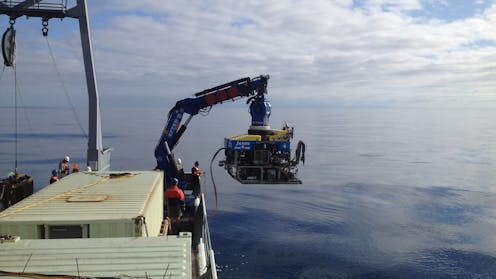
A submersible, which travels to the seafloor to collect rock and microbe samples, is lifted by the arm of a research vessel. James F. Holden

People have long wondered what life was first like on Earth, and if there is life in our solar system beyond our planet. Scientists have reason to believe that some of the moons in our solar system – like Jupiter’s Europa and Saturn’s Enceladus – may contain deep, salty liquid oceans under an icy shell. Seafloor volcanoes could heat these moons’ oceans and provide the basic chemicals needed for life.

Similar deep-sea volcanoes found on Earth support microbial life that lives inside solid rock without sunlight and oxygen. Some of these microbes, called thermophiles, live at temperatures hot enough to boil water on the surface. They grow from the chemicals coming out of active volcanoes.
Sign up to read this article
Read news from 100's of titles, curated specifically for you.
Already a member? Sign in here
Related Stories
Top stories on inkl right now
One subscription that gives you access to news from hundreds of sites
Already a member? Sign in here
Our Picks
Fourteen days free
Download the app
One app. One membership.
100+ trusted global sources.