Get all your news in one place.
100's of premium titles.
One app.
Start reading
Digital Camera World
Alan Palazon

Meet William Constable: The unsung pioneer of photography who helped pave the way for portraiture

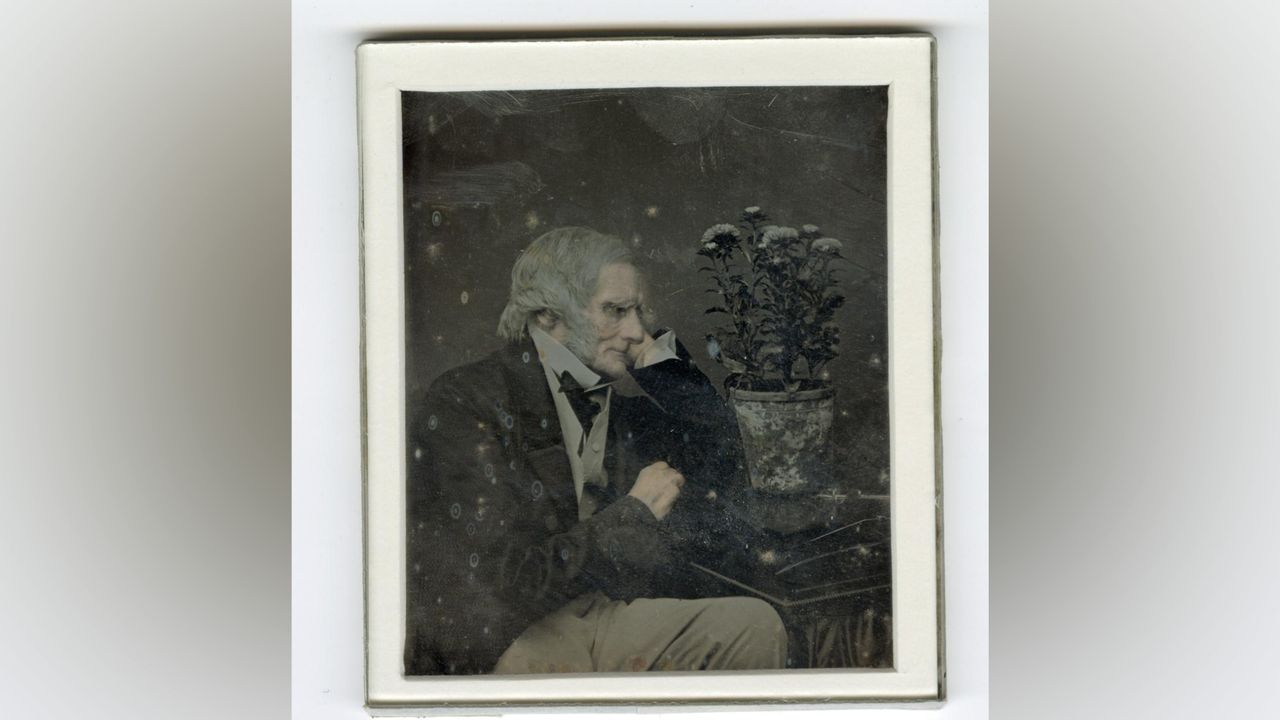
Profile self-portrait of a man.

Sometimes, even the most influential photographers get lost to time – and William Constable was certainly one of them. Even though the late artist was, for a time, the go-to photographer for British royalty, and pioneered commercial portraiture, his contributions to our beloved craft have never truly received the widespread recognition they deserve.

That was until a few days ago when the descendants of Constable, along with researchers from the University of Brighton, teamed up to unveil a blue plaque at the former site of Constable’s Brighton studio, on the south coast of England, deservedly bringing his name into the modern limelight almost 165 years after he died.
Leone Glukman playing chess with William Constable, observed by Eliza Constable. Daguerreotype by William Constable c.1850s (Image credit: Courtesy of Smithsonian’s National Museum of American History.)

William Constable (1783-1861) had been a successful civil engineer and surveyor before transitioning to photography, just two years after the public announcement of the daguerreotype – the first publicly available photographic process, which formed images on a polished, silver-coated copper plate.

At this time he founded The Photographic Institution, one of the world’s earliest commercial photography studios in Brighton, England.

Just a year later, in 1842, Constable captured what is believed to be the first ever portrait of British royalty: a headshot of Prince Albert (1819-1861), husband of the iconic Queen Victoria (1819-1901), who presided over Britain’s 19th-century industrial expansion.

Although Constable has since become best known for his portrait of Prince Albert and subsequent photographic documentation of Queen Victoria, few realize that his work was much more than high-end pictures of royal subjects.

A portrait of William Constable’s niece, Eliza Constable, with a backdrop of chalk cliffs. Daguerreotype by William Constable. c.1849-mid-1850s (Image credit: Courtesy of Smithsonian’s National Museum of American History.)

Constable played a major role in introducing Victorian Britain to photography, and spreading awareness of the craft throughout the country and further afield. He became well known as a commercial portrait photographer among the aristocracy in different parts of Europe, bolstering his reputation with pioneering portraiture techniques.

To show his subjects favorably, Constable carefully controlled the lighting in his studio, known as the “Blue Room,” which had a glazed roof made of blue-colored glass to filter out harsh light and admit only a soft, flattering blue tint.

He also seated subjects on a revolving platform, allowing him to easily rotate them to catch their best angle as well as the optimal illumination. Constable’s approach was also more than flattering; he creatively manipulated shadows using heavy velvet drapes to create contrast, depth, and a dramatic quality in his images.

Constable died in 1861, at the age of 78, cutting short his photography career. At the time of his death, he was still working and his Brighton studio was an established success, but he left behind a legacy much greater than that: one of pioneering portraiture techniques and photographic education.

You can visit the blue plaque at 57 Marine Parade, Brighton, England, the site of Constable's studio – also the first photographic studio in the city.

You might also like…

Take a look at the best cameras for portraits and the best portrait lenses.

Sign up to read this article
Read news from 100's of titles, curated specifically for you.
Already a member? Sign in here
Related Stories
Top stories on inkl right now
One subscription that gives you access to news from hundreds of sites
Already a member? Sign in here
Our Picks
Fourteen days free
Download the app
One app. One membership.
100+ trusted global sources.