Get all your news in one place.
100's of premium titles.
One app.
Start reading
Space
Space
Science
Anthony Wood

Massive 'X' and 'V' shapes will appear on the moon tonight — here's how to see them

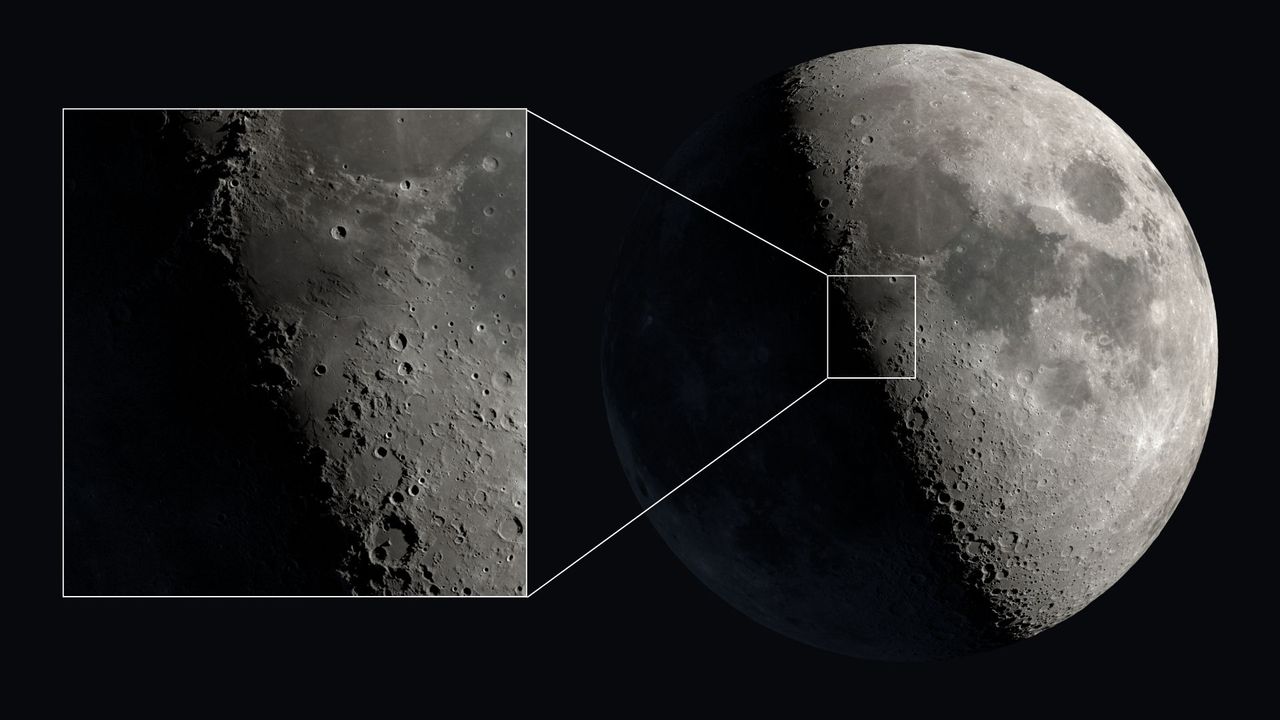
An image of the moon with its right side lit by sunlight against a black background. A zoomed-in shot of the lunar surface is shown to the left, revealing the location of the lunar "V" effect.

Celestron SkyMaster Pro 15x70

(Image credit: Celestron)

These are our best binoculars for moon views. The 15x magnification and 70mm objective lenses deliver sharp contrast along the terminator and lunar details that pop, but make sure you grab a tripod for steady views.

_

Celestron SkyMaster Pro 15x70 review

A trick of the light will make a colossal "X" and "V" appear on the moon overnight on May 23-24, as sunlight catches broken crater rims along the line separating night from day. Here's how and when to find the striking "clair-obscur" effect.

The face of the moon never looks the same from one night to the next, as the shifting angle between the moon and sun causes sunlight to sweep across its surface, altering the shadows cast by craters, mountain ranges and ravines.

Our brains are predisposed to find familiar shapes in the heavily cratered lunar landscape, giving rise to so-called "clair-obscur" effects — a name derived from a French word for light (clair) and another for shadow (obscur).

When to see the lunar "X" and "V"

The "X" and "V" will be visible on the lunar surface around the moon's first quarter phase on May 23, as the lunar disk appears with its right half lit by direct sunlight and its left hidden behind a veil of shadow.

Both clair-obscur effects will be at their most visible from 6 p.m. EDT (2200 GMT) on May 23 through the early hours of May 24, as they appear close to the line separating lunar night from day, known as the terminator.

Where to find the "X" and "V" on the moon's surface

A small telescope or binoculars will allow you to spot the lunar "V" shining close to the terminator between the lunar seas of Sinus Medii and Mare Vaporum, approximately 10 degrees above the lunar equator. The letter-like shape marks where sunlight glances off the rim of the Ukart crater, along with other pieces of broken terrain and small impact sites.

How to find the lunar "X" and "V" on the moon's surface. (Image credit: NASA Scientific Visualization Studio, created by Anthony Wood in Canva.)

Follow the terminator down to a point 25 degrees below the equator to find the lunar "X", which is formed from the broken rims of the Purbach, Blanchinus and La Caille impact sites. Be sure to check out our guide to photographing the moon, along with our roundups of the best cameras and lenses for astrophotography, if you want to snap your own image of the striking clair-obscur effects!

Editor's Note: If you would like to share your moon photography with Space.com's readers, then please send your photo(s), comments, and your name and location to spacephotos@space.com.

Sign up to read this article
Read news from 100's of titles, curated specifically for you.

Already a member? Sign in here
Related Stories
Top stories on inkl right now
One subscription that gives you access to news from hundreds of sites
Already a member? Sign in here
Our Picks
Fourteen days free
Download the app
One app. One membership.
100+ trusted global sources.