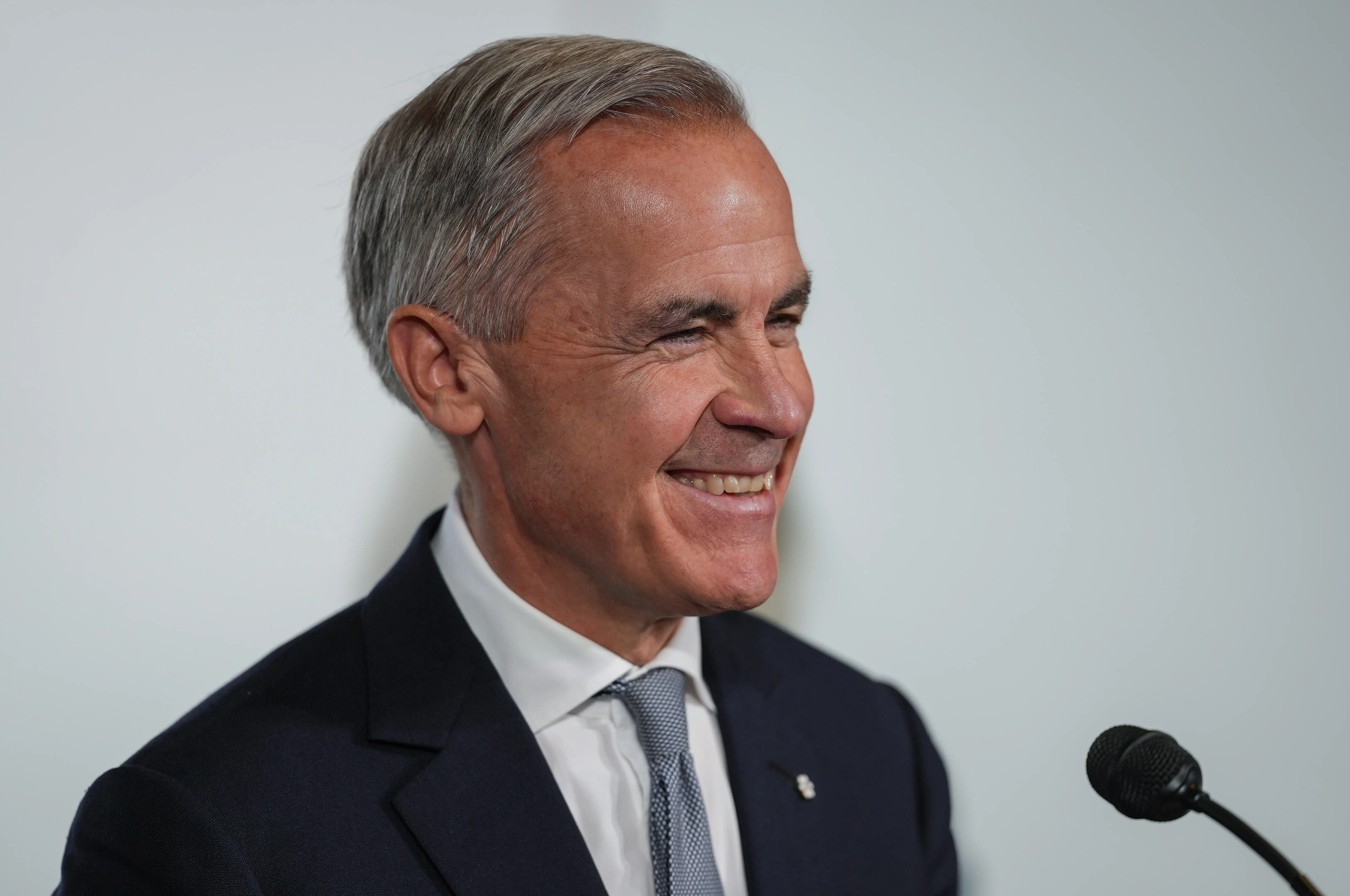
Canadian Prime Minister Mark Carney has emerged as one of the more prominent global political figures of 2026 after taking a firm stance against US President Donald Trump, and that profile has now fuelled speculation that he could end the year with two of the world's most high-profile honours.
Carney briefly became the favourite on Monday on Kalshi, a US-based prediction market, for the 2026 Nobel Peace Prize, with traders putting his chances at 14%. His odds later fell, underscoring the highly speculative nature of prediction-market wagers.
Also Read: From motorcycles to booze, US ban on $1 billion worth of Canadian imports goes into effect
There is no public evidence that Carney is on the Nobel Committee's secret shortlist. The winner of the peace prize is due to be announced on Oct. 9 in Oslo, Norway.
Still, the buzz around a possible Carney victory reflects the central message that has helped elevate his international standing: middle powers should work together to defend their sovereignty as major powers increasingly use economic and military leverage to pursue their interests.
Whether that argument resonates with the Nobel Committee is impossible to know. But the possibility of Carney receiving the prize has an added dimension given Trump's repeated public desire for the honour.
Trump wants Nobel recognition
Carney and Trump have been locked in an escalating trade dispute, with the United States imposing 50% tariffs on billions of dollars of Canadian goods and Canada retaliating. Trump has also warned Canadian leaders to "fall in line" or face consequences "far WORSE" than the tariffs already in place.
Trump, who has twice been named Time's Person of the Year, has repeatedly complained that he has not received the Nobel Peace Prize. In July, he said he "should have won that award more than anybody."
"If this ever happens, I would love to be a fly on the wall of the Oval Office to see the president's face when he learns about it," said Daniel Beland, a political science professor at McGill University in Montreal.
Trump already has a Nobel medal, although he was not the recipient of the prize. Venezuelan opposition leader Maria Corina Machado, who won the 2025 Nobel Peace Prize, presented Trump with her medal during a White House visit in January. Trump accepted it, while the Nobel Committee stressed that the award itself remains Machado's.
Also Read: Canada has prepared for the unthinkable: A military attack by the US
"Trump will be unhappy whoever gets the Nobel," said Nelson Wiseman, professor emeritus at the University of Toronto. "If Carney got it, it would make relations with Canada rockier than they are."
Carney also in contention for Time honour
Carney's profile has also risen in the race for Time magazine's Person of the Year.
Time included him in its list of the 100 most influential people of 2026 and highlighted how his popularity had grown as he confronted Trump.
On Tuesday, Carney was the second choice on major prediction markets for Time's Person of the Year, behind New York Mayor Zohran Mamdani. Time is scheduled to announce its choice on Dec. 10.
Time has described Trump's cumulative impact as helping create a "new global order" shaped increasingly "not by systems or institutions, but by the will of a single man." Carney's response has been to argue that middle powers should cooperate rather than yield individually to pressure from major powers.
New York University professor Scott Galloway has gone further, saying Carney has effectively secured the honour.
"I believe, hands down, Time's Person of the Year has already been decided and it's going to be Mark Carney," Galloway said.
On his podcast, journalist Fareed Zakaria said Carney was gaining admiration internationally by offering countries facing a less predictable United States "a kind of language and a path" for building new alliances rather than simply bending to Washington.
Carney's push for a new global order
Carney's international profile began rising sharply in January at the World Economic Forum in Davos, Switzerland, where he argued that the old international order would not return and called on middle powers to work together rather than wait for its restoration.
"We are in the midst of a rupture, not a transition," Carney said in a speech that received a standing ovation.
Since then, he has sought to put that vision into practice, moving Canada closer to Europe while looking for new partnerships in Asia as Trump's tariffs strained the country's traditionally close relationship with the United States.
European lawmakers gave Carney another standing ovation this month after European Commission President Ursula von der Leyen proposed opening the door for Canada to become the European Union's first associate member.
"Carney's international profile has been driven by his standing up to Trump, unlike the Europeans and Asians who rushed to make deals with him," Wiseman said. "Trump's pressure on Canada has helped elevate Carney in the eyes of the world."
For now, neither the Nobel Peace Prize speculation nor the prediction-market odds offer evidence of an eventual award. But Carney's emergence in both conversations reflects how his confrontation with Trump and his campaign for greater cooperation among middle powers have transformed his international profile in 2026.