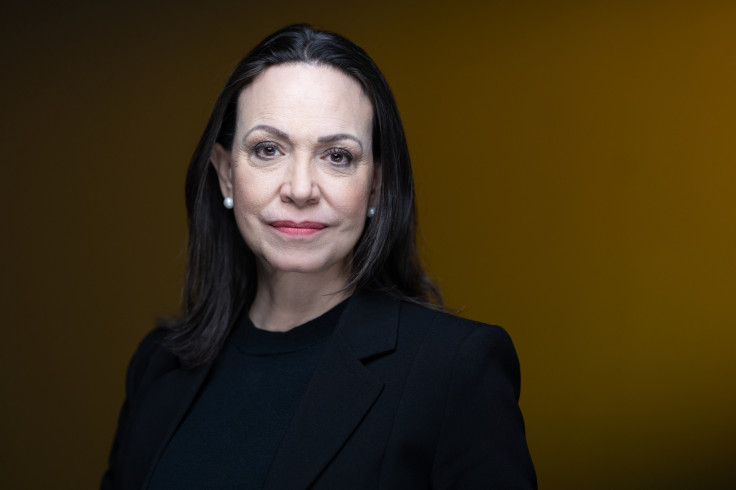
María Corina Machado delivered her clearest public challenge yet to President Donald Trump's handling of Venezuela's post-Maduro transition, questioning whether an oil agreement negotiated with Delcy Rodríguez's interim government can provide the stability, transparency, and legal certainty needed to attract the investment Venezuela requires.
The opposition leader did not break with Trump or reject the United States as a future partner. In fact, she described the U.S. as the principal strategic ally Venezuela needs to develop its vast energy resources and rebuild its economy.
But her statement on the oil agreement marked a significant change in tone after months of public gratitude toward Trump and his administration.
Machado had previously avoided directly criticizing Trump's approach to Venezuela after the U.S. operation that removed Nicolás Maduro. In January, she called that action "a huge step for humanity, for freedom and human dignity," according to Reuters. She later met Trump in Washington and presented him with her Nobel Peace Prize medal.
Now, as the White House advances a major oil agreement with Rodríguez, Machado is openly questioning its foundations.
"Who signs? What exactly is being signed? Who puts up the money? Who provides the guarantees? How does this benefit Venezuelans?" she said, arguing that the public does not yet know the actual scope or terms of the deal.
The agreement gives the United States control over production from 17 Venezuelan oil fields with approximately 65 billion barrels of proven reserves through North American Blue Energy Partners, or NABEP. The arrangement includes a 100-year operating term, according to The Associated Press, while U.S. Energy Secretary Chris Wright has said Washington will oversee the movement of funds generated under the pact, Reuters reported.
Trump has described the agreement as a major strategic and economic victory, arguing it will help rebuild Venezuela's oil industry while benefiting the United States. But Machado's remarks put the agreement at the center of the political debate over who has the authority to decide Venezuela's future and whether a deal signed with Rodríguez can survive a democratic transition.
"The wealth beneath our soil does not belong to an illegitimate regime. It belongs to the Venezuelan people," Machado said.
Her criticism was measured, but unmistakable. Machado did not accuse Trump of acting against Venezuela or demand that Washington abandon the agreement. Instead, she argued that its durability depends on the very democratic conditions that remain unresolved.
For years, Machado has promoted a vision of Venezuela's recovery built on a close partnership with the United States, foreign investment and a competitive oil industry. Her objection is not to U.S. capital entering Venezuela. It is to an arrangement made without a legitimate National Assembly, public bidding, enforceable contracts or clear public accountability.
She restated her own five-point energy plan: a transparent legal framework approved by a legitimate legislature; an independent hydrocarbons agency; open and competitive tenders; a stable fiscal regime; and international arbitration to protect investments.
Machado also warned that oil alone cannot revive Venezuela. The country needs reliable electricity, functioning ports, security, integrated supply chains and institutions capable of enforcing the rules.
"Venezuela is worth much more than its oil," she said. "The true value of Venezuela is its people."
Her intervention represents the first major test of whether Machado can maintain her alliance with Trump while publicly challenging a deal that she believes could shape Venezuela's future without the consent of Venezuelans.