
A man says he found one way to make a painful trip to the gas station a little easier: Skip the regular pump and go straight for E85.
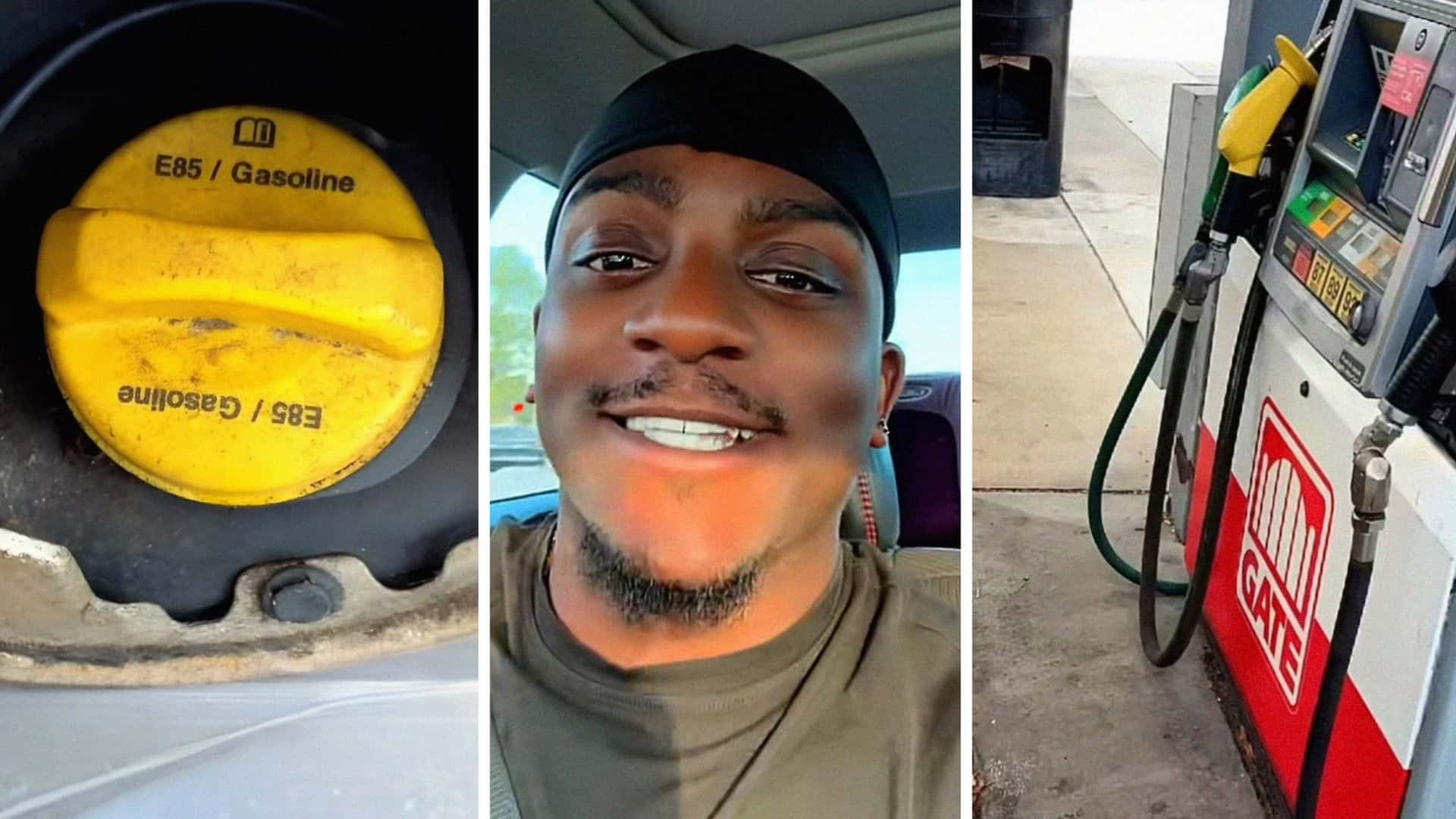
TikTok user @blockedup904 shared a clip from a Gate gas station where the price gap between traditional gasoline and flex fuel immediately caught his attention.
“Aye, this [is] what I love at the gas station,” he says.
He then pans over the posted prices.
Premium is listed at $5.14 a gallon, plus at $4.80, and regular at $4.50.
Then he points to a different pump.
“But that yellow cap?” @blockedup904 says.
The station was advertising E85 flex fuel for about $3 a gallon—roughly $1.50 less than regular.
“E85 me,” @blockedup904 quips.
His video has received nearly 64,000 views.
Why Is E85 So Much Cheaper?
Of course, a $1.50-per-gallon discount is enough to get anyone’s attention, but E85 isn’t interchangeable with regular gasoline.
The U.S. Department of Energy says E85, also called flex fuel, is a blend containing roughly 51% to 83% ethanol depending on the season and location. It’s designed for flexible-fuel vehicles, or FFVs, which can run on gasoline or higher-ethanol blends. E85 isn’t approved for every car, Kelley Blue Book reports, and putting it in a vehicle not designed for it can cause issues.
That means drivers need to know whether their vehicle is actually flex-fuel compatible before following @blockedup904’s lead.
Then there’s the lower sticker price, which comes with a tradeoff.
Ethanol contains less energy per gallon than gasoline. DOE says E85 with 83% ethanol contains about 27% less energy per gallon than gasoline, which generally means lower fuel economy.
DOE’s Alternative Fuels Data Center similarly says drivers using E85 should generally expect fewer miles per gallon than they would get from gasoline “to varying degrees.”
So the better comparison isn’t simply $3 versus $4.50 per gallon at the pump—but how much each fuel costs per mile the car can actually travel.
Flex-fuel vehicles are specifically calibrated to handle higher concentrations of ethanol. The DOE says they have ethanol-compatible fuel systems and different powertrain calibrations than comparable gasoline-only vehicles.
In other words, E85 can still be the cheaper option for some drivers. But the savings depend on both the price gap and the drop in fuel economy—and only if the vehicle was built to use it in the first place.
Is E85 Worth It?
Many viewers immediately pointed out the catch with E85: The cheaper pump price can come with worse fuel economy.
“You put E85 in your car and watch how fast your gas gauge goes down,” one person wrote.
“It’s actually about the same price. E85 won’t get you as far. Your gas mileage will be about 25-30% less. You’ll just be filling up more frequently,” another echoed.
Not everyone agreed the drop was that dramatic, though.
“Guys, I’ve tested it in multiple different kinds of vehicles and only seen a drop of .5-1 mile drop per gallon,” one viewer claimed.
Others focused on whether the fuel belongs in the car at all.
“You better check and see if he can use E85 and your automobile doesn’t work in all of them,” one said.
Another commenter offered their own mixing strategy.
“Got to mix it. E85 is going to act like you have a hole in your tank. I would go half E85 and 93 octane = 87 octane,” they suggested.
Another viewer was more suspicious of E85 altogether.
“That’s the big plan. Raise the prices on the gas, so [you] will invest in a vehicle that either doesn’t take gas or uses E85. E85 also messes up your engine,” they claimed.
And one commenter thought the current price spread changed the math.
“It is absolutely worth it if you have an E85 vehicle when it was $.30 more for gas, it wasn’t, but now it is,” they said.
Motor1 contacted @blockedup904 via TikTok direct message. We’ll be sure to update this if he responds.