
Get all your news in one place.
100’s of premium titles.
One app.
Start reading
Newslaundry
Newslaundry
Comment
Abhinandan Sekhri

Main dardi…ki loki kende chui-mui: A song for despots who can devastate millions but not take a joke

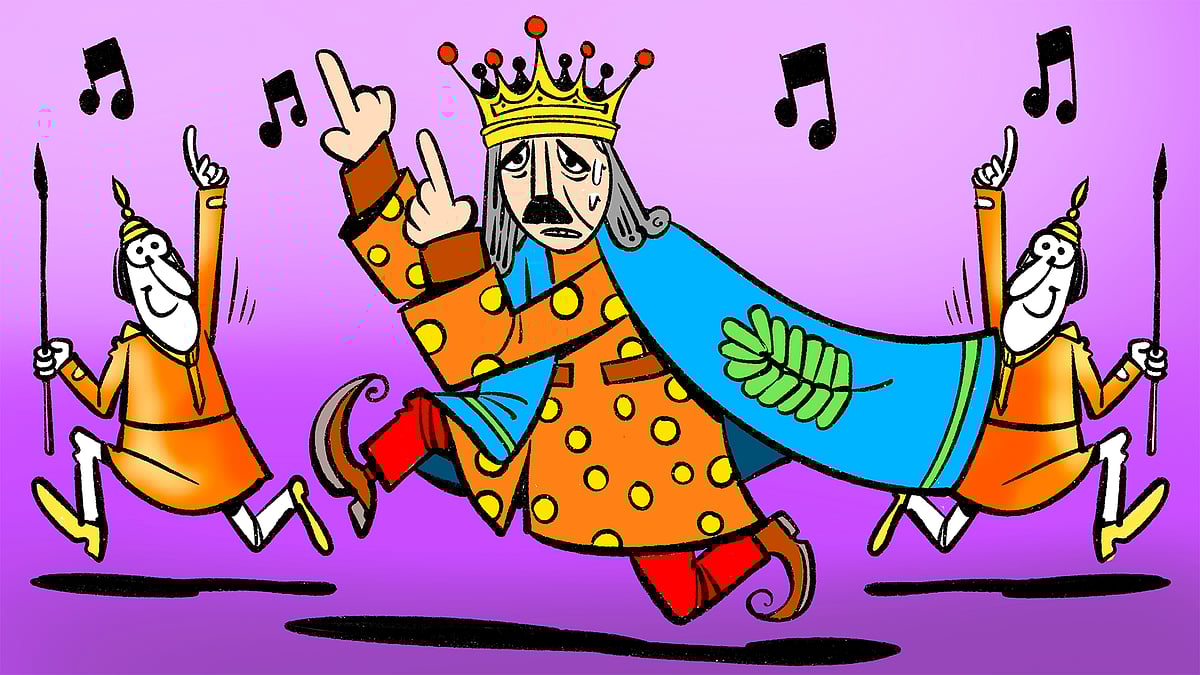
In the immortal words of the great philosopher and kabootarbazi-convicted Daler Mehndi: Main dardi, Rab Rab kardi, ki loki kende chui-mui, chui-mui, chui-mui.


Quick translation note: In Punjabi, Rabba is a hotline to the divine. If you’re Christian, it could be Jesus or Yesu (with di balle balle thrown in for good measure). If Muslim, Allah. Ram/Shiva/Bajrangbali for Hindus. Since I’m Hindu and, in the current socio-political climate, the Lord called upon most often to solve all crises is Lord Ram, I’ll translate accordingly. 

So the line means: I’m scared, always chanting Sri Ram, Sri Ram, and people are calling me touch-me-not, touch-me-not, touch-me-not. Or Mimosa Pudica, Mimosa Pudica, Mimosa Pudica, if you’re a stickler for biological accuracy. But if you’re a non-biological type, chui-mui may suit you better.

The snowflake myth

The biggest myth you’ve been fed is that it’s progressives or conservatives who are most rattled by jokes. Pre-Trump, liberals were accused (rightly) of being snowflakes who couldn’t take a politically incorrect barb. Now it’s the MAGA base and conservatives being (justifiably) accused of shutting down late-night comedy and artistes because satire stings their leader. As Jon Stewart accurately points out, who’s the snowflake now?

The fact is, neither of these groups can win the fragility Olympics. The real snowflakes are active or wannabe autocrats, dictators, and their minions. The kinds whose upper lip quivers while relating decades-old sob stories – even as they live in luxury and wield absolute power, devastating thousands of lives with absolute disregard.

They have the unique ability to expect citizens, especially journalists, to absorb injustices from badly drafted laws (for most effective use), and for communities to remain steadfastly unmoved by violent racial slurs from their minions. Yet they themselves collapse (we will never know whether in anger or trauma) at the smallest joke or satire, forcing the might of the state machinery to take down posts, articles, channels, publications or social media handles. The tough-guy despots with oversized chests are predictably frail.

When satire was alive

I’ve told this story on our weekly podcast Hafta several times. (Subscriber-only: Click here if you want the full version. We’re an unafraid, ad-free platform built by subscribers. Plug complete.)

From 2003 to 2010, I was the lead writer of Gustakhi Maaf (NDTV India) and The Great Indian Tamasha (NDTV 24X7). Some may remember the oversized marionettes of political leaders. What we satirised about Prime Ministers Manmohan Singh and Atal Bihari Vajpayee,  Sonia and Rahul Gandhi, the Ambani brothers is all unthinkable now. Today’s “political satire” is India Today’s cringe suck-up appropriately titled So Sorry. Although just a sorry is not enough to be forgiven for that drivel.

I met regularly with beat journalists to understand behind-the-scenes politics so we could comment on what couldn’t be reported. That’s what satire does. Sometimes we introduced faceless off-camera voices of well-known fixers – inside jokes for netas and journalists. Politicians would message us about gags they enjoyed. This is because the personality or character traits of a government or society flows from the top, like a waterfall.

Gustakhi Maaf and The Great Indian Tamasha were launched in 2003. The first marionettes made were of Sonia Gandhi and Vajpayee. But they weren’t the first to be put on air. Because we weren’t sure how PM Vajpayee and the often oversensitive sarkaari agencies would react. India’s record with humour and satire is not great.

The US–Iraq war kicked off in 2003. Bush and loyal sidekick Tony Blair decided to look for Osama bin Laden (and the non-existent WMDs) in Iraq. So the show went on air with marionettes of Saddam Hussain, Osama bin Laden, George Bush and Tony Blair. Safe, topical, newsy. Each of these characters provided enough material to work with. Two gags twice a week quickly moved to thrice a week as the show gained popularity. Sonia Gandhi and Atal Bihari Vajpeyi were added. No pushback. We felt we could do more.  

In late 2003, elections were announced for Delhi, Rajasthan and Madhya Pradesh. The news cycle demanded six new marionettes: Sheila Dikshit, Madan Lal Khurana, Vasundhara Raje, Ashok Gehlot, Digvijaya Singh and Uma Bharti. Don’t know if they were amused or offended, but since Sonia and Vajpayee hadn’t complained, it would be hard for small fry to express outrage when the biggest two didn’t seem to mind. 

In 2004, UPA replaced NDA. Younger BJP leaders – Venkaiah Naidu, Arun Jaitley, Sushma Swaraj, Pramod Mahajan – jostled to be the next-gen prime mover after Vajpayee and Advani. Gustakhi Maaf appearances became a relevance metric. Reporters covering the BJP (some editors too) would sometimes tell me that so-and-so was asking why his/her marionette had not been made. Is he less important than Venkaiah Naidu? Why is Mr Naidu featured so many times in a week? Or some such grouse. By now the show’s frequency was daily. (Here’s my cue to look back and get teary eyed and whine about how hard it was to wake up every morning at 6 to have 3 scripts ready by 11 am and how hard life has been to me and how if anyone makes fun of me now, they should be sent to jail etc etc. You know the drill, you’ve seen many self-indulgent narcissists go down this road.)

Naidu was elected full-time party president in 2004 after Jana Krishnamurthy stepped down in 2003 (Naidu was a temporary replacement at first) – explaining his frequent appearances. Also, marionettes were expensive and time-consuming (latex masks, clay, sculptures). Already-made ones were milked until the person became politically irrelevant.

I met regularly with beat journalists to understand behind-the-scenes politics so we could comment on what couldn’t be reported. That’s what satire does. Sometimes we introduced faceless off-camera voices of well-known fixers – inside jokes for netas and journalists. Politicians would message us about gags they enjoyed.

This is because the personality or character traits of a government or society flows from the top, like a waterfall. Since Vajpayee had a sense of humour and the confidence to tolerate satire, others did too. If the top is an insecure, prickly intolerant whiner – the society is incentivised by that behaviour leading to constant outrage cycles. 

A couple years later in 2006 we went to Pakistan for the Rafi Pir performing arts festival (which Gen Musharraf himself attended with his wife, I’ve written about this mind blowing experience here). We were all set to perform our gags in some lawns around the Gaddafi Stadium in Lahore using marionettes of Inzamam-ul-Haq, Shoaib Akhtar and Musharraf. A couple hours  before the performance, the organiser asked us to remove Musharraf from the skit. We told them that we thought he liked the show since we were told he wanted to watch some DVDs when he visited India the year before. But that didn’t matter, you see. He was the dictator of Pakistan. I had to scramble to rewrite scripts in an hour removing one character altogether (cue for hard work, crisis management whining and how I have had it so hard etc). 

What democratic leaders understand

Jawaharlal Nehru said to celebrated cartoonist Shankar: Don’t spare me Shankar. For all his flaws, Nehru was committed to democratic values and demonstrated it. We have the benefit of hindsight to see that. 

Satire, mockery and humour is an integral part of an intelligent, mature society and polity. Only insecure, small minded weaklings want to clamp down on this tradition. It is not insignificant. This has profound implications.

When nations have fragile leaders, with an insatiable lust for power and a childish insistence of wanting to be respected (and if that’s not possible, they’ll make do with fear), the outcomes are less likely to be strongish-steel, more likely to be weakish-shit. 

How situations like this play out is hard to say. When you have brittle egos coupled with trembly ideological foundations and a chaotic political climate paired with unpredictable technological tools – it’s often down to the wire. Which reminds me, The Wire did something too, right? How was that received?

Fourteen years of asking hard questions and poking the powerful – ad-free and backed only by readers. Subscribe, keep us fearless, and proudly say: I built Newslaundry.

Newslaundry is a reader-supported, ad-free, independent news outlet based out of New Delhi. Support their journalism, here.

Sign up to read this article
Read news from 100’s of titles, curated specifically for you.
Already a member? Sign in here
Related Stories
Top stories on inkl right now
One subscription that gives you access to news from hundreds of sites
Already a member? Sign in here
Our Picks
Fourteen days free
Download the app
One app. One membership.
100+ trusted global sources.






