I’ve found Lezyne’s Radar Drive Rear – also referred to as the Radar Drive 300 – among the very best bike radars available. That’s quite an achievement, because there are only a couple of brands – Garmin and Wahoo – that sit anywhere near the top of my list, so I’m excited that Lezyne is able to join them with its first radar release.
It impresses because, like its aforementioned competitors, it is reliably accurate, which is critical for a bike radar. If you’re not familiar with the concept of bike radar, these little units, which are not much larger than regular rear bike lights, can detect vehicles approaching from the rear. This traffic information is typically relayed to a smartphone or GPS head unit mounted on the handlebars, warning the rider of any immediate threats. For these warnings to be of any use whatsoever, they need to be true and precise.

Lezyne has also earned my respect by designing a bike radar like no other. It looks unique, it behaves distinctly, and it offers features – one in particular – that no other radar has. The brand has really ploughed its own furrow with the Radar Drive Rear, which I applaud. I believe it’s currently the most versatile bike radar on the market.
That’s not to say that it’s perfect. There’s one feature that, fortunately, doesn’t affect its accuracy or rider safety, but it drove me nuts during testing.
Construction

The Lezyne Radar Drive Rear can communicate traffic conditions to three different types of receivers. While many of its peers require you to own or purchase a separate bar-mounted bike computer to display traffic threats, represented by animated vehicle icons proceeding up a thin lane on the side of a data screen, the Radar Drive Rear can display the same information on Lezyne’s free Radar Ally companion smartphone app.

Uniquely, it can also be purchased with a 1,200-lumen front LED light – the React Drive Front – which displays traffic alerts on a rider-facing illuminated panel. In fact, even when nothing is connected, the Radar Drive Rear will still warn passing traffic of your presence with an intense flash. Of course, in this scenario, it won’t – it can’t – warn you of a threat, but it does increase your presence on the road. You can buy both products separately, or pick them up together within Lezyne’s Radar React System bundle.

Essentially, if you have no other need for an expensive bike computer, there’s no requirement to buy one solely to display radar data. Just clip your smartphone to your bars with a phone mount and use the app. If you don’t have a bike computer and prefer not to use your phone, consider the front light option. It doesn’t provide as much information, but it’s a great solution for leisure riders and commuters who could benefit from a powerful front light but don’t want to get bogged down in too much tech. It goes without saying that, if you already own a GPS head unit, the Radar Drive Rear will play nicely with that too.
In fact, you can connect all three – light, head unit, and phone — simultaneously. While this might be overkill, linking your phone along with the light or head unit allows you to hear alerts through bone-conduction headphones. You can even tuck the phone into a pocket, where you’ll still feel it vibrate.

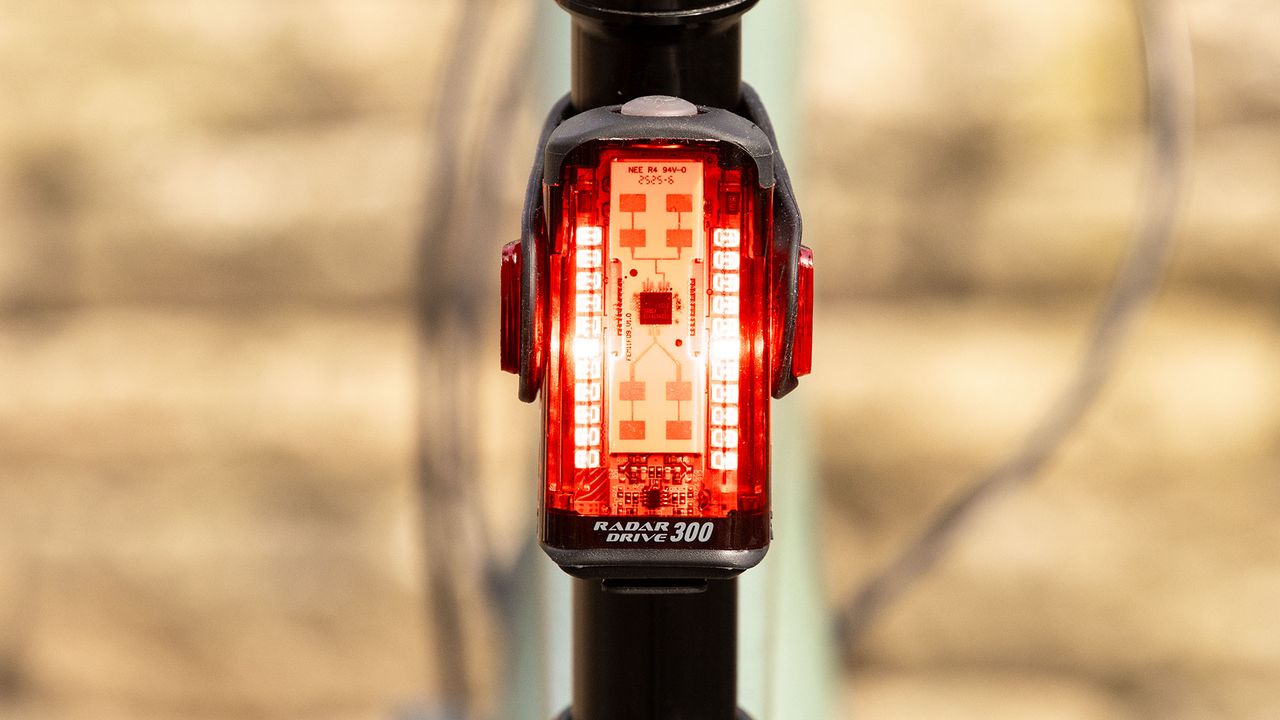
The Radar Drive Rear’s brutish aesthetic is dominated by a huge wraparound transparent polycarbonate lens that covers the entire rear-facing panel and sides. It screams ‘see and be seen’ – a bold look that prioritises safety over svelteness. At 104g for just the light alone, it’s a bit of a lump. However, the co-moulded construction feels incredibly sturdy and carries an IPX7 waterproof rating, which was well-tested during a particularly soggy British winter.
Aside from the smooth polycarbonate lens, the rest of the body is coated in armoured rubber, another unique feature for bike radar. I didn’t drop it, but its appearance exudes a tough confidence that suggests it would weather a nasty topple better than any other part – body or bike. It feels bombproof, but the rubber coating’s tactile yet slightly tacky feel is catnip for dust, as my photographs show.

A large illuminated circular button sits on top of the Radar Drive Rear, which is used to power the device on/off. Pressed repeatedly, it will manually cycle through the lighting modes, and it also functions as a status indicator, glowing or flashing shades of green, orange and red to denote charge status and other states.

At the base, you’ll find a USB-C charging port protected by a very sturdy rubber bung. Unfortunately, there’s no officially supported way to dismantle the unit in order to replace the rechargeable battery, which is a shame. Tantalisingly, there are two readily accessible Torx bolts in the base, next to the USB-C socket, but Lezyne says that any ‘attempt to remove electronics’ will void the warranty.
My love for the Radar Drive Rear’s distinctive, Tonka-Toy-esque design is tempered by its frustrating mounting arrangement. It’s both cumbersome and limited, which is ironic for an otherwise versatile piece of kit. Lezyne has chosen to omit the familiar, and frankly superior, quick-release quarter-turn mount similar to those used by Garmin, Wahoo, and pretty much every other brand. Instead, the entire unit is strapped to the seat post, cushioned by a removable rubber shim.

Fittingly, the ‘ladder’ strap is characteristically beefy and a doddle to adjust, which at least means the Radar Drive Rear is held very securely. However, when it comes to removing the radar – perhaps when locking your bike up in a garage or leaving it outside a café in a less salubrious neighbourhood – the whole lot has to be removed. Invariably, this means watching the rubber shim drop and bounce across the road as soon as the strap is loosened. Then, before you ride off again, everything needs to be reassembled. It’s a first-world problem, but I find a simple quarter-turn mount so much easier to manage when my brain is low on caffeine and depleted in sugar.
Lezyne includes two rubber shims in the box, one for D-shaped seat posts and the other for aero posts. It reckons the rubber-armoured coating provides enough purchase on a regular round seat post, which wasn’t my experience. I found that using either shim – D-shape or aero – significantly increased grip and security when fitting the Radar Drive Rear on round posts.

The rear light is a powerhouse. It outputs a whopping 300 lumens in Day Flash mode, which is exceedingly bright for a rear light, yet it should last for 18 hours before the battery fails. Behind the wrap-around lens are two stacked LED arrays, one on the left and the other on the right. Each stack comprises two vertical CoB arrays, with a single, very bright LED sandwiched between them. The four CoB arrays offer fantastic near-distance conspicuity – the wrap-around lens ensures they’re visible across 270° – while the pair of bright single LEDs adds long-distance reach.
The other five modes are more subdued, ranging from a 10-lumen solid mode (good for 16 hours) to an 80-lumen high mode (4 hours 32 minutes).

Strictly speaking, this review concerns the rear radar unit, but because they’re so closely associated, it’s worth running through the specs of the React Drive Front light too. It closely resembles many other front lights in Lezyne’s range, such as the Lite Drive 1200+, in that it’s elegantly crafted from machined aluminium and features multiple LEDs behind optical-grade composite optics.
Its 1200-lumen output makes it more than capable of serving as a primary front light for night road riding, as well as a great daytime running light. Rugged and long-lasting – battery life is claimed to be 70 hours when using 700 lumen Day Flash mode – and it’s rated IPX7, just like the Radar Drive Rear. Its unique feature is the illuminated panel on the back of the light, which communicates threats identified by a paired Radar Drive Rear.

When a ‘normal’ threat – a vehicle travelling less than 60kph relative to your speed – is detected, the panel flashes red once per second until the vehicle is within 50 metres, at which point it turns solid. A high-threat alert - triggered by a relative speed exceeding 60kph - causes the panel to blink rapidly with a distinct long-short-short pattern. Along with visual cues, the React Drive Front also emits loud warning tones when a threat is detected and again when the road is clear.
The Ride

I found the Radar Drive Rear to be the easiest bike radar I have ever set up, by far. Why? The instructions provided by Lezyne are simply outstanding. Where many brands provide little more than a hastily thrown together quick start guide, Lezyne has prepared a proper manual that provides detailed guidance on setup and radar best practice. What’s more, there’s a great selection of walkthrough tutorials on the brand’s YouTube channel.

The best place to start is Lezyne’s Radar Ally app, available for both Android and iOS, which pairs with the Radar Drive Rear over Bluetooth simply by having both devices within a few feet of one another. There’s no tiresome pairing sequence to battle through. Using the app, you can download and install the latest firmware and configure a multitude of settings, such as Vehicle Detection Flash and the audio and vibration options. The real meat is in the Radar display page, where you view threats and cycle through the lighting modes.


Pairing with a GPS head unit is a similarly straightforward, this time over ANT+. You cannot update the Radar Drive Rear’s firmware via a head unit, but it is possible to configure the light settings and, of course, view vehicle threats. Pairing the React Drive Front is initially completed through the app, but it’s a one-time only setup. From there on in, as soon as both devices are fired up, they’ll pair automatically. No settings can be configured through the React Drive Front, it’s all achieved through the app.
To judge the effectiveness of the Radar Drive Rear, I put it through its paces on the predefined 13km circuit I regularly use for assessing bike radar products. This loop features a variety of traffic flows and the kind of structural reflections from buildings and parked vehicles that often trip up bike radar. Part of the route includes a narrow, winding road through a local industrial estate that is chock-a-block with panel vans, large metal gates, and loading bay shutters – it’s super reflective.
To supplement active road-ride testing, I set up a static rig on a long, straight stretch of road to verify maximum range. All results were logged using the excellent Garmin ConnectIQ plugin from MyBikeTraffic.com.

In practice, Lezyne has done an excellent job developing its detection algorithm. No false positives or negatives were observed during my tests, and the maximum detection range of 150m was routinely exceeded by larger vehicles. Speed-matched vehicles – those travelling closely behind me at roughly the same pace – remained persistently on my Garmin Edge 1050 and Wahoo Elemnt Roam screens for as long as could be expected.
While the Lezyne has a relatively narrow 35° field of view compared to many competitors' radars, I’m not unduly concerned. I regard this as a trade-off that avoids extraneous detail rather than a fault – it may go some way to explain why the Radar Drive doesn’t suffer false positives from reflections.

Using the React Drive Front in place of my head unit offered a pared-down experience that took some getting used to. The front light provides almost no information about vehicle position; it’s only possible to ascertain from the display whether a threat is closer or further than 50 metres from your position and roughly how fast it is travelling.
However, I quickly realised that’s all that’s really necessary. After the initial warning tone sounds, you only have a fraction of a second to glance at the display before refocusing on the road. All you really need to know is whether a threat exists, something the React Drive Front communicates effectively enough.
Value and Conclusions

With an RRP of £170.00 / $179.99, the Radar Drive Rear presents tough competition for both Wahoo and Garmin. It falls within a similar price range to these brands, though it is noticeably cheaper than the new flagship Garmin Varia RearVue 820, while offering more versatility for riders who prefer not to invest in a head unit.
If you can overlook the somewhat awkward mounting process and its weight, which might be a consideration for some performance riders, you're left with a device that is just as accurate as the market leaders but notably more versatile.
Specs
- Price: £170.00 / $179.99
- Range: 150m
- Field of detection: 35°
- Light output: Max 300 Lumens (Day Flash)
- Light modes: 7 (including Car Alert Flash/Solid)
- Connectivity: ANT+, Bluetooth, USB-C
- Battery life: Up to 20 hours
- Weight: 144g
- Dimensions: 78 x 48.9 x 47.6mm
- Weatherproofing: IPX7
- Mount: D-post and aero post adapters included
- Companion app: Lezyne Radar Ally