
Get all your news in one place.
100's of premium titles.
One app.
Start reading
Digital Camera World
Matthew Richards

Laowa Aksen 5-10x Ultra Macro Apo review: Forget 'full' macro – this lens ramps up magnification all the way to 10x more

Laowa Aksen 5-10x Ultra Macro APO product image.

Venus Optics makes plenty of garden-variety lenses for stills and cine. I’ve long been taken by its more esoteric offerings that deliver a different kind of shooting experience to the norm.

Examples that spring to mind, and that I’ve reviewed in the past, include the Laowa 90mm f/2.8 2x Ultra Macro Apo, the Laowa FFII TS 100mm f/2.8 Macro 1X which features full tilt and shift functions as well as 1.0x macro magnification, and the Laowa 8-15mm f/2.8 FF Zoom Fisheye that delivers both circular and diagonal fisheye effects for full-frame cameras at either end of its zoom range.

A relative newcomer on the oddball scene is this Laowa Aksen 5-10x Ultra Macro Apo, which hits the ground running with 5.0x macro magnification, then zooms all the way to a monster 10x magnification at full stretch. Thankfully, there’s no physical ‘stretch’ involved as the lens retains the same overall dimensions at all settings.

A major claim to fame is the lens’ novel ‘parfocal zoom’ mechanism, which maintains the same focus distance throughout the entire zoom range. This makes the Laowa easier to use than some high-power macro lenses, like the legendary Canon MP-E 65mm f/2.8 1-5x Macro, which is now sadly obsolete.

In short, the Aksen 5-10x and simultaneously launched Laowa Aksen 1-5x Ultra Macro Apo (with more modest magnifying power) aim to be among the best macro lenses on the market.

Even the minimum magnification factor of 5x is pretty spectacular. The maximum 10x magnification is simply stunning (Image credit: Matthew Richards)

Laowa Aksen 5-10x Ultra Macro Apo: Specifications

Mount options

E Z RF L F EF X MFT

Full frame

Yes

Autofocus

No

Image stabilization

No

Lens construction

17 elements in 12 groups

Aperture range

f/1.7 to f/5.6

Diaphragm blades

11

Working distance

22.48mm / 0.89in

Macro magnification

5x to 10x

Filter size

None

Dimensions

70x128mm / 2.8x5.0in

Weight

570g / 1.26lb

Laowa Aksen 5-10x Ultra Macro Apo: Price & Availability

The Laowa Aksen 5-10x Ultra Macro Apo is the embodiment of ultra-high-precision design and manufacture. It’s hardly surprising then that it comes with a fairly hefty price tag of $749 / £899 (Australian price TBA), despite lacking any electronics whatsoever.

The sibling 1-5x lens costs the same money in the USA but is less in the UK, at £799. Venus Optics also offers a twin lens bundle at $1,399 / £1,679.

A variety of optional accessories are advertised in the USA, including a tripod collar with rods at $80, a Leofoto MP-180S macro focusing rail at $139 and a WeMacro electronic slider bundle for $599. There’s also an optional USB Coaxial Light for the 5-10x lens at $50, but that’s incompatible with the 1-5x lens.

Laowa Aksen 5-10x Ultra Macro Apo: Design & Handling

The Laowa Aksen 5-10x Ultra Macro Apo has a focal length of just 17.5mm and an aperture range of f/1.7 to f/5.6. That might sound like a very ‘wide’ aperture range for a macro lens, but it comes with the 10x territory – and, like other macro lenses, light transmittance drops off at greater magnification settings.

Those equate to longer zoom settings in this case, rather than shorter focus distances, as the lens has a fixed focus distance.

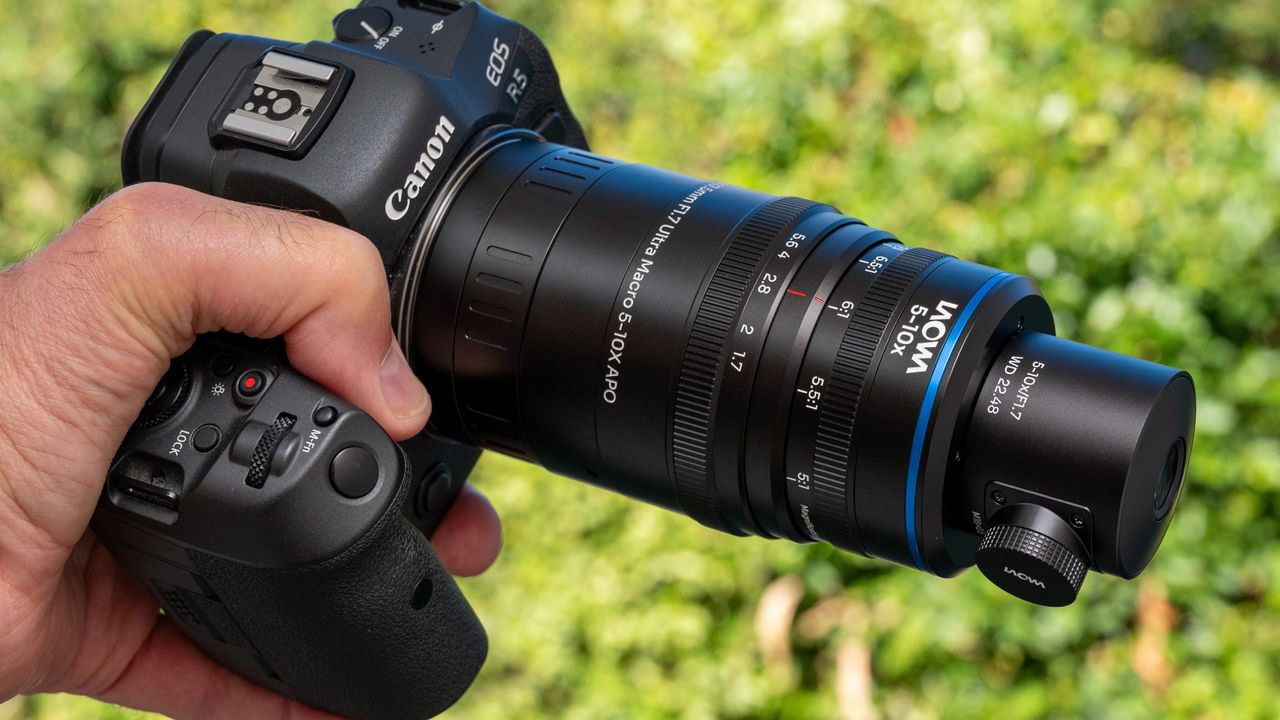
The internal zoom mechanism is wrapped inside a sturdy metal barrel with a fixed length, so there’s no elongation at higher magnification settings. The longest zoom setting reproduces objects at 10x life size on the camera’s image sensor (Image credit: Matthew Richards)

The big idea of this macro zoom lens is that once you position the camera and the object you’re shooting so that the latter is in focus, it should stay that way throughout the entire magnification/zoom range.

The Laowa is advertised as having a fixed focus distance and groundbreaking parfocal zoom mechanism that results in focus remaining locked at any zoom setting, avoiding the need to reposition the camera or the object that you’re shooting.

To sweep from 5x to 10x magnification and anywhere in between, the zoom ring rotates smoothly and is clearly marked at major intervals (Image credit: Matthew Richards)

The fixed working distance between the front of the lens and the subject is quoted as 22.48mm / 0.89in, so it’s less than an inch. In more worrying news, that working distance is specified to a tolerance of 1/100th of a millimeter, or about a hair’s breadth.

Suffice it to say that positioning your camera and the object you’re shooting is a very precise affair. In practice, I found the lens virtually impossible to use without at a macro focusing rail.

I’d have been tempted by the optional Leofoto MP-180S, but I already have an excellent NiSi NM-200s Macro Focusing Rail, which serves the same purpose. I’ll come back later to how that worked out during my testing.

The NiSi Macro Focusing Rail or an alternative tool for fine positional adjustments is essential kit for using the lens effectively (Image credit: Matthew Richards)

The lens is fully manual so there are no internal electronics. In fact there’s neither autofocus nor manual focus, due to the fixed object distance. The lack of electronics also means that you have to set the aperture manually and that no lens-based EXIF data is recorded in image files.

On the upside, the purely mechanical nature of the lens makes it relatively easy to manufacture in a wide variety of mount options, which include Canon EF, Canon RF, Nikon Z, Nikon F, Sony E, L-Mount, Fujifilm X and Micro Four Thirds. Pentax shooters might feel a bit left out at this point.

Like the zoom ring, the aperture control ring has a nice tactile feel and is clearly marked. It rotates in full f-stop click steps (or thereabouts) from f/1.7 to its narrowest aperture of f/5.6. Another noteworthy point is that the aperture diaphragm is based on 11 curved blades and is very well-rounded.

The aperture control ring rotates in click steps from f/1.7 to f/2 and then in full f/stop clicks to f/5.6 (Image credit: Matthew Richards)

In terms of optical design, the Laowa 5-10x is more complex than its 1-5x sibling, with additional elements in extra groups.

In total, there are 17 elements in 12 groups, with the inclusion of 5 ED (Extra-low Dispersion) elements and 3 UHR (Ultra High Refraction) elements, aiming to boost clarity and minimize color fringing.

As with the 1-5x lens, the 5-10x is advertised as an Apo (Apochromatic) lens that effectively eliminates color fringing.

The complex optical path is based on 17 elements arranged in 12 groups, incorporating five ED elements and three UHR elements, along with an 11-blade aperture diaphragm (Image credit: Matthew Richards)

The design also features a relatively small-diameter protruding front section, as shown in the image above. As I’ve mentioned, the fixed working distance of the lens is very short, so it can be a challenge to channel sufficient light in towards the subject.

There’s no filter attachment thread for adding macro lights or a ring light, as there’s simply not enough room to play with. Instead, Venus Lens offers a USB-powered coaxial LED lamp which costs $50 and screws into the front section of the lens. It’s certainly a workable solution for illuminating your subject, if you feel like splashing out.

The relatively small-diameter front section also enables the easy fitment and removal of a slip-over hood, as shown below. Like the lens barrel, the hood is made from metal rather than plastic and feels like a quality item.

(Image credit: Matthew Richards)

Continuing the theme from the barrel and hood down to the mounting plate, the lens has a metal rather than plastic mounting plate.

Again, as a fully manual lens, there are no electronics, so none of the various mount options features any data contacts and there’s no need for a USB port for applying firmware updates. Perhaps a more disappointing omission is that the mounting plate also lacks a weather-seal ring.

Although basic, the mounting plate is sturdy and made from metal rather than plastic, but lacks any electronic contacts or a weather-seal ring (Image credit: Matthew Richards)

Laowa Aksen 5-10x Ultra Macro Apo: Performance

I used a big gun to test the lens, in the shape of the mighty 45MP Canon EOS R5, the resolution of which is a stern test for any lens. I mounted the camera on a sturdy Peak Design Pro Tripod via the NiSi NM-200s Macro Focusing Rail that I mentioned earlier.

A couple of things immediately became obvious. The first was that the fixed working distance of less than an inch put the front of the lens very close to whatever I was shooting. Lighting was a challenge but I used LED light panels to supply sufficient illumination, rather than adding the optional coaxial lamp.

The other instantly noticeable factor was that accurate focusing is absolutely essential. It proved a tricky task even when using my macro focusing rail to enable very small adjustments. The fiddly business of focusing, or rather camera and object placement, is due to the incredibly tight depth of field.

Anyway, I started off by shooting a small section of pixels on my 27-inch 1080p LCD computer monitor, to give a sense of the magnification on offer.

I found that even just touching the camera resulted in small positional changes that could affect the accuracy of focusing.

Combining the extreme levels of magnification with a magnified live preview in a mirrorless camera also revealed that it can take a long time for the camera to fully settle and for vibrations to fade away, after being touched.

During testing, I used a ten-second self-timer delay and fully electronic shutter to make the camera as motionless as possible. Even then, it was still susceptible to vibrations caused by passing traffic on the street in front of my house, so good timing was of the essence.

Putting a lot of care and attention to detail in setting up a shot can reward you with very pleasing images. Living up to its billing, the lens exhibits excellent sharpness and clarity, along with negligible color fringing.

Distortion is also very well controlled, which is just as well as the fully manual nature of the lens makes automatic in-camera correction unavailable.

The bottom line is that if you put the effort in, this lens can reward you with spectacular results.

Laowa Aksen 5-10x Ultra Macro Apo: Sample Images

There’s more to the following gallery of example shots than meets the eye, in more ways than one. A third of the shots weren’t even taken with the 5-10x lens that I’m reviewing here. Basically, I’ve included sets of three shots for each subject.

The first image in each threesome was taken at 1.0x magnification using the sibling Laowa 1-5x lens, to set the scene, and is just for reference so you can see what the usual 1.0x magnification looks like for each subject. The next two shots in each group of three were taken at the 5-10x lens’s minimum 5x and maximum 10x magnification factors.

Subject matter includes standard-sized body text (Aptos 12pt) printed onto plain paper with an inkjet printer, a postage stamp, a wristwatch day/date mechanism, a leaf, colored pencils, a textile flower and a nutcracker ballet doll.

Laowa Aksen 5-10x Ultra Macro Apo: Lab Results

Due to the fixed and very short focus distance of the lens, it’s impossible to take shots of the test charts that we use for capturing and processing lab test data for regular lenses. As such, we’re unable to provide any lab test results for this lens.

Laowa Aksen 5-10x Ultra Macro Apo: Verdict

I found that using the Laowa Aksen 5-10x Ultra Macro Apo was challenging and rewarding in equal measure. The high magnification factors involved make shooting a fiddly and sometimes arduous business, requiring a lot of attention to detail, exacting technique and a little frustration along the way.

Get everything right, however, and you’ll be rewarded with spectacular imagery that goes far beyond what the naked eye can see in real life.

Features

★★★★☆

A standout feature is the internal zoom mechanism for enabling 5-10x macro magnification but the lens has a fixed focus distance and no electronics.

Design

★★★★★

The ‘groundbreaking’ design is based on a ‘parfocal zoom’ facility, built into a high-precision, robust construction, earning the lens TIPA 2026 and Cine Gear Expo 2026 Camera Technology awards.

Performance

★★★★½

The Laowa is capable of superb image quality and results that have genuine wow factor, but you might need a lot of patience along the way.

Value

★★★★½

It’s a ‘dumb lens’ with no electronics but the Laowa is still very good value considering the high-end design and all-round quality.

Overall

★★★★½

(Image credit: Matthew Richards)

Alternatives

Sign up to read this article
Read news from 100's of titles, curated specifically for you.
Already a member? Sign in here
Related Stories
Top stories on inkl right now
One subscription that gives you access to news from hundreds of sites
Already a member? Sign in here
Our Picks
Fourteen days free
Download the app
One app. One membership.
100+ trusted global sources.