Get all your news in one place.
100's of premium titles.
One app.
Start reading
Latin Times
Latin Times
Entertainment
Alicia Civita

Karol G in Coachella 2026: La Bichota is Back, and She Arrived Like a Full-blown Latin Pride Hurricane

Karol G made history in the 2026 edition of Coachella, after becoming the first Latina to headline the festlval. To the cry of "Don't be afraid. Raise your flag," she built a spectacle around Latinidad, female power, and the idea that her place on that stage was bigger than a personal career milestone.

The Colombian star turned her set into a declaration of identity, with guests, visuals, and musical shifts that made the show feel like both a party and a cultural statement. Karol G s show felt less like a standard festival set and more like the launch of a new universe, one built from Latina mythology, female power, tropical fantasy, old-school reggaetón, heartbreak, pride, and pure spectacle.
By the time the fireworks exploded and the party hit full speed, she had made one thing clear: her performance was a manifest of the talent, resilience, and pride of Latinos, particularly in the U.S.

In a way, it felt like the next chapter of the book of Latino pride that Bad Bunny started to write at the Super Bowl.

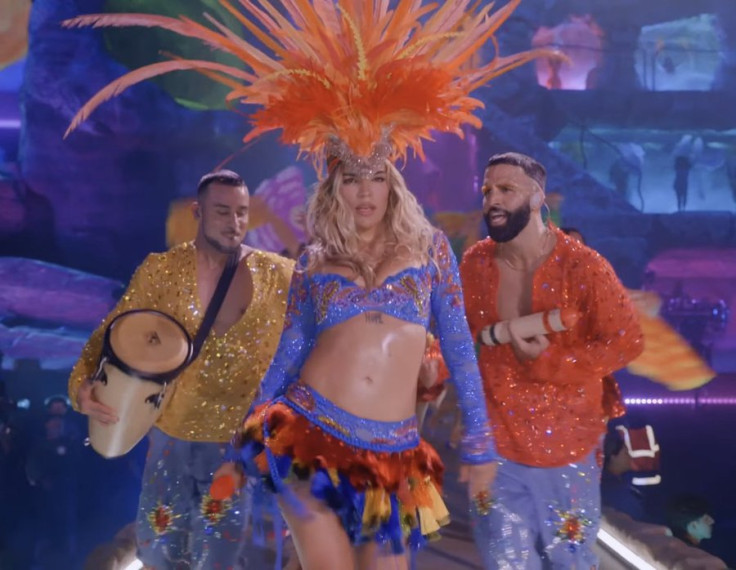
From the start, the show leaned into the imagery of her new Tropicoqueta era. She started with a tiny gold bikini and short set. Then there were bright colors, references to Carmen Miranda, a giant macaw with stairs, gold accents, tropical visuals, and a sense of exaggerated Latin glamour that was playful, sensual, and even sexual

At times, the aesthetic approached a campy style, but this was intentional. Karol G was reclaiming stereotypes about Latina women and turning them into art, performance, and power. She explored concepts such as the "wild woman," feminine intuition, sexual freedom, and the right of women to express themselves in a world that still attempts to silence them.

There was also a deeper thread running through the set, one that touched on Latin American culture in all its color and contradiction. Jaguars, mythology, Andean flute sounds, mariachi, salsa, reggaetón, and visual references to Indigenous and folkloric elements all coexisted in the same world.

One of the strongest visual and cultural representation moments came with the all-women mariachi section. Karol G brought out female mariachi musicians and turned the stage into something proudly Latina and defiantly feminine. It was one of the clearest expressions of what the concert was trying to say.

This was a world of women: Latinas

The setlist helped tell that story. The tracklist 'LATINA FOREVA,' 'Un Gatito Me Llamó,' 'OKI DOKI,' 'Tá OK (Remix),' 'EL MAKINON' with Mariah Angeliq, 'S91,' 'Tropicoqueta,' 'Papasito,' 'Negrita de Mis Pesares' as an instrumental moment, and 'Ese Hombre Es Malo' reimagined with mariachi.

She also brought in 'Gatúbela' and gave the crowd the kind of perreo chaos they came for. At one point it turned into full "perreo loco," dirty, loud, sweaty, and gloriously out of control.

Her guests helped shape the emotional and musical arc of the night. Becky G joined her for 'MAMIII,' one of the biggest crowd-pleasers of the set. Wisin brought the force of old-school Puerto Rican reggaetón, pushing the energy even higher with a segment that felt like a tribute to the genre's roots.

Arturo Sandoval added another layer entirely, bringing trumpet and musical gravitas to the stage during a moment tied to 'TQG.' And there was also a new song produced by Greg Gonzalez of Cigarettes After Sex, who acompanied her on the stage, which added a moodier, dreamier texture to a set otherwise driven by rhythm and heat.

La Bichota also made room for tribute and memory. Karol danced to the rythm of Daddy Yankee's 'Rompe', invited Wisin to the stage, who sang three of his greatest hits, including 'Rakata,' from his Wisin y Yandel era, and performed Gloria Estefan's Mi Tierra, and it landed as one of the most meaningful moments of the night, a tribute to Latinos who leave home in search of better opportunities while carrying their roots with them.

It was a dignified homage, one that fit perfectly inside a concert obsessed with identity and belonging.

Throughout the night, Karol kept speaking directly to the crowd, mostly in Spanish She told them, "I am Carolina Giraldo from Medellín, Colombia," and reminded everyone that she is the first Latina woman to headline Coachella.

And the crowd answered. Colombian and Mexican flags were the most visible, but there were also flags from all Latin America At one point, flags were distributed through the audience, and their reflections on the giant screens created one of the most beautiful images of the night. Karol looked out and said there were people everywhere, thanking them for being there with her.

Not everything was perfect. There were some voice equalizer issues, and parts of the show felt built more for television than for the people standing on the floor, where visibility could disappear during certain segments. There were also perhaps too many dark transitions between costume changes or chapters of the concert, which briefly interrupted the momentum. But those flaws did not erase the ambition.

There was water onstage, a waterfall behind a rock set with rooms, pyrotechnics, silver and gold flashes, wet choreography, and enough visual overload to keep the performance constantly shifting. At one point she came out in green, evoking a kind of comic-book heroine energy, almost like a Latina version of Uma Thurman's Poison Ivy. Later, in a white miniskirt, bra top, white boots, and braids in the colors of Colombia, she looked every bit like the architect of her own mythology.

And then came the ending. She started to close with 'Tusa,' in a salsa arrangement that erased completely the Nicki Minaj participation in the original song (if you know, you know) and closed with 'Provenza,' bringing the night back to one of the songs that helped define her ascent, but this time with the weight of everything that had happened before it. Fireworks, emotion, memory, pride, perreo, mariachi, immigrant tribute, women-centered imagery, and the sheer joy of seeing a Latina artist own one of the biggest stages in music.

La Bichota is back. And she did not return quietly. She came back to remind everyone that her story, and the story of the people she represents, is still being written in lights, in rhythm, and in flags raised high.

The best part of all is that she will do it all over again next Sunday, for Coachella's second weekend.

© 2025 Latin Times. All rights reserved. Do not reproduce without permission.

Sign up to read this article
Read news from 100's of titles, curated specifically for you.
Already a member? Sign in here
Related Stories
Top stories on inkl right now
Our Picks
Fourteen days free
Download the app
One app. One membership.
100+ trusted global sources.