As the sun sinks over Bondi beach, Rabbi Yossi Friedman begins to sing in Hebrew. Then, standing outside Bondi Pavilion, he recites the names and shares stories of the 15 people whose lives were extinguished metres away.
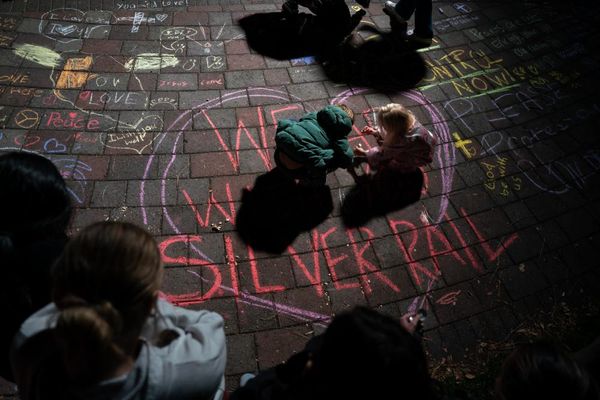
The floral tributes that carpeted the path, swelling up the hill in the days after the 14 December terrorist attack, are gone but, even now, people still bring flowers as they mourn at the site. Some come specifically for Friedman’s vigils – which he holds three times a day outside Bondi Pavilion at 7.30am, 1pm and 7.30pm – others come to pay respects and stumble upon the service.
Sign up: AU Breaking News email
The ritual began the day after the attack, when only six victims’ names were known and Friedman stood up to share them in front of a crowd of thousands.
He had come to the beach that day to connect and pray but then was moved by what he saw when Bondi Pavilion became the locus for memorial, as the site of the massacre, Archer Park, was still cordoned off by police.
Alongside the raw grief was an “outpouring of love” – people laying flowers and stones – which Jews traditionally bring to graves to remember their dead – candles and cards, creating what Friedman describes as “this beautiful, holy space, a quiet area of reflection and connection”.
“It made me realise that, in Judaism, we have moments of silence but then we also have moments that we infuse with meaning. And so I thought, why not?”
In that first week Friedman shared the victims’ names and stories every hour on the hour, as well as the Kaddish, the Jewish mourner’s prayer and Oseh Shalom – a song of peace. Now, the vigils also include recitations of Psalm 23:4 and end with the Australian national anthem. Friedman plans to continue the commemorations at least until the end of the initial 30-day period of mourning which is especially significant in Judaism.
Friedman, who works as a “rabbi on demand”, knew that a communal space was needed after the public tribute of flowers and messages of solidarity outside the pavilion was swept up one week after the massacre in order to be preserved.
“I felt that the flowers were removed too soon. People still needed a space to grieve and still today … there are still people who come and are laying their own flowers,” Friedman says.
As he attends the site each day, he sees hundreds of people “still coming to grieve and to connect”.
Among them is Shoshana Ghent, who visited the site on Monday afternoon.
“My underlying feeling is of immense grief and sadness, and that I can’t do anything … So all I can do is leave a stone and say Kaddish,” she says.
Laura and her partner, Leslie, who lived in Bondi for six years before moving to Victoria, came to hear Friedman after going for a swim in the ocean.
“It’s very hard to just walk through that park… and so [Friedman’s vigil] was a very important anchor to be here, to hear the names and just centre ourselves around the event,” says Laura, who asked for her last name not to be used.
“I think it’s incredible the energy that he has and also to sing together was incredibly powerful.”
The couple both speak of the pain not only of the past two weeks but the past two years for the Jewish community since the 7 October 2023 massacre in Israel. “We’ve been navigating a lot of difficult things. So, this grief is not just about the event here. There’s more grief involved and obviously long ancestral grief too,” Laura says.
Friedman says it is important to address this grief, especially “here at the site where it happened”, to give people a space to cry and “express their emotions freely and not bottle it up”.
He has also started asking a different survivor of the Hanukah party to share their testimony at the 7.30pm vigil.
On Monday evening, Rabbi Mendy Litzman, a paramedic for Jewish ambulance service Hatzolah, shares his story, telling the crowd he was on duty at a Hanukah party nearby at Dover Heights, when “in one instant, our lives were changed”.
He heard a raspy voice over his radio: “I’m shot. I need help. Send backup code one.” For a second he thought someone grabbed his Hatzolah colleague’s radio pranking him but the voice said it again. Then he heard sirens.
Litzman got to the site and parked his ambulance under the footbridge, where the alleged gunmen were still firing.
He ran up on the bridge to drop tourniquets after police yelled for some, where he saw the two alleged terrorists.
He then went in search of his colleague Yanky, who he knew had been shot, and he thought perhaps one or two others. “I had no clue this was going to be the biggest mass casualty of my career.”
Litzman started triaging more than 50 patients all with gunshot wounds.
“One of the hardest things in my career, 27 years, is leaving a patient, someone shot, who’s still talking and breathing – I’m going to cry, sorry – and you know, he’s going to live, and you have to tell the mother who’s telling you, ‘Mendy, don’t leave, my child’s going to die’, and you say, ‘no, I have to go to the next one’,” he says.
Litzman remembers the evening as a dark cloudy day, despite the reality of it having been a beautifully hot, sunny summer evening. He says the scene was “very eerie” when he arrived as the celebratory Hanukah music was still going, and carnival lights of children’s rides still flashing.
Litzman acknowledges the trauma surgeon, standing in the crowd at Monday evening’s vigil, who saved Yanky – who had 300 bullet fragments embedded in his lungs and back. Then, describing the difficulty he faced in coming back to speak within view of the footbridge the shooters used, he addresses survivors who have returned to the site.
“Several people here today said, ‘it’s the first time back’, but we should go back. We should stand united,” he says.
Terrorists will not win, Litzman says, as “the Australian way is not this way. We have no hatred in our hearts.”
For Friedman, the goal now is to keep the stories of victims alive and build a “movement of people who are committed to spreading light and standing side by side, regardless of affiliation”.
To illustrate this, he describes an moment on Sunday night, where a Muslim man came up to him and “said that he was preaching in his mosque just yesterday about standing with the Jewish community”.
“He was here hugging me and shedding a tear, such a beautiful moment … sharing the same sentiment that is that we’re all human beings, and that this should never have happened to anyone,” Friedman says.
The horror at Bondi has seen a public outpouring of support for Australia’s Jewish community from non-Jews, which Friedman hopes will continue.
“That is what will heal and that is what will cure antisemitism,” he says.
“Because we as Jews can’t do it alone.”