
Get all your news in one place.
100’s of premium titles.
One app.
Start reading
Euronews
Euronews
Gavin Blackburn

Japan's PM dissolves parliament after three months in office, setting up snap election

Japan's Prime Minister Sanae Takaichi dissolved the lower house of parliament on Friday, paving the way for a snap election on 8 February.

The move is an attempt to capitalise on her popularity to help her governing party regain ground after major losses in recent years, but will delay parliamentary approval for a budget that aims at boosting a struggling economy and addressing soaring prices.

Elected in October as Japan's first female leader, Takaichi has been in office only three months, but she has seen strong approval ratings of about 70%.

Takaichi's Liberal Democratic Party (LDP) could still face some challenges as it reels from a series of scandals about corruption and the party's past ties to the controversial Unification Church.

But it's not clear if the new opposition Centrist Reform Alliance can attract moderate voters while opposition parties are still too splintered to a pose a serious threat to the LDP.

Japanese Prime Minister Sanae Takaichi during an extraordinary Diet session at the lower house of parliament in Tokyo, 23 January, 2026 (Japanese Prime Minister Sanae Takaichi during an extraordinary Diet session at the lower house of parliament in Tokyo, 23 January, 2026)

Takaichi is also seeing rising animosity with China since she made remarks that touched on Taiwan. And US President Donald Trump wants her to spend more on weapons as Washington and Beijing pursue military superiority in the region.

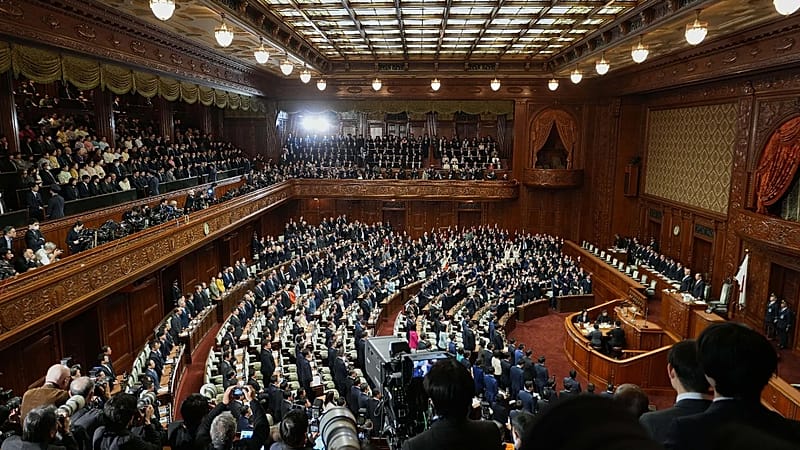
The dissolution of the 465-member lower house paves the way for a 12-day campaign that officially starts on Tuesday. When house speaker Fukushiro Nukaga declared the dissolution, the assembled parliamentarians stood up, shouted banzai — "long live" — three times and rushed out to prepare for the campaign.

Takaichi hopes to win majority

Takaichi's plan for an early election aims to capitalise on her popularity to win a governing majority in the lower house, the more powerful of Japan’s two-chamber parliament.

The scandal-tainted LDP and its coalition had a slim majority in the lower house after an election loss in 2024. The coalition lacks a majority in the upper house and relies on winning votes from opposition members to pass its agenda.

Opposition leaders criticised Takaichi for delaying passage of a budget needed to fund key economic measures.

Lawmakers cheer after dissolving the lower house of parliament in Tokyo, 23 January, 2026 (Lawmakers cheer after dissolving the lower house of parliament in Tokyo, 23 January, 2026)

"I believe that the only option is for the people, as sovereign citizens, to decide whether Sanae Takaichi should be prime minister," she told a news conference on Monday when announcing plans for the election. "I'm staking my career as prime minister" on it.

A hardline conservative, Takaichi wants to highlight differences with her centrist predecessor Shigeru Ishiba.

Takaichi stresses that voters need to judge her fiscal spending moves, further military buildup and tougher immigration policies to make Japan "strong and prosperous."

While an upbeat and decisive image has earned her strong approval ratings and fans of her personal style, the LDP is not popular as it recovers from a political funds scandal.

Many traditional LDP voters have shifted to emerging far-right populist opposition parties, such as the anti-globalist Sanseito.

Takaichi promises results on economy and defence

Takaichi is focusing on the economy, looking to attract voters with measures to address rising prices and stagnant wages, as well as support for low-income households.

But the security hawk has also pledged to revise security and defence policies by December to further strengthen the military and to eliminate arms export restrictions to allow more sales and develop the Japanese defence industry.

Her party is also vowing tougher immigration rules and restrictions on foreigners living in Japan to address growing anti-foreign sentiment.

Earlier this week, the LDP proposed new immigration policies including tougher requirements for foreign property owners and a cap on the number of foreign residents in Japan.

Sign up to read this article
Read news from 100’s of titles, curated specifically for you.
Already a member? Sign in here
Related Stories
Top stories on inkl right now
One subscription that gives you access to news from hundreds of sites
Already a member? Sign in here
Our Picks
Fourteen days free
Download the app
One app. One membership.
100+ trusted global sources.