
Get all your news in one place.
100's of premium titles.
One app.
Start reading
Space
Space
Science
Monisha Ravisetti

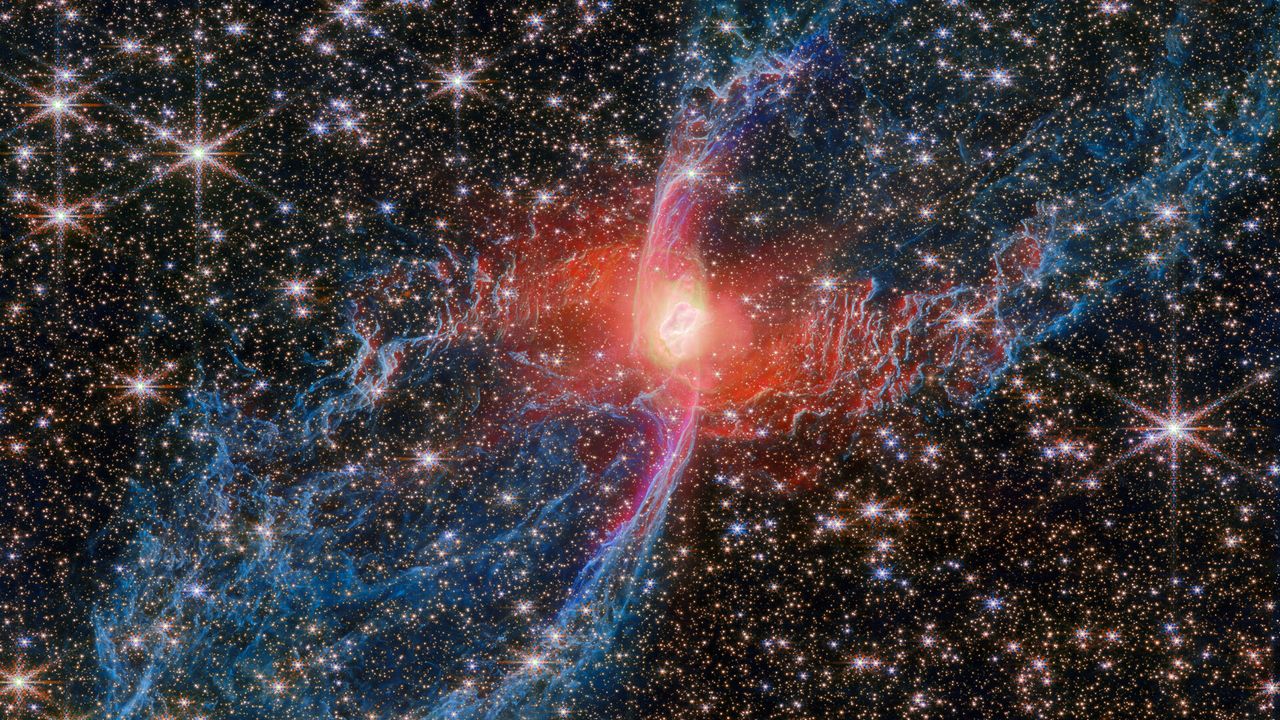
James Webb Space Telescope spots the haunting Red Spider Nebula with 3-light-year-long legs

A large planetary nebula. The nebula’s central star is hidden by a blotchy pinkish cloud of dust. A strong red light radiates from this area, illuminating the nearby dust. Two large loops extend diagonally away from the centre, formed of thin ridges of molecular gas, here coloured blue. They stretch out to the corners of the view. A huge number of bright, whitish stars cover the background, also easily visible through the thin dust layers.

Out in the cosmic landscape, planetary nebulas would offer the perfect Halloween doors to knock on.

They're spooky tricksters in their names, as they have nothing to do with planets at all and are rather the gory scenes of stars dying. The term "planetary nebula" actually comes from an accident. Long ago, astronomers using early-iteration telescopes thought these objects looked like planets because of how rounded they appeared. We now know this to be untrue, of course, but the planetary nebulas continue to be disguised by their own titles.

Sign up to read this article
Read news from 100's of titles, curated specifically for you.
Already a member? Sign in here
Related Stories
Top stories on inkl right now
One subscription that gives you access to news from hundreds of sites
Already a member? Sign in here
Our Picks
Fourteen days free
Download the app
One app. One membership.
100+ trusted global sources.







