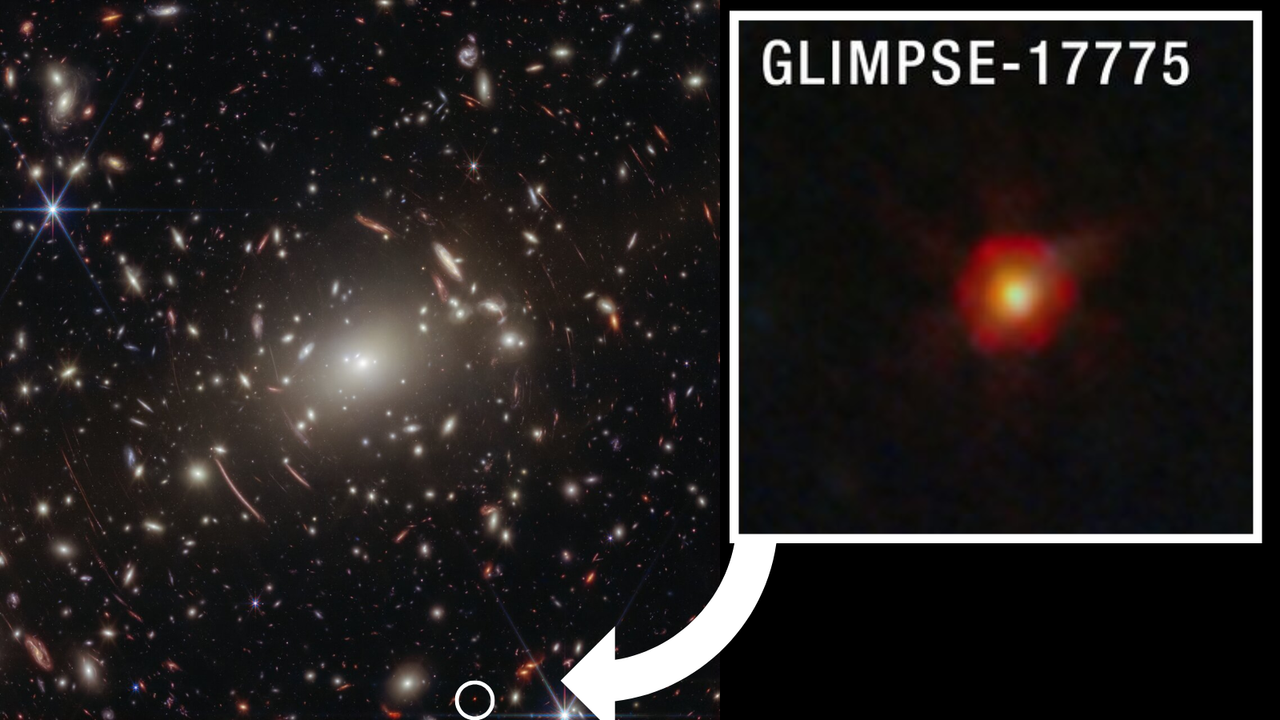
Astronomers using the James Webb Space Telescope may be close to solving the mystery of "little red dots" in the early universe. The team has studied one of these strange objects, designated GLIMPSE-17775, finding evidence it is a black hole star — a ravenously feeding, growing supermassive black hole cocooned in a dense cloud of partially ionised gas.
Little red dots first started to turn up when the James Webb Space Telescope (JWST) began sending data back to Earth in the summer of 2022. They were said by some scientists to have "broken cosmology" because they appear in large numbers around 600 million years after the Big Bang, but they appear to disappear before the universe reaches 2 billion years old. Several explanations for little red dots have been proposed, but one that has emerged as a frontrunner is the concept of black hole stars. If black hole stars exist, the little red dot disappearance would be the result of their intense, short-lived growth spurts that cause them to burn out — or, because the growing supermassive black holes at their centers eventually clear away the dense gas and dust obscuring them, changing their appearance as they evolve into more typical active galaxies.