
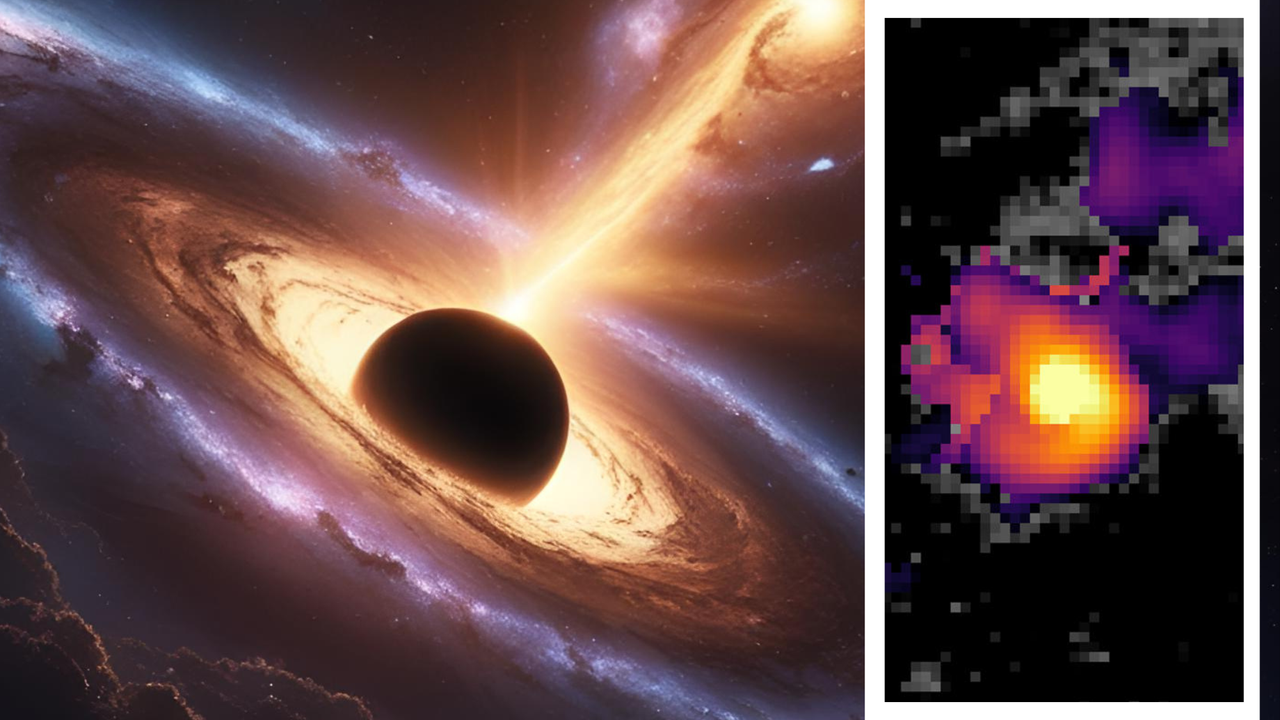
Thanks to the James Webb Space Telescope (JWST), astronomers have been given a glimpse of the mechanisms that supermassive black holes use to feed themselves. The observations could help scientists discover how supermassive black holes with masses millions, often even billions, of times that of the sun grew so fast so soon after the Big Bang.
While all large galaxies have supermassive black holes at their hearts, some are slumbering giants, consuming little surrounding gas and dust, while others are ravenously feeding and acting as the engines of bright central galactic regions called active galactic nuclei (AGN). These feeding black holes also blast matter from their poles in jets that can drive gas and dust — the raw material needed for star formation — out of their host galaxies, thus cutting off star birth and effectively "killing" these galaxies.















