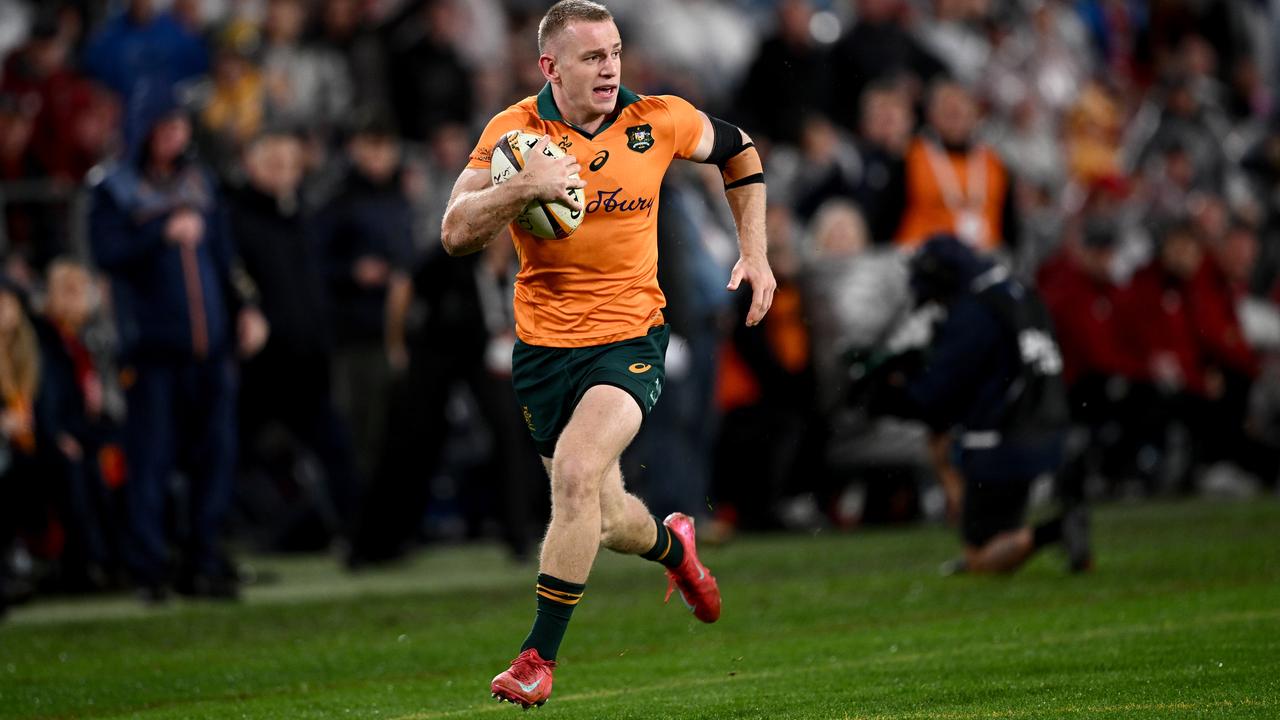
Sam Cordingley has urged World Rugby to outlaw a "catastrophic" tackle technique and has solutions for a talent retention problem outgoing Wallabies coach Joe Schmidt thinks won't go away.
The Queensland Reds football boss has doubled down on his calls for the hip-drop tackle to be documented in rugby's rules as a dangerous tackle after star back Treyvon Pritchard was the latest victim during the under-20s World Cup.
Pritchard's ankle was fractured when a Welsh rival left his feet and used his weight to swing him to the ground and crush his lower legs.
The technique was outlawed by the NRL in 2020 and is banned in New Zealand's junior and community rugby competitions.
Quade Cooper led calls for action in 2024 when Reds and Wallabies scrumhalf Tate McDermott injured Brumbies hooker Lachlan Lonergan in a similar tackle.
But current laws only focus on height and timing when determining dangerous tackles.
"The prevalence is increasing, other codes are doing things about it," Cordingley told AAP.
"It would be an easy one for World Rugby, to call out a tackle that can have a catastrophic impact on a player's career.
"They need to document it in the law."
It comes as NRL clubs circle 19-year-old Pritchard after his eye-catching rookie season with the Reds, who have the backline ace on their books until the end of next season.
The battle for signatures between codes is ongoing, with Mark Nawaqanitawase set to return to rugby in Japan from the NRL's Roosters next year and clubmate Angus Crichton signing with the NSW Waratahs for next year.
Australian exports are now common sights on rival Test team sheets.
France debuted Brisbane-raised prop Moses Alo-Emile alongside fellow Brisbane junior Emmanuel Meafou when they played the Wallabies at Suncorp Stadium this month.
Schmidt sees no end to the battle given the "economies of scale don't allow Rugby Australia to capture everyone".
"You've got 30 professional clubs in France and ... you only need to look at the island nations to see the people who are most disadvantaged by that, the amount of Polynesian players playing in overseas competitions or qualifying for overseas teams," he said.
"But you get a legend of the (rugby league) game like Brad Fittler, whose (son) Zach Fittler is playing for the Junior Wallabies."
Schmidt said rugby academy offers often didn't cut it for elite juniors in high demand.
But Cordingley has challenged Rugby Australia (RA) to target that area, pointing to the expiration of the current collective bargaining agreement in November as a crucial moment.
"That's the catalyst for appropriate reform," he said of the upcoming negotiations that follow RA's record operating surplus of $70.6 million for the 2025 financial year.
"We need to rival what they're offering over there (in France) ... the picture painted by overseas clubs is of full-time training, meals, live-in programs.
"We offer a very similar on-field experience but the time I've spent over in French clubs, their resourcing is at a high level. That's our goal."
As for the established talent, Cordingley said mid-contract sabbaticals should be central to negotiations.
"It is the wonderful advantage of our game; the world's open for players to explore a different culture and we should lean into those opportunities in our contracting model," he said.
In a positive sign, Waratahs and Test winger Max Jorgensen has two sabbaticals built into his five-year deal.
"Leveraging those opportunities - playing overseas and earning good money - within the cycle is a good opportunity.
Les Kiss, who replaced Schmidt as Wallabies coach on Monday, played rugby league for Australia in England but has seen 30 different countries as a rugby union coach.
He will retain an "open-minded" approach.
"The landscape that rugby exists on is different to league and Aussie rules and other competitive sports," Kiss told AAP.
"We have to extol the virtues of what our game can provide.
"Being wise about how we go about that is important and once I'm settled into the role I'll understand it."