
Dining rooms have evolved hugely over the years. They started as formal rooms in grand homes for hosting and symbolizing status, then, for a while, they disappeared almost entirely, with designs favoring open plan and casual arrangements.
But in 2026, the dining room is back, reviving the best of their past and combining it with new, more functional requirements. And the way you design it is key to the success, not just visually, but as a practical part of your home, too.

And who better to inspire your dining room than interior designers who have tried it all? Here's how they design and decorate a dining room that blends aesthetics, function, and long-lasting style, and how they can inspire your own scheme.
36 Dining Room Ideas For a Chic-Meets-Functional Design
Whether you have a grand dining room that needs a fresh look or a small nook you want to make chic, there are so many fun and thoughtful ways to give it a lift. Even if you need it to become a multi-functional room, this year's dining room trends prove that the practical details needn't impact the appearance of your scheme.
So, if you need some inspiration, look no further. These designer-approved ideas will help you to reinvent your dining room in no time.
1. Wood Drench For a Country Cabin Feel

The drenching trends have taken the design world by storm in recent years, and in the dining room, wood drenching can be an impactful choice, especially if you are surrounded by countryside views.
'This is a mountain cabin vacation getaway for a young family. The 1980s A-frame was purchased originally for the husband's hunting cabin. The original goal was a "simple refresh," but as we entered the design process, the clients changed their directive: Let's see what you would do to create an undercover-fancy retreat,' says interior designer Allison Lind.
'It's tucked on a woodsy hillside, so our goal was to create a space that felt at home in its environment. The family wanted this space as a getaway from city life – the experience while there should be universal inside and out. We intentionally designed the whole interior so that there isn't one inch of flat, white drywall exposed. It's wrapped in natural materials and textures wherever possible.'
2. Add an Antique Hutch to Display Your Favorite Dinnerware

If you love to host, you've probably got a beautiful collection of dinnerware hidden away in your kitchen cupboards. But these pieces can double as decor in your dining room, especially if you find a beautiful antique or vintage furniture piece to display them on, like in this dining room.
'The clients wanted a dining room that felt special and glamorous. The room didn’t get a lot of natural light, so we leaned into the dark color, but the wallpaper still feels sparkly with its gold details. Our clients already had a gorgeous collection of dinnerware that they wanted to display, so we found a lovely antique hutch for that purpose,' says interior designer Jessica Helgerson.
'We love the contrast of the old patinated hutch and the modern wallpaper, the vintage rug, and the modern chandelier. As we furnish our projects, we are often bouncing between traditional and modern, old and new – it helps to create a more dynamic, collected feeling to a room.'
3. Go Bold With a Colorful Dining Table

When you think of a dining table, a wooden design probably comes to mind. Yes, it's a classic, but it's also an area where you can get a bit more creative and introduce a really striking focal point, like in this dining room by Studio Duggan.
A bold red dining table has been introduced, infusing the space with color and playful style. It balances the busy wallpaper on the walls and takes the design from mostly neutral to something more showstopping.
Paired with more traditional dining chairs and a terracotta-toned rug, the space feels characterful and full of personality. It's warm and welcoming, rather than an intimidating formal room typical of bygone eras.
4. Embrace Moody Colors For a More Intimate Space

Dining room colors are a crucial part of the design, setting the tone and mood for the entire space. And while it can be tempting to go light and bright, there's something a bit cozier and a bit more interesting about decorating with moody colors, as shown in this dining room.
'The color palette of the dining room relates to the beautiful cement tile checkerboard floors in the adjacent kitchen. We added a beautiful, wide opening so that these two areas could be more connected. The dining room is also congruent with the living room – the sheer draperies are also in olive green so that the whole first floor has a cohesive look,' explains interior designer Bethany Adams.
'The dining room is incredibly simple, so each piece needed to carry a lot of weight design-wise. The starting point for the room was this incredible vintage brown marble dining table I bought at auction for the clients. The shape and size are perfect for the nearly square room, allowing guests to freely flow around it and into the other rooms. From there, brown velvet on the dining chairs was an easy and practical choice.'
5. Let Architectural Features Become the Star of the Dining Room

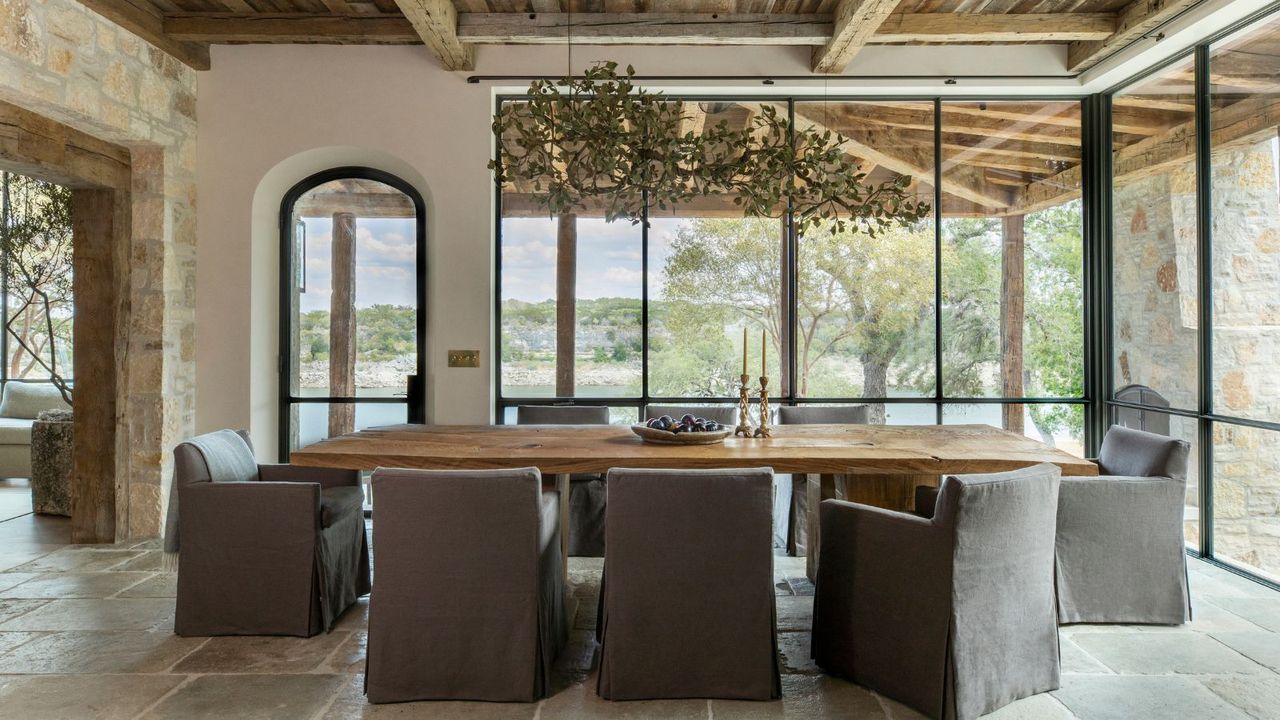
Sometimes the design of a dining room is less about reimagining the space with decor and more about honoring and highlighting what already exists. If your dining room benefits from beautiful architecture, let that be the focus of your design. Here, walls of windows, original ceiling beams, and organic materials led the design.
'The clients envisioned a dining space that made entertaining effortless while honoring their family’s history and the natural beauty of Lake Travis. As a generational home, the room needed to feel deeply connected to its surroundings – refined and simple, never fussy – with materials that would age gracefully and tell their own story,' says interior designer Marie Flanigan.
'This home had such incredible bones, and we wanted every detail to highlight that craftsmanship. Rather than competing with the architecture, the design choices were made to complement it. The lighting fixture, inspired by a tree on the property, became a sculptural nod to the landscape, while the simple silhouettes and natural textures throughout the space allowed the architectural materials to take center stage.'
She continues: 'Even with its expansive windows and stone floors, warmth comes through in the layered textures and organic tones. The natural wood table anchors the room with its rich grain, while the slipcovered chairs bring softness and comfort.'
6. Maximize Seating Space with a Kitchen Banquette

Even if you don't have a separate dining room, you can still create the illusion of one by carefully dividing your kitchen. Banquette seating is a stylish and effective way of zoning a dining area without making the room feel small or overcrowded, as shown in this design by Alison Lind Interiors.
'When we were renovating this kitchen, the existing large window along the side of the house proved tough. It was placed too low for cabinetry, and the previous floor plan had that space as a formal dining room with a floating table. But in that setup, there wasn't room for much else, and storage was at a premium,' explains Allison.
'So instead, we opted to maximize the perimeter with full-height storage and get a casual family dining space via the built-in aspect. And the L-shaped banquette helps connect the functional kitchen space and adds cabinetry, so nothing feels disparate. It invites a more casual, cozy experience.'
7. Mix Furniture Styles for an Eclectic Feel

The key to creating a warm, welcoming dining room? Introduce an eclectic mix of furniture to bring character and interest to the scheme – extra points if you can make them vintage. In this dining room of this New York apartment, warm hues and characterful furniture instantly bring the room to life.
'The clients wanted their dining room to feel inviting and lived-in, a place that could easily transition between family dinners and gatherings with friends. As a family of five, comfort and flexibility were key. The vintage 1970s sofa beside the dining table encourages lingering conversation and offers a softer, more casual spot during dinner parties, while also serving as a relaxed perch for the children. The result is a space that feels elegant yet approachable, layered with pieces that support both connection and ease,' says Heide Hendricks of Hendricks Churchill.
'The dining room table is surrounded by vintage Henning Kjaernulf chairs. Case goods include a floral-covered Swedish mid-century cabinet in the style of Josef Frank and a large Swedish display cabinet from the 1800s. The 1970s sofa was reupholstered in a velvet fabric, and the Lariat pendant lighting by Apparatus elegantly drapes above the table, casting a soft glow. All of these choices create a layered, almost inherited, feel, one that evokes intimacy against the grand backdrop of the cityscape.'
8. Incorporate a Bar Into Your Dining Room

A successful dining room functions for the way you use it. In the case of this design, a home bar has been integrated into the main dining space, creating not just a multi-functional room, but one that is perfectly set up for hosting, gathering, and enjoying.
'Our goal was to make it feel both functional and inviting. We introduced a bespoke bar with concealed cooling drawers and ample storage, paired with open shelving to display curated pieces. The countertop provides a practical surface for setting down trays or dinnerware without taking over the dining table,' says interior designer Katie Harbison.
'Clad entirely in silver travertine, the bar has become a striking design feature that anchors the room. The travertine was the first material we sourced, setting the foundation for the entire palette. Its subtle tones and texture informed the rest of the scheme, with the green veining in the fireplace echoing the soft green accents within the bar.'
9. Make a Statement With Oversized Art

Your dining room is a space for making bold design choices. It's not used as frequently as the living room, and it becomes the focus of gathering, so introducing statement decor will instantly give your scheme that wow factor.
In this dining room designed by Studio Duggan, a single oversized piece of art has been chosen in place of multiple smaller ones. It feels modern, confident, and the art becomes the talking point of the room.
It's a great approach if you have very tall ceilings, too, as it gives the room dimension and fills the space in a thoughtful way.
10. Decorate With Earth Tones For a Calming Atmosphere

In this refined Dublin home, the goal was to create a space that could easily transition between casual and more formal occasions. Earthy tones are a great way to achieve a warm yet transitional room, and it works perfectly in the grand proportions here.
'In the dining room, we wanted to create a space that felt both refined and inviting, a room that could shift effortlessly from everyday family meals to more elegant gatherings. We chose a neutral, nature-led palette to keep the dining room calm and harmonious, allowing the materials and lighting to take center stage,' says Aisling Wilson, founder of Ash Wilson Design.
'Contrast came through texture rather than bold color: warm timber tones, honed marble, soft fabrics, and brushed metal finishes all add depth and richness. This approach keeps the palette serene but still visually dynamic, making the room feel elevated without overpowering its original architectural features.'
11. Merge a Dining Room and Home Library

For many of us, dedicating a whole room to become a dining space is unrealistic. These rooms are no longer formal, saved-for-best rooms, and they need to cater to a long list of needs, from homework stations to pop-up offices. And in this home, the dining room has become a hybrid space, sharing the room with a moody home library set up.
'I wanted this room to serve dual purpose – one, to make the small space feel cozy and comfortable, and two, to give us a space to hold and display our large book collection, for which we had no other home,' explains interior designer Shannon Claire.
'I added these bookshelves to surround the room and the window, making it feel like they'd been here since the house was built. And the bonus is that I can use one bank of bookshelves as a bar, which works so well in a dining room! All in all, the darker color (Card Room Green by Farrow & Ball) and floor-to-ceiling built-ins make the space feel like a warm hug, and look beautiful lit up with candles for a dinner party.'
12. Add Pretty Pattern With Floral Wallpaper

One of the simplest yet most impactful ways to add interest and personality to a dining room is with wallpaper. In this San Francisco remodel, designer Melanie Love opted for a floral design with a floral motif. It instantly turns a small square room into an art piece in its own right.
'The dining room's placement at the center of the first floor suits the flow of the house nicely, but limits the views of the outdoors. Given this, we wanted to make it feel visually open via the wallpaper selection. With our client's passion for nature-inspired motifs in mind, we sought a fresh interpretation of chinoiserie for the dining room,' she explains.
'The scale of the trees in the wallpaper perfectly suits the space, and our client loves the harmonious connection between the wallpaper and the shifting outdoor view. Our goal was for the wallpaper to be the room’s focal point, so we paired it with a complementary floral chandelier in a soft antique bronze to emphasize the immersive feel.'
13. Make an Unexpected Feature With an Acrylic Table

A table is always at the heart of a dining room, so choosing something sculptural can really set the tone for your design. It's an approach taken in the dining room of designer Brigitta Spinocchia Freund's London Home, which she describes as 'refined and lets art and collectible furniture pieces shine.'
'I’ve always gravitated toward pieces that are both collectible and completely liveable objects with sculptural presence that don’t feel too precious to use. The Zaha Hadid Liquid Glacial table (David Gill Gallery) is a very good example of this principle. We fell in love with it early on, long before construction was finished,' Brigitta explains.
'It’s otherworldly and refracts light in shifting ripples throughout the day, yet it’s also where my children do their homework. The protective cover has quietly saved the table more times than I can count, which makes me love it even more.'
14. Mis-Match Dining Room Chairs For a Collected Look

Collected interiors have been sought after for a while now, and it's a look that works beautifully in a dining room. Instead of opting for the usual matching set of chairs, introduce a few different styles or designs for a more mismatched look, like in this remodel of a once-bland home.
'The client had a few mismatched chairs, and we really liked going in that direction with how clean and white the house was. So we added a few more around the table for her. It helps to have things feel imperfect and worn in a house that is so clean and white on the walls and cabinets,' says interior designer Jess Cooney.
'The open shelves were part of the fresher, cleaner envelope of the house, and then we layered vintage rugs and furniture over it to give some tension to the design and have it feel more collected. The shelves keep the space feeling open as well, since it was a smaller dining space.'
15. Work With the History of Your Home

In an older home, working with the history of the property when designing your dining room goes a long way. This soft vintage-style dining room perfectly reflects the home it lives in: a 1920s Tudor-style home.
‘The William Morris wallpaper feels cozy and helps make a room that can be underutilized feel like a space you want to spend time,’ says owner and interior designer Heidi Caillier.
Dining room wallpaper ideas aside, touches like displaying china on the wall feel at home here – you can play around with similar crockery or even mirrors. Vintage style furniture will set the scheme off, but if you can buy original, do; it’s more sustainable and, as Heidi says about the table, ‘it’s a really great choice for families with young kids because it can handle a lot of wear and tear.’
16. Use Rugs to Zone an Open Plan Dining Space

In smaller properties, it may seem tricky to add a standalone dining room. To delineate the dining area without a separate room, go the route of ‘broken-plan living rooms’, with either glass doors or, as here, with architecture visually separating the spaces without interrupting the flow of the room and the light.
Even without architecture to do the heavy lifting, simply adding a rug beneath the dining table can create that sense of zoning, as can a pendant light in a different style or finish suspended over the center.
17. Take Cues From Coastal Style For a Laid Back Look

Not every dining space is reserved for hosting lavish dinner parties; for many, it is a family space, where everyone gathers together at meal times to share their stories of the day.
When designing a family dining room, you want to create a laid-back space in which the whole family can feel comfortable. In this room designed by Neptune, white tongue and groove paneling creates a textural backdrop, elongating the height of the room and helping to increase the natural light.
Wooden flooring laid in the same direction as the wall paneling helps to lengthen the room and creates a cohesive look. A simple navy blue and white color scheme with weathered wooden accents channels coastal decor ideas, harkening back to family holidays by the sea.
18. Mix Design Styles For a Personalized Scheme

Chiefly entertaining guests, dining rooms are spaces where you have the chance to really showcase your personality to visitors. Make it unique by pulling together your favorite pieces, regardless of era or style.
In this dining room by interior designer Sarah Stacey, white walls make for a chic backdrop to a monolithic oak table, abstract artwork on the walls, and modern metal chairs. The decor, a candle chandelier with a contemporary twist, a Persian-style rug, and blown glass vases, add interest and dimension.
19. Take Inspiration from Scandi Style For a Modern Approach

For modern dining room ideas, look to Scandinavia for inspiration. Designer Ginny Macdonald looked to northern European design when planning this open-plan kitchen and dining space, including direct inspiration from Noma chef Rene Redzepi’s personal kitchen in Copenhagen.
In the dining room, a light and bright approach sees white walls laced with white oak and teak furniture, and punctuated with black accents in the chairs and Sputnik chandelier. Color is applied deftly and subtly through soft furnishings, including a woven rug.
20. Choose a Round Table For a More Social Dining Room Layout

Different dining table shapes create a different atmosphere. A large rectangular table feels more grand and formal, but if you want a more casual, sociable feel, opt for a round table.
In this scheme, a circular table in the center of the room is surrounded by six chairs. This layout removes the formal head of the table and allows everyone dining to see, hear, and communicate with each other.
21. Keep It Classic with Checkerboard Dining Room Flooring

A chic, black and white checkerboard floor adds impact to a calm, neutral scheme. The monochrome palette combined with warm wooden furniture creates an inviting dining room.
Not only do these classic floor tiles add an effortlessly sophisticated feel to a room, but they are also a practical and fuss-free option for a much-used family space. It's practical, has enduring appeal, and will never go out of style.
22. Ensure Your Dining Room Layout is Functional

To create a pretty scheme, make sure you don't overlook the dining room layout. It's important to have sufficient space around the table, so people can walk around and easily get in and out of their chairs.
‘Think about what you will use the dining room for,’ says Pam Cox, owner of Ham Interiors. ‘If it will be almost entirely dedicated to dining, it’s crucial to leave enough room between the seating and other furniture to allow people to get to and from the table with ease.
'Where space is limited, you may have to sacrifice storage to retain an open feel. Attempting to squeeze in too much could detract from the overall look and function of the space, so consider what is really necessary.’
23. Create a Country Cottage Feel with Patterned Textiles

If you love the charm of a country cottage dining room, you can recreate the look by introducing layered textiles in pretty patterns. Small-scale prints work best, like in this design.
There's a clear color story of warm reds, burnt oranges, and earthy greens. ditsy florals and simplistic botanical prints bring the outside in, perfectly capturing that quaint country cottage look. It makes the dining room feel cozy and inviting.
24. Upholster Seating in Durable Fabrics

Whether you love entertaining or use the dining table as an everyday space, choosing the right upholstery material is key. Especially in family homes or where bench seating is used, durability needs to be considered.
‘We love to use upholstered benches around dining tables, and we are careful to use practical finishes like acrylic performance fabrics or faux leathers to protect against sticky fingers,’ says Emma Pocock, co-founder of Turner Pocock.
‘The feel of upholstered benching is so much more versatile, becoming a place to chat, sit and do schoolwork or linger with a drink after dinner.’ Add extra interest with contrasting seat pads to the backrest, or to those on the dining chairs.
25. Use Light to Soften Sloped Ceilings or Additions

‘When designing a dining space in an addition, I recommend incorporating a skylight into the ceiling paired with solid timber, as opposed to a fully glazed roof,’ advises Emma Sims Hilditch, founder and creative director of Sims Hilditch.
‘This creates a lovely soft light which falls onto the table and seating area, without making the space too hot. If the addition has a view out onto the backyard, then I advise placing the table so that guests can soak up the natural surroundings while they enjoy a delicious meal.'
'In terms of lighting a dining room, why not make a statement with large pendant lighting or a chandelier, drawing the eye upwards and adding drama to the space? You might also consider adding wall lighting to create a cozy and moody atmosphere as the evening draws in and the natural light dies.’
26. Create a Vignette with an Antique Sideboard

It's not unusual to have a lot of empty wall space, so introducing small dining room furniture that sits to one side can add a focal point, as well as space to display decor. 'One of the main furniture pieces I like to include in my dining rooms is a stunning antique sideboard,' says Kristen Scharer of Kristen Scharer Interiors.
'The sideboard itself maximizes the functionality of your dining room by allowing space for a gorgeous dessert or beverage display during large gatherings. It also adds space for seasonal decor to enhance your table space, as well as dining room storage for special occasion dishware, flatware, and table linens. An antique sideboard is a statement piece that can set the tone for the room – offering a feeling of warmth and tradition for your guests,' she adds.
27. Create a Versatile Room with an Extendable Table

It simply wouldn't be a dining room without a table. Instead of opting for something average, make a statement with a large, well-made wooden table. Not only will it look great, but it will last a lot longer than less sturdy alternatives.
'I love really big, long dining tables. They feel so grand,' says Bailey Todd, of White Cliff Studio. A large, beautifully crafted dining table really takes the spotlight in a dining room and offers plenty of space to add dining table decor, so you can get away with a more minimal theme for the rest of the room.
If you're worried a bigger table will look too crowded, or you feel you don't host often enough to get enough use out of it, consider an adjustable table that can cater to different requirements. 'If you don't have the space for a really large dining table, I love our Double Extendable Table. It's simple, and the extension easily folds into itself so you can switch from your everyday table to dinner party mode in a matter of seconds,' Bailey adds.
28. Add Extra Storage with a Hutch

If you're working with a larger dining room or simply have a lot of extra space, introducing a larger piece of furniture against the wall is often a perfect addition. Here, you can display decorative items and artworks, or add additional dining room lighting, as well as benefit from extra storage space.
'If there is room, I always suggest having a sideboard or hutch in your dining room. I absolutely love our flotté sideboard. It comes in a few different sizes and even a tall cabinet to match. This allows for everyday storage, and this particular one has a mix of hidden storage and open storage to display some of your nicer pieces,' says Bailey.
'I find this versatile in not just everyday storage but also for dinner parties as you can use the top to set up a fancy cocktail station so that guests don't have to leave the room for refills,' she adds.
29. Choose a Dining Table That Echoes the Shape of the Room

For a layout that creates an impact and makes the most of the space, pay attention to the shape of a dedicated dining room in your table choice. Especially in long, narrow rooms, choosing a table that works with the proportions feels more balanced and functional.
‘Go for a long, narrow table in a rectangular room to mimic its shape,’ says interior designer Artem Kropovinsky. ‘It’s a layout that feels both grand and practical, especially in a space that doubles as a work area.’
30. Work a Small Space

If dining space is limited, it’s important to choose a layout that makes dining comfortable without compromising the space to move around within the home. But there’s a neat solution.
‘For smaller homes or dining areas that feel cramped, try a banquette or dining nook,’ recommends Staci Holt, kitchen and dining room designer for COOPER Design Build.
This style of seating works particularly well in smaller spaces, like in this design, where a bay window provided the perfect spot for an eat-in area. It feels cozy and intentional, and maximizes an otherwise underused space.
31. Hang a Tapestry For Visual Interest

Once used to insulate and decorate in historic houses, tapestries make great dining room wall ideas in modern homes. And it's a dining room wall decor idea that's proving increasingly popular with designers.
'A large tapestry can create a brilliant focal point behind a dining area, while also breaking up the monotony of a wide-reaching blank wall,' says Henriette von Stockhausen of VSP Interiors, who created this dining room above. 'Tapestries also help with noise reduction.'
32. Use Wallpaper to Separate a Dining Room From a Kitchen

‘Wallpapers can bring warmth and character to a dining room, adding texture from modern graphic motifs to mid-century styles through to the more traditional damask designs,' advises Patrick O’Donnell, Brand Ambassador at Farrow & Ball.
'Do commit to all four walls when papering – this will give better cohesion to a room scheme. However, in an open plan layout, think about delineating your dining area – papering just one wall adjacent to your dining table to help individualize the different areas. So, the kitchen, living and dining room all feel like distinct spaces in their own right.’
In this dining room, the beautiful green wallpaper has been extended to the ceiling and entryway of the room divider, creating more of a zoned space. Paired with matching curtains in the same print, this green scheme with pink accents creates an inviting area to sit with friends and family.
33. Give Your Dining Room Ceiling the Attention it Deserves

Dining room wallpaper ideas shouldn't be limited to the walls – using a dramatic design for your ceiling wallpaper ideas will make it advanced, creating a more intimate atmosphere. This works particularly well with darker color schemes – think: grey dining room ideas.
'Add surprise and delight by making use of the fifth wall – the ceiling is a perfect opportunity to extend a design, as we have demonstrated with the tempestuous rolling skies of Nuvole,' says Marie Karlsson, creative director at Cole & Son.
If you do wallpaper the ceiling, lighting a dining room well is important – this chandelier above highlights the design above beautifully.
34. Create a Unique Finish on the Walls

There is no denying that whether you are working with an expansive open plan or a small dining space, how you treat your five walls will have an impact on the ambiance of a room. For a particularly elevated finish, it's all in the detail.
Limewash paint is a beautiful addition to spaces that want a cocooned feel. 'Number one for me lately is a lime wash wall finish,' shares Ami McKay, creator of PURE Design. 'It gives any room depth, texture, layers, and visual interest. I am using lime washes and plaster finishes in all of our projects these days.'
35. Lean Into Design Elements That Make Guests Feel Comfortable

Kara Smith, founder of KES Studio, shares the importance of thoughtful detail in the dining room – particularly to impress guests. To elevate the space, it's all about bringing in as much of that sense of cozy, quiet luxury as you possibly can.
'Upholstered dining chairs that make guests comfortable, good color choices to ensure everyone looks their best, and great art are always elements that elevate a dining room,' she says.
Keeping the room balanced in terms of color and design will naturally bring a sense of serenity to the space also. Use rugs, and consider other soft furnishings for an even more cohesive finish.
36. Think About Your Tablescape and Accessories

In all this talk of how to make a dining room look expensive, it's important not to forget the room's raison d'etre! Anyone invited to share a meal at your table won't be thinking about how much things cost. They will, however, be ready to enjoy good company and good food, and will also appreciate the care that's gone into the dining room scheme.
It's when you're entertaining and hosting special family meals that dining table décor ideas take on extra importance, just as much a part of creating a memorable occasion as any furniture, wall, and floor coverings.
Interiors expert Marie-Claire Mrad says, 'Don’t underestimate the power of a meticulously crafted table setup. From exquisite plates and cutlery to a unique centerpiece, it’s a tactile experience that ensures your dining room exudes opulence at every turn, making each meal a luxury affair.'
As for choosing accessories, designer Valentina Piscopo warns: 'Too many times I see clients adorning their dining table with a few candles and a generic glass vase that just doesn’t look right. Instead, make a statement by carefully curating the table display. Extra-large, sculptural, statement vases, filled with fresh wildflowers or branches, if your room has tall ceilings. And add tall plants in empty corners of the room to add richness to the space.’
FAQs
Does a Dining Room Need to be Next to a Kitchen?
One of the major advantages of locating a dining room next to the kitchen is that it’s convenient for both serving food and clearing up after a meal.
‘Placing the dining room adjacent to the kitchen is time-honored. It ensures hot meals are served without delay,’ says interior designer Artem Kropovinsky. Meanwhile, there’s minimal distance between dining and dishwashing when cleaning up, he points out.
However, there are no rules to your dining room location, and one located further from your kitchen is not a bad thing. A dining room that’s not right next to the kitchen can have a different atmosphere from one that is, and there are reasons to prefer this.
‘A stand-alone dining area can be curated for ambiance, separate from the bustle of the kitchen,’ says Artem. ‘Though it may demand more footwork, the spatial distinction makes each meal feel like an event.’
How Do You Decorate a Dining Room That Doubles as a Living Room?
Create zones
Furniture can sometimes appear disjointed or marooned in large open-plan spaces, but a little subtle zoning is all it takes to corral some order into the room. ‘Placing a rug under the dining table helps to zone the dining area, grounding the table and giving that part of the room a clear purpose and personality,’ explains Amy Hicks, Lead Designer, Blakes London. ‘The dining room rug also helped soften the acoustics in the room and offered a softness to contrast with the marble table.’
Choose a cohesive color palette
The best living room layout ideas that include a dining space feature clear color connections so that the overall design has a shared aesthetic. It could be as simple as painting the dining room walls the same color as the living room rug, for example.
Introduce curved furniture
Shape-wise, both dining and living room furniture can lean towards blocky, angular silhouettes. When it’s all in the same room, the look can easily become a bit ‘furniture showroom’ and makes it difficult to achieve a smooth ergonomic flow through the space. The solution is to incorporate some curves, which is also a huge interior design trend right now.
Vary the lighting
One of the simplest ways to create separation in an open plan living and dining room is with lighting. Lighting suspended directly over the table signals that this space has a different feel – bonus points if you can have lighting for each zone on a different switch.
What Furniture Do You Put in a Dining Room?
Be fussy with furniture, especially in a compact dining room. Furniture can be a cumbersome business, especially in small rooms so it pays to arrange and buy items correctly.
One great way to make the most of a smaller space is by using multi-function furniture, like an extendable dining table, folding chairs, or chairs that can be neatly tucked under the table when not in use.
Another important pointer is to place large pieces of furniture against walls so the open space in the middle is not broken up. Scale the furniture to fit the size of the room and don’t block walking pathways – if you can see the floor, the room will look larger.
A great tip is to choose a dining table and chairs with open arms and exposed legs, both will keep the appearance of a much more open and free space, allowing light to filter under and around the furniture far easier.
In smaller homes, where space is tight, you might consider extending a worktop to create a breakfast bar or introduce a small circular table for informal dining.
Does Dining Room Furniture Have to Match?
Nowadays, dining room furniture does not have to inherently match. There is beauty in imperfection, after all.
'Traditionally, a dining set would match, but that is not as common today,' says Ami McKay, Creator of PURE Design. 'Today, not being too matchy-matchy is a style choice,' says McKay.
This is not to say that there is no room for overlaps in style, texture, and/or color, but rather, you want to be more intentional with how you match up dining room furniture as part of the bigger picture for your space.
How Can You Make a Dining Room Feel Cozy?
There are so many ways to make a dining room feel cozy, from warm dining room color ideas and ambient dining room lighting ideas to simple updates like dining table decor ideas.
'There are many tricks of the trade that can be used to make a dining room cozy and warm. From architectural features, such as proportions, to material choices, to furniture selections, the options available to create a glamorous and warm environment are limitless,' says New York City-based interior designer Phillip Thomas. 'One of my favorite ways to create a cozy environment is through color.'
Interior designer Susan Sutter agrees, explaining that, 'wall color is critical in setting the feel for the space. We prefer to use warmer paint tones like a dark slate gray or taupe,' she says.
However, for Amy Forshew of Proximity Interior Design, 'wallpaper is always the best option for making a dining room feel cozy. Texture and pattern can wrap a room around you,' she adds.
While dining room wall ideas, such as paint and wallpaper, undoubtedly set the mood for the space, it's important to note that a cozy room often starts with a well-thought-out layout. Too sparse and the room can feel cold and uninviting, and too cluttered and it can make guests feel uneasy, so it's important to think carefully about this if you are embarking on a new dining room design.
How Can You Make a Dining Room Look Bigger?
Decorate with mirrors
Designer Kati Curtis notes how the use of mirrors will help a dining room appear larger. 'When strategically placed and properly designed into a room, mirrors can create an illusion of more space by reflecting light and the room around them.'
'This works by tricking the eye into perceiving more depth in the room, as the reflection extends the line of sight. Moreover, mirrors enhance the brightness of the room by reflecting both natural and artificial light, which further contributes to a feeling of spaciousness.'
Introduce the right furniture
'Cultivate a minimalist ambiance by embracing only the essential furniture and decor items, transforming the space into a clutter-free haven that naturally feels more expansive,' says designer Ginger Curtis.
From subtly transformative designs to the undeniably ergonomic, choose wisely, and it could make all the difference. 'Having a banquette and an off-center table against a window or in the corner allows you to have more space,' shares Ami McKay. 'It’s also super inviting and cozy.'
Think vertically
'Elevate the grandeur by hanging curtains high, gracefully brushing the floor, imparting an elongated allure to the windows, and infusing a touch of refined elegance into the dining experience,' Ginger suggests.
Devon Wegman of Devon Grace Interiors also vouches for this method. 'Additionally, tall features on the walls will add to this effect, such as ceiling-mounted drapes. By keeping drapes clean and minimal, such as ripple fold linen drapes, they don't clutter or crowd the space, but create lines that guide the eye upward, making the room feel even taller,' she says.
How Can You Decorate a Dining Room on a Budget?
Ditch the dining set
Make a small dining room stylish on a budget by choosing not to use a dining table and chair set, recommends Jessica Hubner, founder of Hubner Studio. ‘By combining a dining table and chairs from different suppliers, you can create a more high-end feel,’ she explains.
Shop vintage and second-hand
‘Another great way to do this is by combining vintage pieces with new,’ she adds. ‘For example, you may want to use a new and contemporary style dining table combined with vintage or secondhand dining chairs that can be found at affordable antique markets. This eclectic approach also allows you to bring some more personality into the space.’
Focus on flooring
Don’t neglect the decorative potential of the dining room floor. Even without laying new flooring, color and pattern can be introduced to bring the space to life without a big spend.
As well as patterned rugs, ‘geometric shapes on floor tiles look fabulous and modern and are easy-peasy to create: use bowls, plates, you don’t need anything more over complicated than that,’ says color and paint expert Annie Sloan.
Update lighting
‘Don't be afraid to use “living room” lighting in the dining room: a floor lamp in a corner or a table lamp at the end of a sideboard,’ says Niki Wright, co-founder of Lights & Lamps. These can complement a pendant light above the table, with a floor lamp to light the corner of a dining space.
Utilize small decor
‘Style your dining table to give your dining room an elevated feel with a lovely linen tablecloth that can conceal a tired or dated table,’ says Jessica Hubner. ‘Combine this with some fun colored glassware and place mats.’
Paint furniture
‘Painting the legs of a dining table a different color to the top is a wonderful thing to do if you’ve got a lovely old wooden table which has seen better days,’ suggests Annie Sloan.
A dining room should be just as warm, inviting, and cozy as a living room, just with the additional elements that allow it to function as an eating space. Avoid dated details and dining room cliches if you want to design a timeless scheme.