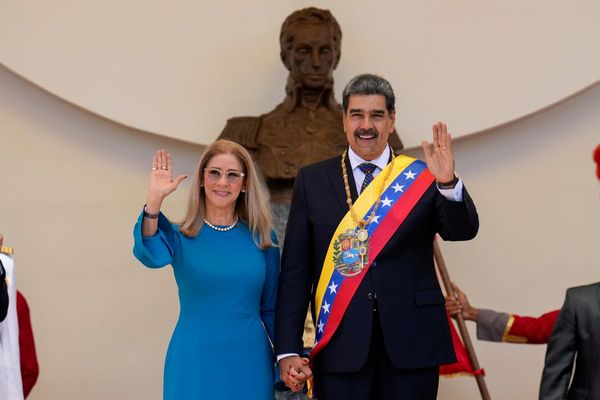

“This is just like the Capitol in The Hunger Games!” a dolled up teen girl beside me remarks, a little too gleefully. As we take our seats at the packed TikTok Entertainment Centre in Sydney with the 8,000 other attendees, all dressed in gowns with professionally done make up, I can’t help but silently agree. It is not until the show starts that I fully grasp how correct she is. The TikTok Awards is an event ripped straight from Black Mirror.
Now in its third year, the TikTok Awards is the internet’s night of nights, bringing together the most popular content creators on the app. The most successful TikTokkers appeal to viewers by being relatable; exploiting their normal-ness by making interesting content based on their day to day. This means, despite all the fanfare of a Hollywood-style ceremony, there are no actual famous people nominated for the TikTok Awards. Every attendee is a niche internet microcelebrity, identifiable only by the video content they went viral for — like “guy who does the splits in high heels”, or “girl with extremely bushy eyebrows”, or “sustainable mum who makes air fryer snacks from her kids’ leftover dinner scraps”. No matter the age, everyone there has a strong “kids playing dress up” vibe — even if the actual guy who does the GlamBOT for the Golden Globes is there (which he was).
If you’re wondering what an awards show looks like in the age of short form content, it is this: the red carpet starts at 3pm and the awards go from 6pm to 8pm. In contrast to TV and Film awards shows that have free flowing alcohol and late night partying, everyone at this event goes home to bed early. Presumably so they can put on ten layers of face masks and mouth tape before getting up early the next day to film their morning shred. Unlike other awards ceremonies I have been to, you have to pay for food and drinks.

This year, there were 14 categories, ranging from Food, Fashion and Entertainment to more philanthropic and educational (Learn on TikTok and TikTok for Good). The awards themselves began with the “Nothing beats a Jet2 holiday!” TikTok sound, as the host Sophie Monk, dressed as a flight attendant, welcomed us to the show. Despite its origins in advertising, The Jet2 Holiday sound opens the show because it has become viral TikTok audio, used ironically to underscore things going wrong. In this new context, it is not used for ad purposes — it is a global meme.
Here in the theatre with Sophie Monk and her cast of dancing flight attendants, the tone for the show was set: the lines of marketing and content are blurred.
The TikTok Awards is essentially a big ad for itself. TikTok is a lottery which you can win by going viral. The tickets are videos that you create yourself. The payment is the time dedicated to making and uploading each video. The more you pay, the higher chance you have of winning.
The first winner for the night was Leah Halton, or @looooooooch — a cute girl of indiscriminate age (anywhere between 12 and 24 years old). She looks disturbingly like an AI generated girl come to life. Looooooooch won the award for the video with the highest number of views (more than 150 million views). You might wonder if the most watched video is someone doing a difficult skill, and you would be wrong. The video is just Looooooooch, doing… basically nothing. I guess it works for some people.
(Also, every nominee’s username was a weird sound, like “loooooch” or “ulaulaulaula” or “sophadopha”. Every time a new name was announced, it was hard to tell if they were announcing a human being or a piece of Ikea furniture.)
As the night wore on, each subsequent winner felt like I was watching The Las Culturista’s Culture Awards (a fake comedy awards show created by comedians Bowen Yang and Matt Rogers, where every award is a punchline). The winner of the Learn on Tiktok Award was a nurse whose catchphrase is “Stop scrolling! It’s time to squeeze!” She led the whole audience through 30 seconds of kegel exercises. The man who won the TikTok for Good Award, who I’m convinced is secretly Andy Samberg in a wig, saved Australian wildlife. Finally, a guy called Donut Daddy, who seductively makes baked goods and fingers the pastry, won the High Quality Content Creator Award. That means he does everything I just mentioned, but films it in a studio in 4K. I don’t know who the audience is, but he has over two million instagram followers.
Despite every winner’s job description sounding like a 30 Rock joke, there was something incredibly wholesome about everyone. Their pre-made video packages were crafted to pull on your heart strings. Two winners were fathers who made sweet content with their kids. The live musical act consisted of a boy and his mother who went viral for singing together in their kitchen and when they sang an Abba duet live onstage, everyone cried.
Every speech was overly emotional and tread similar territory: “I was no one, with nothing, until I uploaded my video to TikTok. Then I found my community, and my life changed forever.” Some people had been uploading consistently since 2020 but only recently amassed a big following. The first time I heard the story, it was sweet. By the tenth time, it sort of felt like we were in a cult.
The message was always the same: “If your first video doesn’t go viral, upload one every day for several years, and eventually you’ll become a star.” One winner said that her friends and family were worried about her, because she was so obsessed with making tiktok content. But it was all worth it, because now she had won. Every creator thanked the audience by saying, “Without you, this wouldn’t be possible.”
It felt like by simply watching their videos, we had all contributed to changing their lives. Though the reality is we probably consumed their content by scrolling mindlessly before bed. Somehow, we had caused these people to become incredibly successful and they were grateful to us. But at the same time, we could be them if we followed their path. It felt like we were in a content-fuelled Mega Church.
If I had to guess, I’d say at least 20 per cent of the audience consumed the whole awards show with a phone directly in front of their face, live-streaming the whole event (which TikTok’s main account was already doing). A guy near me was live-streaming on his front camera, so people could watch his face reacting to the event. His behaviour confused me, until the winner of Best Live TikTok Creator said, “Go live! It changed my life!” This guy was just following her advice.
Though sentimentality was at an all time high, there was something offputting and impersonal about the whole thing. The crowd did not really connect to anyone on stage. It was easy to get them to invest in an emotional story assisted by a video — but jokes told by humans on stage mostly fell flat. This wasn’t helped by the fact Sophie Monk was reading what seemed to be a script written by Chat GPT. The only joke she seemed to make was a reference to “67”, which everybody cringed at. You’d think after Sophie’s 67 joke tanked, that all the millennials afterwards would take the hint, but literally every presenter over the age of 35 made a 67 joke, each less successful than the last. The only exception was Blake Pavey, who was a real highlight of the night, probably because he told actual jokes that he wrote by himself.
During the show there was no acknowledgement of anything bad going on in the world. There was no mention of war, or Palestine, or certain presidents, or billionaires. It was as if this new Utopian society was full of guys who made food for their girlfriends, cute young girls, dads who loved their family, oiled up buff guys sensually massaging dough, and everything was run on hopes and dreams.
As I sat in the theatre watching Keli Holiday perform the final dance number, thinking about the smoke and mirrors of it all — I squealed with glee when I noticed Anthony Wiggle playing the bagpipes in a sequinned blue skivvy. Next to him Abbie Chatfield danced around playing the congos. I got out my phone and immediately filmed the moment.
I knew it was hokey, but I just couldn’t look away. And maybe that’s the problem. Even though we try, we just can’t stop watching.
Lead photo: Supplied / TikTok.
Nina Oyama is a writer, comedian and actor.
The post ‘It’s Just Like The Hunger Games’: What The TikTok Awards Are Like In Person appeared first on PEDESTRIAN.TV .