President Donald Trump again criticized Iranian leadership as negotiations to reach a ceasefire continue to be stalled, saying he could escalate hostilities if a deal is not reached by the November midterms.
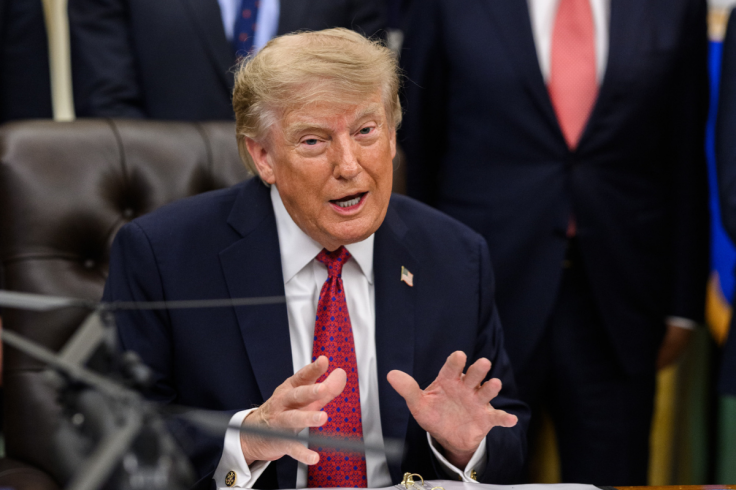
In a wide-ranging interview with TIME Magazine, Trump said the U.S. "created peace in the world" by "annihilating Iran."

"With Iran, I don't think you could ever have peace," Trump added. He went on to recall that the Tehran regime killed "75,000 people in the last number of months" to quash protests.
"It's unbelievable. It's a bloodbath. So we'll see. And the reason people don't rise up, because they're afraid of being killed. You know, they go out in the street and they end up killing 1,000 people, 2,000," Trump said.
The interview was published around the same time Axios reported that Secretary of State Marco Rubio ordered the Iranian delegation to the UN to leave the U.S. after failing to make progress in negotiations.
"Secretary Rubio kicked out the Iranian delegation who had overstayed their welcome. The UN General Assembly was over, so it was time for them to go," a U.S. official told the outlet.
The outlet went on to note that there seemed to be progress on Monday morning, but by the afternoon that notion had evaporated. Hours later, Rubio ordered the Iranian delegation to leave the country, something that happened in the early hours of Tuesday. Another source told the outlet that the delegation was scheduled to leave anyway.
Iranian media reported on Wednesday that Araghchi presented the U.S.'s counterproposal for a seven day ceasefire to President Masoud Pezeshkian. While Tehran has not announced its response, the United Kingdom Maritime Trade Operations Centre (UKMTO) noted that three tankers were hit in the key waterway around that time.
Another report detailed that efforts by Qatari mediators have not yielded much progress as neither side is willing to make significant concessions.
Despite the ongoing hostilities, crude oil is once again moving through the Strait of Hormuz at rates approaching prewar levels.
Ship-tracking data shows a significant recovery in crude flows through Hormuz. According to The Washington Post, Kpler estimated that nearly 12.5 million barrels per day moved through the strait during the week ending September 27, about 1 million barrels below its prewar baseline. Windward, another ship-tracking platform, put the figure closer to 10 million barrels per day.
However, that rebound is not delivering the sharp drop in oil, gasoline, and diesel prices consumers might expect. The reason is that months of disruptions have created shortages that cannot be erased simply by restoring crude shipments.
Most of the crude still being blocked is believed to be Iranian, as the United States seeks to limit Tehran's oil revenue and its ability to finance military operations. Non-Iranian shipments, meanwhile, continue to fluctuate sharply, with some September days seeing only a few million barrels pass through the strait. Maintaining higher flows also depends on expensive U.S. military protection and shipping workarounds that could quickly be disrupted by renewed Iranian attacks.