
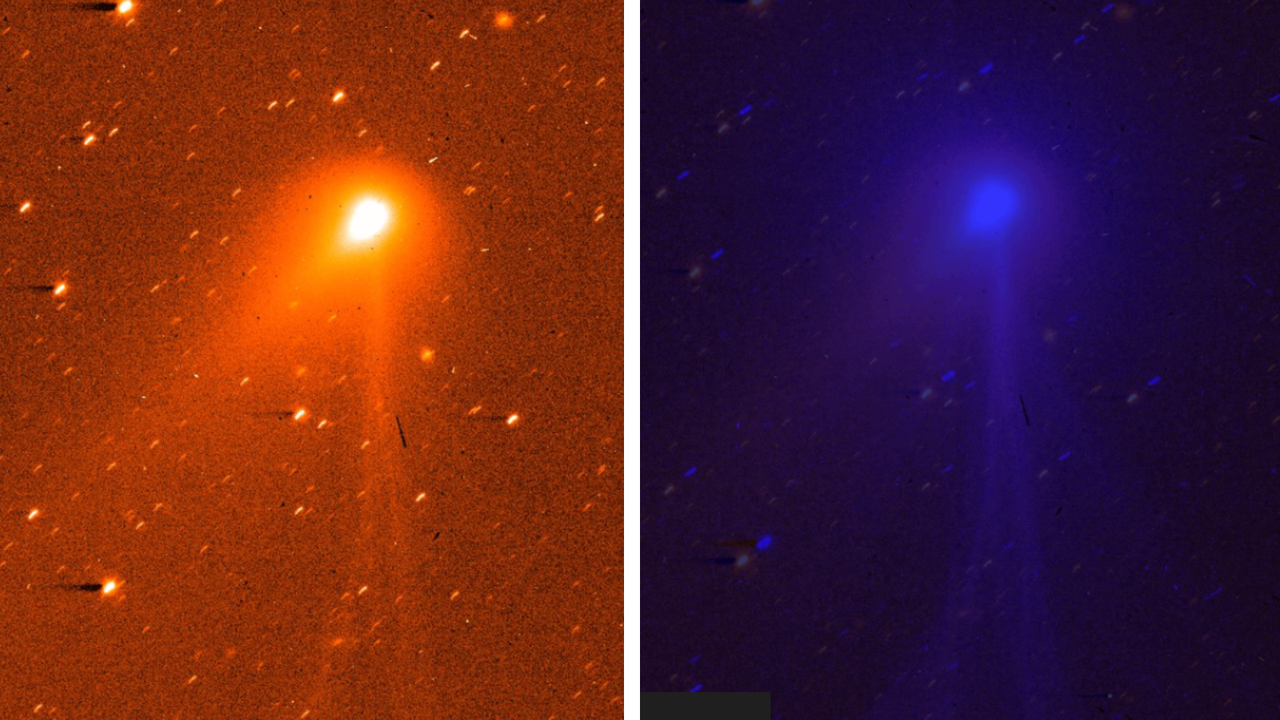
The interstellar invader comet 3I/ATLAS is spraying enough water into space to fill 70 Olympic swimming pools each day. The discovery gives scientists a remarkable opportunity to study the elements present during the formation of planets around other stars, potentially much older than the sun.
The discovery was made by the European Space Agency (ESA) mission Jupiter Icy Moons Explorer (Juice), which is currently heading towards Jupiter and its icy moons. JUICE observed 3I/ATLAS, which is just the third object found passing through the solar system from beyond its boundaries, in November, 2025, using its MAJIS (Moons And Jupiter Imaging Spectrometer) and JANUS (Jovis, Amorum ac Natorum Undique Scrutator) instruments.
Like comets native to the solar system, 3I/ATLAS began expelling material when it passed close to the sun, with solar radiation heating its icy heart, causing solid ice to transform immediately into gas, a process called sublimation. As this gas makes its explosive escape, it forms the coma and tail that are characteristic of comets. This is accompanied by a brightening of the comet, but 3I/ATLAS brightened even more than expected.