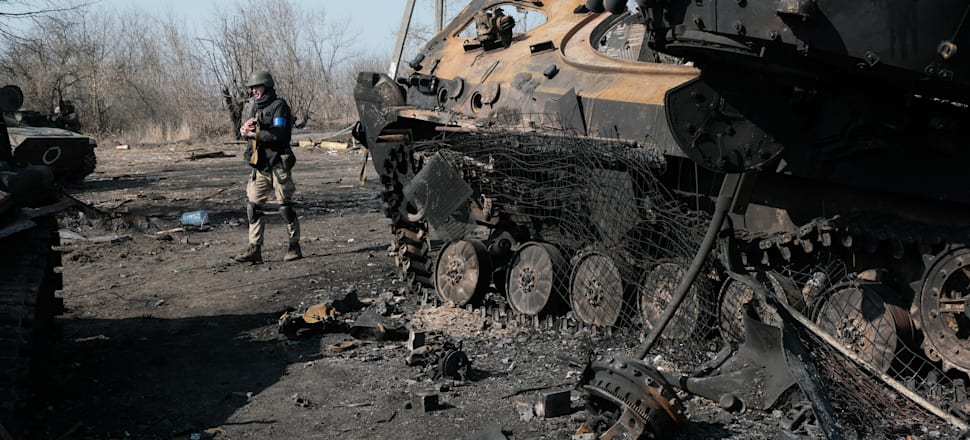
As the world marks the first anniversary of Russia's invasion of Ukraine, a panel of experts has looked at the major issues raised by Vladimir Putin's war and what the future may bring
The "war of intense and grinding attrition" between Russia and Ukraine may drag on for some time with neither side able to land a knockout blow or willing to compromise, a former New Zealand diplomat has cautioned.
Countries around the globe are holding events and vigils to mark the first anniversary of Vladimir Putin's "special operation" into Ukraine, which has since turned into a bloody and prolonged conflict.
READ MORE: * NZ's nightmare scenario in Ukraine war * Lessons from Ukraine the West should learn
A panel convened by Victoria University of Wellington's Centre for Strategic Studies earlier this week looked at how the war had played out and its ramifications for the rest of the world.
Retired Kiwi diplomat Ian Hill, whose 42-year career involved three stints in Moscow (two as ambassador), said the invasion had not been the “slam dunk” anticipated by Putin, instead turning into “a war of intense and grinding attrition”.
Hill said Putin had long been obsessed with Ukraine, refusing to accept the country’s distinct sovereignty and national identity while holding a sense of resentment over its loss following the breakup of the Soviet Union.
Geopolitical considerations were also at play, with Moscow trying to resist the eastward expansion of Nato while restoring Russia’s strategic depth and sphere of influence.
“As in the past, Russia’s leaders view the world through a lens of suspicion, insecurity, and threats…
“The Kremlin has cultivated a siege mentality at home, and a narrative of grievance prevails. The sense of victimhood he's developed has allowed Putin to frame the Ukraine war as a war of necessity, not a choice.”
'Entirely counterproductive for Russia on every count'
However, Hill said the war had been “entirely counterproductive for Russia on every count”, permanently estranging Ukrainians from Russia in addition to promoting greater European and Western unity.
It would be difficult for either side to deliver a knockout blow in the conflict, and neither appeared ready or willing to compromise in potential peace talks.
Ukraine’s goals had expanded beyond survival to the recovery of its full territorial integrity and sovereignty, while Putin would at a minimum want to maintain control of the four eastern Ukrainian provinces that Russia had illegally annexed last year.
Hill said it was possible that Ukraine’s Western allies would encourage it to be more pragmatic and accept an imperfect outcome, given the United States and Europe did not want to become involved in an outright war with Russia.
Such a ceasefire could be more in Moscow’s interests than those of Kyiv, given it could allow Russian authorities to consolidate their control over annexed provinces and leave Ukraine “divided and dysfunctional”.
“If I had five cents for every time I heard [comments] about [New Zealand] being in line with partners, I’d have a good deposit on a Magnum ice cream…probably more than that.” - Robert Ayson, Victoria University of Wellington
Speaking about New Zealand’s response to the war, Victoria University of Wellington strategic studies professor Robert Ayson said the country had found its way into a select group of nations taking the strongest action against Russia.
Of the approximately 45 countries to have imposed sanctions over the war, 37 were from Europe, putting New Zealand in the company of just seven others outside of the region (the US, UK, Canada, Australia, Japan, South Korea, and Singapore).
In addition to the principled reasons for such action, significant public pressure within Aotearoa had played a role, along with the growing desire for the country not to fall out of step with its like-minded partners.
“If I had five cents for every time I heard [comments] about being in line with partners, I’d have a good deposit on a Magnum ice cream … probably more than that.”
Dr Marnie Lloydd, an international law specialist at Victoria University of Wellington, said Russia’s aggression against Ukraine had struck against the heart of the international legal system, which was based around the concept of sovereign states.
“Aggression is sometimes known as the supreme crime: to my way of thinking, it colours all the other international legal issues.”
Lloyd said it was clear that war crimes had been committed in Ukraine, while crimes against humanity were also likely to have occurred.
Difficulties in prosecuting Russian leadership
While much of the past two decades had been spent dealing with civil wars, which have a more limited number of protocols, an international armed conflict had over 600 articles in the Geneva Conventions that needed to be followed.
It was also much harder to comply with rules of humanitarian law during a conflict in a crowded urban setting, given the risks to civilians even when both sides were trying to avoid harm.
Lloyd said the International Criminal Court had jurisdiction to prosecute a number of different breaches of international law in the context of Ukraine, including war crimes, crimes against humanity, and genocide.
However, the crime of aggression was currently off limits, as it was not in the original statutes agreed for the International Criminal Court and the UN Security Council would not provide jurisdiction to prosecute given Russia’s veto powers.
Some had been calling for a separate, ad hoc court to try the crime of aggression, potentially established through the UN General Assembly rather than the Security Council.
Even if that came to pass, there would be huge practical challenges in taking a prosecution, given international tribunals usually required a defendant to be present and the highest levels of Russian leadership would need to be prosecuted.