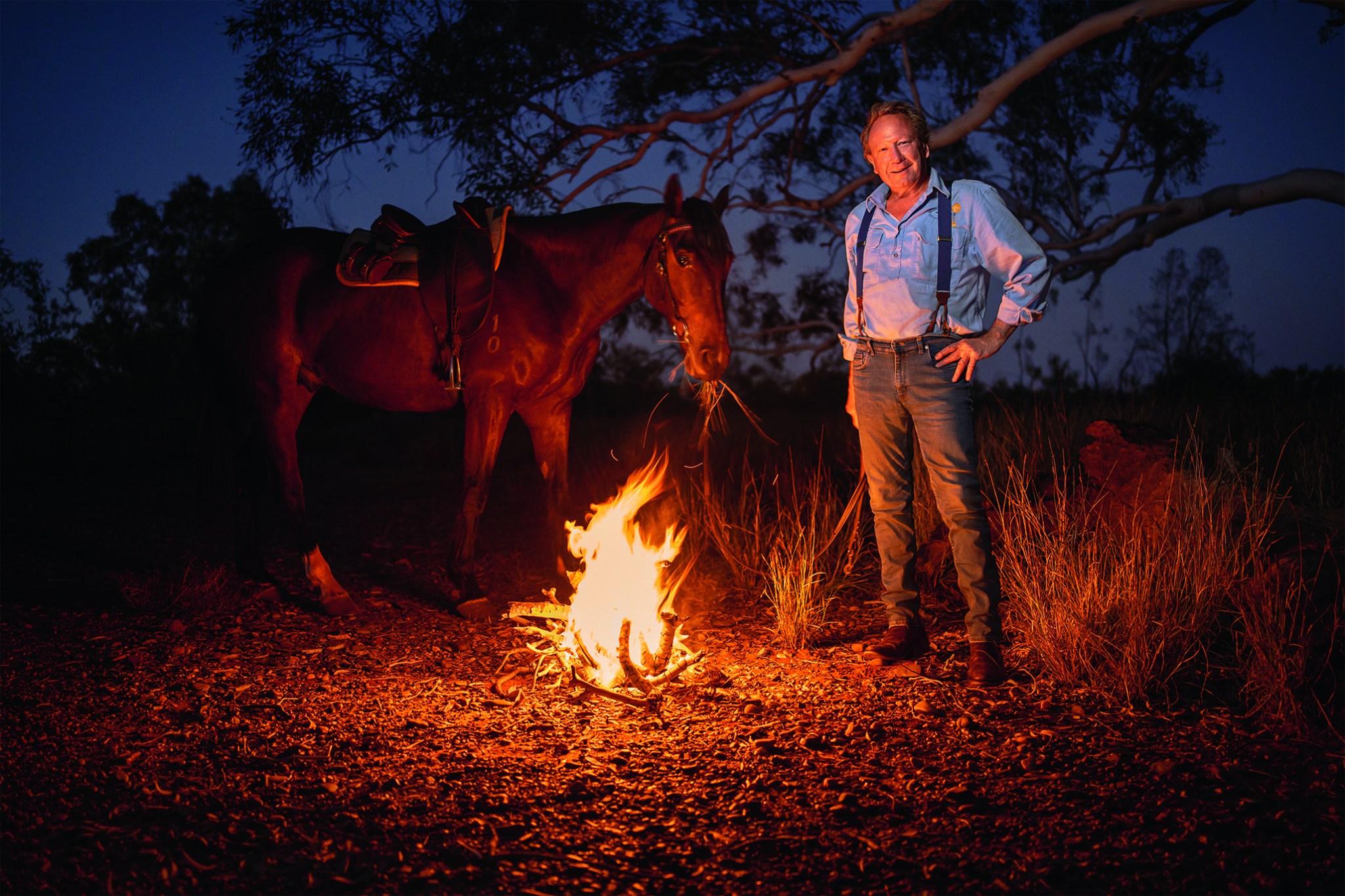
By Andrew Forrest’s account, the childhood bullying he suffered at the hands of bigger kids explains a lot about how his life has turned out. Growing up on a remote cattle ranch in Western Australia, “I was a very skinny kid. I got the nickname ‘Twiggy,’ ” Forrest says in a hotel in London. “I used to have to stand up to bullies.”
Forrest never stopped fighting powerful forces. Now 64, the executive chairman of $17 billion iron ore giant Fortescue is intent on upturning age-old practices in the heavily polluting $3 trillion mining industry. He’s waged a five-year legal fight against Meta over deepfake ads that used his image to promote a crypto scam and other sham investments on Facebook. When Russia invaded its far smaller neighbor in February 2022, igniting Europe’s deadliest war in generations, he was galvanized. He has worn Ukraine’s flag pin ever since, and he’s plowing tens of millions of dollars into supporting Ukraine through years of war. Nor did he hold back when the White House slammed one of his impassioned environmental speeches last January as “vague, radical left-wing climate goals.” Forrest’s response: “I am entitled to say whatever I damn well wish.”
So he has. In the process, Twiggy Forrest, as many Australians call him, has gained notoriety far beyond his native country—no small feat for a kid from the outback. His 36.7% stake in Fortescue, which he founded in 2003, has made him one of the 10 richest people in Australia, worth an estimated $11.35 billion.
Maybe more impressive, Forrest’s reputation is growing not because of his astronomical riches but rather his audacious—some say fantastical—ambition to transform Fortescue’s mines, which produce nearly 222 million tons of iron ore a year, by virtually eliminating the use of fossil fuels and setting a lightning-fast 2030 deadline to do so.
It’s a high-stakes gambit. If Forrest pulls off his green strategy, he could cement his role as a trailblazer in an epoch-defining issue, distinguishing his company from the two biggest mining titans, BHP and Rio Tinto—both more than a century older than Fortescue, and both of which have reined in their climate targets in recent years. What’s more, Forrest’s determination comes as many global corporations have backed away from their “net-zero” goals, limiting their ambitions amid hostility to the issue from the Trump administration.
Forrest, who calls his plan “Real Zero,” dismisses many businesses’ green strategies as smoke-and-mirror schemes that rely on offsets and avoid tackling the full extent of climate change. He is shooting for much more significant results, he says.
If he falls short, it could well confirm other companies’ claims that going green and being profitable are simply not compatible. If Forrest succeeds, however, his experiment could ripple across other industries. He, for one, is convinced he will prove his point in the end. “If we could stand up removing all fossil fuels, and if we could do that and maintain our position, then that becomes the hallmark,” he says. “Everything else is going to be easier than mining. Everyone else has no excuse.”
Forrest’s business career
Forrest’s business career has been a wild ride. He was a Harley-Davidson-riding stockbroker in Sydney in the 1980s, and in 1995 founded the mining company Anaconda Nickel before being pushed out of the job in 2002 amid financial strains on the business.
That barely slowed him down. Forrest founded Fortescue in 2003, determined to break BHP and Rio Tinto’s grip on iron ore. His timing was flawless: He launched the company just as China was scrambling for iron ore to construct the skyscrapers, cars, factories, and machines that would make up the world’s biggest building boom. Investors poured in, even before Fortescue had shipped a single ton. After borrowing heavily in the 2010s to build its port and rail networks, Fortescue rode the commodity upswing. In August, it reported a 9% increase in revenues for the year ending in July. (Its earnings are still less than a third of BHP’s and Rio Tinto’s.)
During Fortescue’s early years, the environmental toll of gouging metals from the earth was all but an afterthought. Forrest says he was pushed into thinking about climate change in the 2010s by his daughter Sophia, who was anxious about the planet’s future. He opted for a two-pronged approach: Having Fortescue drastically cut its oil and gas use on the mines and research how to generate green hydrogen, a renewable fuel that (unlike blue hydrogen) doesn’t rely on burning fossil fuels. In his mind, Fortescue needed a loftier goal than capturing carbon—an idea pushed by Big Oil as a way to cut their emissions but that Forrest dismisses as a feel-good notion cooked up by “super lazy politicians.” Instead, “we said, ‘Let’s see if we can invent another fuel, made from green energy sources,’ ” he recalls.
Then came the biggest crisis of Forrest’s life. In 2015, he fell into a gorge while hiking in Western Australia, breaking his right leg so severely he wasn’t sure he would walk again. Confined to a wheelchair for months, he began studying climate change’s threat to ocean life. “I came out of that and thought, ‘Whoa, this is serious,’ ” he says. “We started saying, ‘How can we make an example out of ourselves?’ No point in preaching to anyone else if we can’t do it ourselves.” He announced Fortescue’s transformation plan in 2022.
A green revolution in the Pilbara
The harsh, remote, red-earth terrain in Western Australia known as the Pilbara is not an obvious place to launch a green revolution. Barely 65,000 people live in the vast, bone-dry region about the size of Spain. Temperatures regularly hit 130 degrees Fahrenheit. Tropical cyclones whip through the area. Aboriginal groups have pushed back against firms operating there. The Yindjibarndi have accused Fortescue of exploiting their land and damaging cultural sites. (Fortescue says it has awarded $362.7 million in contracts to the group’s businesses since 2011.)
But the Pilbara holds the world’s biggest reserves of iron ore—with 60% purity—the essential ingredient for making steel, and hence, for building much of our modern lives. Rio Tinto, BHP, and Fortescue all operate mammoth facilities in these parts. Fortescue’s mines sit nearly 1,000 miles from its Perth base.
Going green in this terrain will require Fortescue to invest about $6.2 billion by 2030, much of it in building new solar and wind plants and battery storage facilities.
Fortescue claims it will save $1 billion in diesel costs a year beginning in 2030—about one-quarter of its operating expenses—in part by overhauling its trucks fleet. In a deal worth billions of dollars, Fortescue ordered up to 400 264-ton battery-powered monster-size haul trucks, made in the U.S. and China, with tires that stand 12 feet tall. The first is scheduled to arrive this year; by 2028 the vehicles will replace all of its diesel trucks. Fortescue also aims to use electricity entirely from wind and solar by 2030, all controlled through an AI system operated from Perth.
From the start, Forrest has had to prove to shareholders that his climate strategy would boost business—not just be good for the planet. “The trick was, if we couldn’t do it and do it cheaper than burning fossil fuels, then it was philanthropy,” he says. In that case, “no one follows.”
Not all investors are convinced. In July, Goldman Sachs downgraded Fortescue, which trades on the Australian Securities Exchange, from neutral to sell. Its mining analyst Paul Young warned investors that Forrest’s “significant investment” in eliminating fossil fuels “[has] yet to generate returns.” In late July, Fortescue told investors China had cut back on its iron ore purchases, hurting revenues.
Forrest’s green hydrogen ambitions have faced setbacks, too. Last year, Fortescue scrapped plans to build a $550 million green hydrogen plant in Arizona after the Trump administration ended federal subsidies.
“If we could stand up removing all fossil fuels … and maintain our position, then that becomes the hallmark.”
—Andrew Forrest, executive chairman, Fortescue
And consultancy Mandala Partners estimates that Fortescue’s own carbon emissions shot up 24% between 2020 and 2025, which the company says is a temporary surge, the result of opening its Iron Bridge mine in the Pilbara in 2023.
Forrest still believes his plan will work. “Our carbon emissions are growing while we’re building out these massive green systems. They will suddenly drop,” he says. “You have big, big machines, off the grid, away from electricity, so you’ve got to make all your own power, with whatever you’ve got.” And green hydrogen fuel, he argues, will ultimately be a boon for the company.
For the ever-restless founder, the quest for Real Zero has allowed him to broaden his own involvement in the energy industry. “We are now speaking to energy consumers around the world about how to send their companies green; how to run their countries green,” he says.
Observers are split on the prospects for Forrest’s strategy. “They are doing a really good job in producing an ambitious, transparent, and accountable climate transition plan,” says Ben Caldecott, director of Oxford University’s Sustainable Finance Group, who was paid by Fortescue to conduct peer reviews of its green plan. “There’s no attempt to obfuscate what’s going on by buying carbon offsets,” he says. “They are very focused on reducing and eliminating emissions at source.” In the corporate world, he notes, “that is very unusual.”
Business journalist Joe Aston disagrees. In the Australian Financial Review in June, he accused Forrest of portraying himself as a “green messiah” while accepting hundreds of millions of dollars a year in tax rebates on the diesel the company consumes, which is allowable under Australia’s tax system. “Nothing precludes the miner from refusing it,” he wrote.
Fortescue characterizes Aston’s stance as a minority opinion. Forrest, for his part, has campaigned publicly against the diesel credits. “This policy belongs to another era,” he wrote in Fortescue’s annual report in August.
Forrest’s Ukraine commitment
Forrest is also fighting battles far from home—in Ukraine. Immediately after Russia’s invasion in 2022, Forrest canceled plans for Fortescue to produce green hydrogen in Russia, telling Bloomberg that any business done there was “blood money.” In response, Russia banned him indefinitely from visiting the country, a move Forrest says he wears “as a badge of honor.” His Minderoo Foundation—named for the cattle ranch of his childhood—has since given about $28 million to Ukraine’s schools and agricultural projects, and to clearing land mines. Ukraine’s ambassador to Australia and New Zealand has said this help “will make a tangible difference where it’s needed most.” Forrest also hopes to raise $500 million to help rebuild the country once active fighting stops, still a sliver of the $577 billion the World Bank estimates will be needed. When I ask Forrest how many times he has traveled to Kyiv during the war, he says: “I have lost count.”
Forrest is drawing on his experiences in the Pilbara to help design a new energy grid for Ukraine, which has long depended on Soviet-era oil-powered plants—easy targets for Russian missiles. “They stand up 100 meters in the air, and say, ‘Come and bomb me,’ ” Forrest notes.
Alongside Ukrainian officials, Forrest is helping roll out a “smart grid” of small-scale power stations that use renewable energy and are less vulnerable to Russian attack; the first is set to go online this winter. Forrest sees it as an investment, similar to Fortescue’s Real Zero plan, that will pay off in time, in this case after the war, likening Ukraine’s prospects to West Germany’s economic boom after World War II. “You will see that in Ukraine, but lightning quick,” he says.
That is one grand Forrest plan that will need to wait for peace—and it could take a while. His plan for Fortescue’s green iron ore mines in the outback, meanwhile, is on a breakneck schedule. Much is riding on both outcomes.
This article appears in the October/November 2026 issue of Fortune with the headline “A mining billionaire’s dark-horse bets.”