
‘We really enjoy parameters,’ say interior designers Nicole Salvesen and Mary Graham. Given the very compressed time frame of this home’s renovation, that’s thankfully no bad thing.
The London townhouse they’re referring to underwent an imaginative decorative overhaul in a blink-and-you-miss-it span of just two months. With its considered blend of heritage floral prints, patterned fabrics and papers, rich yet mellow color combinations, and thoughtfully curated art, the renovation result feels much more like a family home that has evolved over a generation or two.

‘We’re used to spending a couple of years on a project,’ says Mary, ‘and to be honest, being able to turn this around so succinctly was also a lesson for us in what’s possible if everyone – including the homeowners – pulls together in a shared vision.’
The family in question – a Californian couple, plus their three children under 10 – were more than up for the challenge. Spirited and adventurous, they decided to relocate to London in order to broaden their children’s horizons. Passionate collectors, they were also keen to immerse themselves in London’s art scene.
‘This was a serious move for them,’ says Nicole. ‘It was about buying a home and decorating it as a place of inspiration, refuge, and playfulness, full of pieces that felt meaningful, including the art, mementos, and paraphernalia of family life they brought with them.’

To that end, the renovation focused on creating warmth and hospitality through richly layered schemes, cocooning hues, and a furniture configuration that best suited hectic family life within the tall, narrow layout of a Victorian house. It helps that Mary and Nicole, who set up their firm Salvesen Graham in 2013, are known for interiors that balance heritage appeal with playfulness. It’s a combination that has seen their once modest London studio grow to almost cult status thanks to its unique take on quintessential British style.

‘What’s interesting is the two-way dialogue between British and American design that we’ve been lucky enough to explore,’ says Nicole. ‘We’ve always been drawn to the American greats like Gil Schafer and Steven Gambrel because they have an architectural focus, which feels clean and crisp. And I think Americans enjoy our style because it takes all those classic English ideals of chintzes, stripes, and geometrics and layers them in unexpected ways.’

That said, the pair admit that even they were pushed out of their comfort zone at times, citing the blend of teal, aubergine, and olive in the main bedroom that they might not have chosen if not for the owners’ enthusiasm. ‘But the result is surprisingly soothing,’ says Mary. ‘It’s a reminder that color on color and pattern on pattern can be easier for the eye to absorb than just one pattern on a stark canvas, which often feels more jarring.’
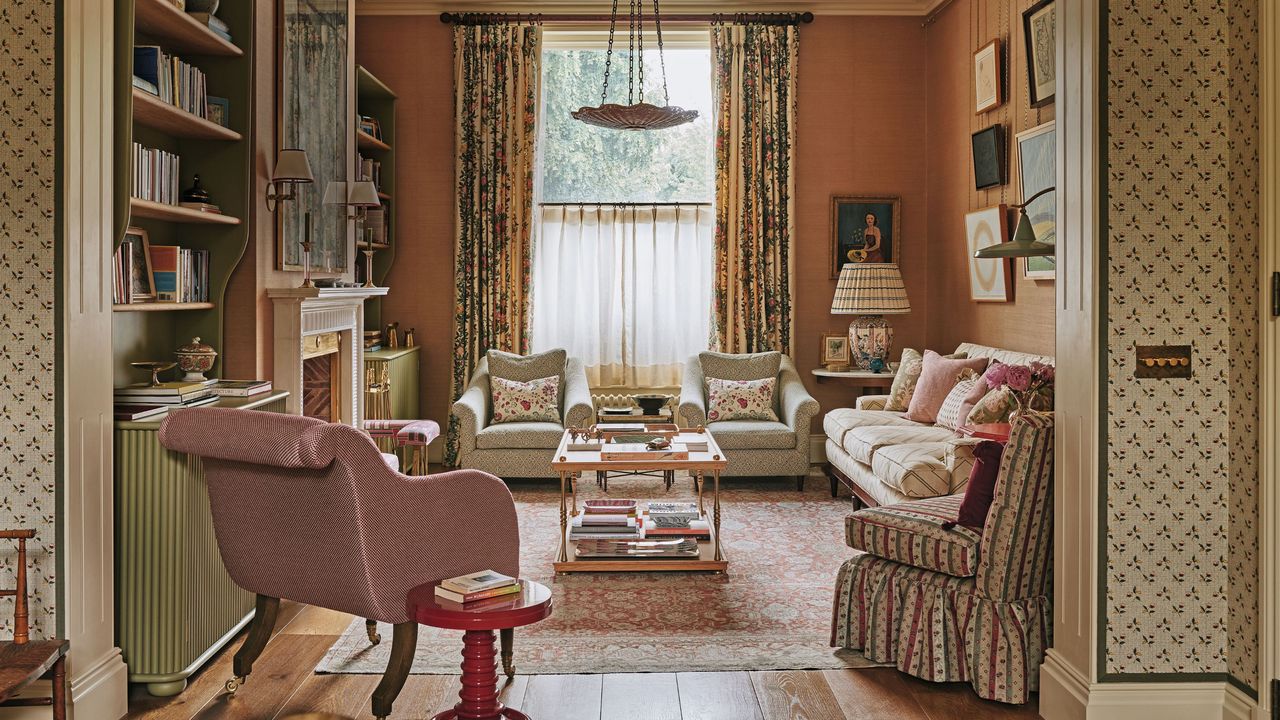
Though no structural work was done, the pair managed a hat trick of replacing floors and the kitchen, plus reinstating cornicing and paneling, all within eight weeks. In the kitchen, a striped banquette and checked chairs complement large-scale floral curtains offset by cabinetry in a warm, brown-toned pink. Those glowing, muted hues are repeated on the ground floor via the tobacco-colored walls of the living room and the soft green florals of the adjoining space.

Florals are a key motif, whether winding their way up the walls of the powder room or adorning the TV room in a striking large format. But the effect feels grounding rather than overly whimsical because, say Mary and Nicole, there are ‘some subtle, masculine undertones, from the Anglepoise lighting in the kitchen to examples of moody photographic art.’
Another key choice was the use of freestanding furniture, from the bookshelves in the rear reading room to the elegant fluted units on either side of the sitting room fireplace, modeled on those by Alfred Newall in Nicole’s own home. ‘We wanted to design pieces that the family can pick up and take with them, should they move,’ says Mary.

That the result of this renovation has produced such lived-in appeal is, suggests the pair, largely down to the trust of its owners. ‘What’s lovely is that it feels very ‘them,’ but also very ‘us,’’ say the designers. ‘We were given a lot of freedom, and the result is something that feels both grown-up and fun – just as much a coming of age for us as for the building itself.’

5 Rules for Confident Pattern Mixing
Mary and Nicole on how to combine motifs successfully
1. Use a variety of different scales. Pair a large-scale floral with a fine ticking stripe, for example. A small pattern can make a larger one feel even more special.
2. Using different types of patterns will help achieve a more layered look. Try stripes to take the edge off florals, ikats for international influence, and flamestitch for a sense of heritage.
3. Color can be a useful unifying tool. Stay within a considered palette – perhaps shades drawn from one key fabric – so the room feels cohesive even when motifs vary. Finally, add in solids to tie the scheme together.
4. Always throw in something that feels a bit ‘odd’ and not a perfect match.
5. Be confident – more tends to be more when it comes to pattern. We often begin with one standout fabric or wallpaper – something that feels joyful and timeless, letting everything else take its cue from it.
For more inspiring house tours, you can sign up for our newsletter so you never miss the latest features.