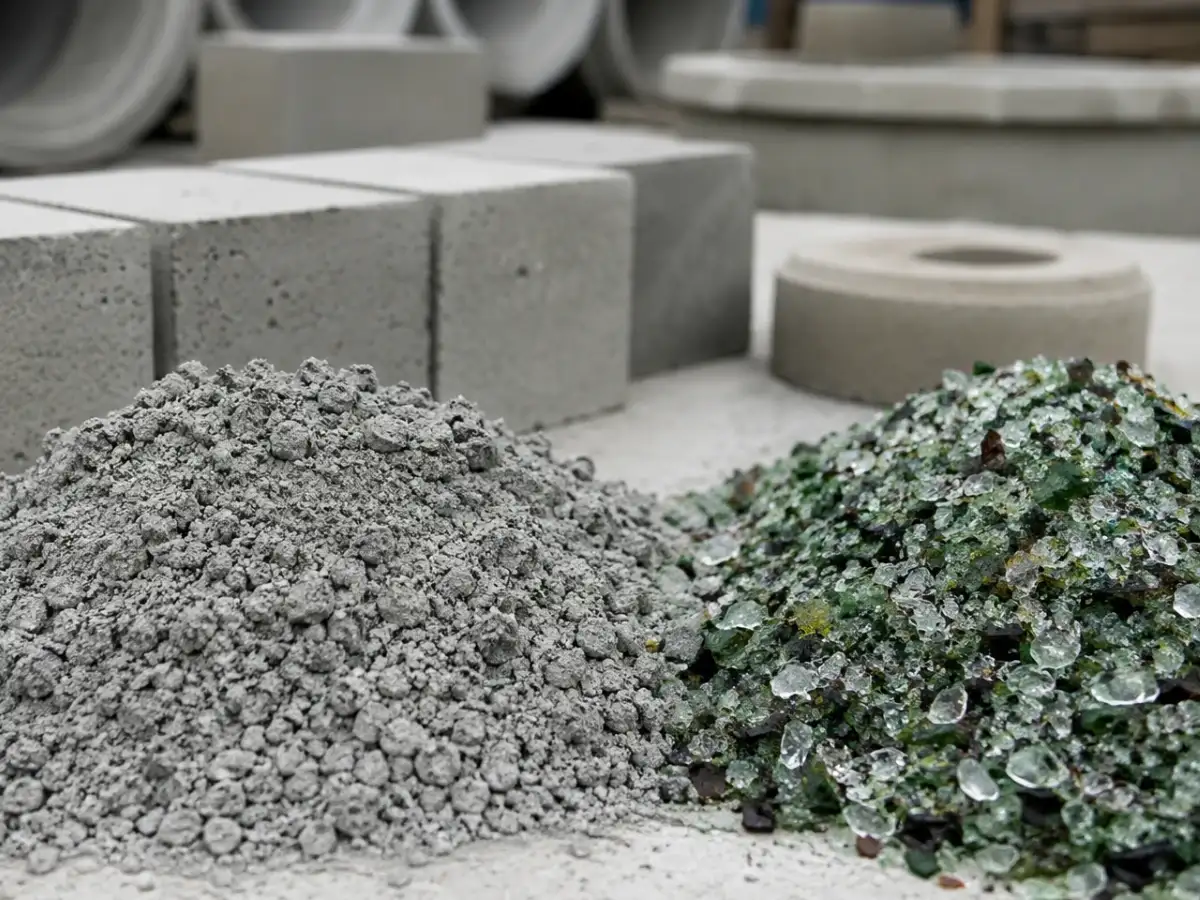
Every time you toss an empty jam jar or a cracked drinking glass into the recycling bin, you probably assume it will be melted down into another bottle. But glass can also have a second life in concrete, including pavement and building foundations. A team at Deakin University in Australia tested what happens when waste glass is crushed into fine particles and mixed into concrete instead of sand. The research explored whether recycled glass could partially replace fine aggregate without reducing concrete strength, while also providing another use for waste glass.
A stronger mix than expected

Researchers M. Adaway and Y. Wang detailed their findings in the Electronic Journal of Structural Engineering. They trialled several replacement levels, swapping out 15%, 20%, 25%, 30% and 40% of the fine sand with crushed glass before measuring the concrete’s compressive strength. Strength increased as the proportion of glass rose, reaching its highest relative performance at the 30% replacement level. According to the paper, the 30% glass mix was nine per cent stronger than the conventional mix after seven days of curing and six per cent stronger after 28 days. At the 40% replacement level, the improvement was no longer maintained, suggesting that 30% was the most favourable replacement level among those tested.
The researchers linked the performance of the crushed glass partly to its physical characteristics. Unlike naturally occurring sand grains, which can have relatively smooth and rounded surfaces, crushed glass particles have sharper, more angular edges. These characteristics can affect how the aggregate interacts with the surrounding cement paste and may help improve the bond within the hardened concrete.