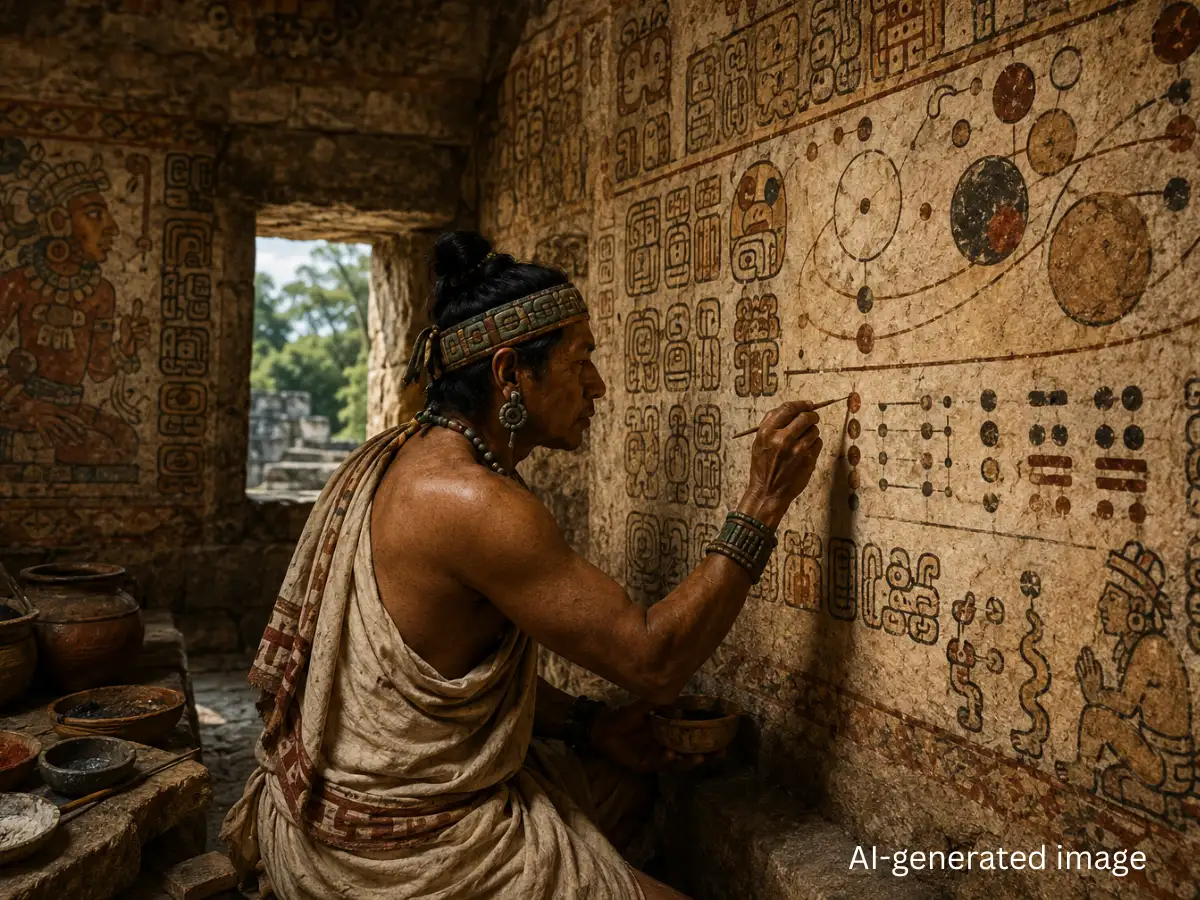
Archaeologists have identified Sak Tahn Waax, meaning "White-Chested Fox," as the author of a mathematical formula painted on the walls of an ancient Maya room in AD 781, making him the earliest known mathematician-astronomer from the ancient Americas whose work can be directly linked to his name.
The inscription, discovered in Structure 10K-2 at the ancient Maya city of Xultun in present-day Guatemala, combines calculations tracking the movements of Venus and Mars with multiple Maya calendar cycles. According to a study published in Antiquity , the final glyphs include a phrase meaning "so says," followed by Sak Tahn Waax's name, identifying him as the author or authority behind the mathematical formula.