Get all your news in one place.
100's of premium titles.
One app.
Start reading
The Economic Times
The Economic Times
Shreya Biswas and ET Science Desk

In 500 BCE, ancient people created vast animal and geometric figures in Peru's desert. 2,500 years later, the Nazca Lines remain one of archaeology's great enigmas

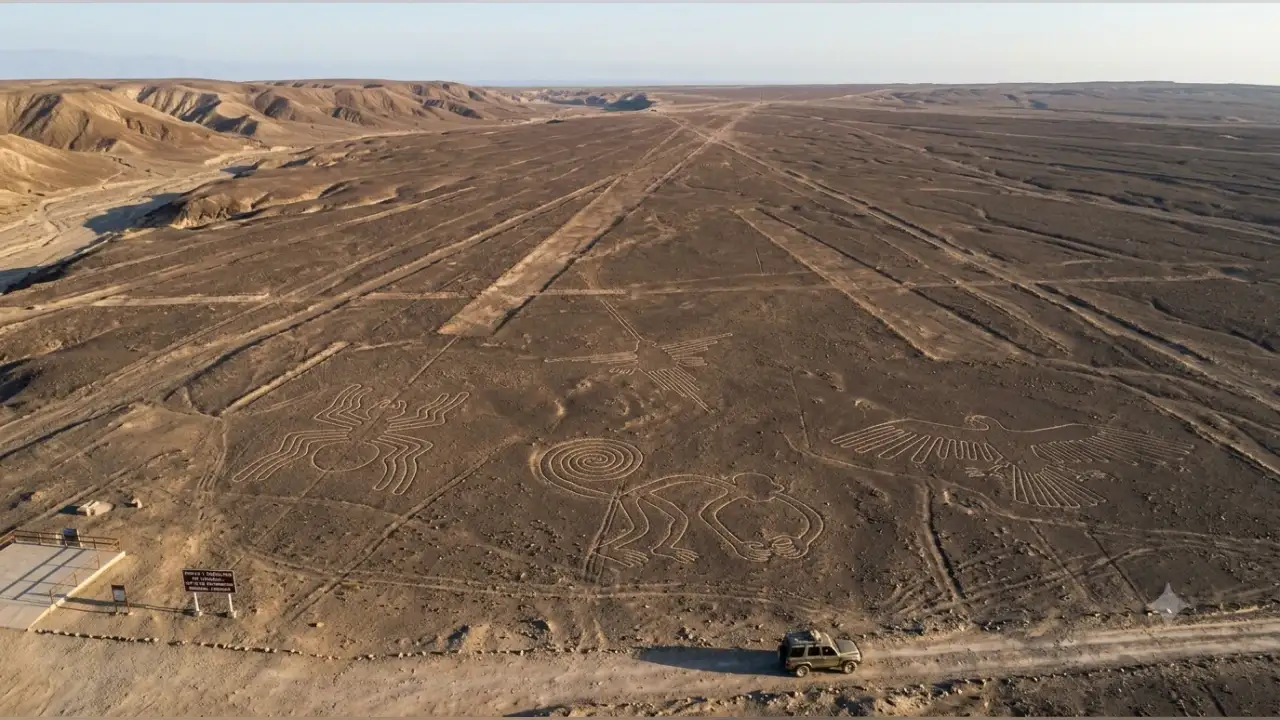
Nazca Lines archaeological mystery : Across the arid coastal plain of Peru, an extraordinary collection of lines and giant figures has survived for more than two millennia. Known as the Lines and Geoglyphs of Nasca and Palpa, the site covers about 450 square kilometers and is located around 400 kilometers south of Lima. UNESCO describes the site as one of archaeology’s greatest enigmas because of the quantity, nature, size and continuity of its geoglyphs.

Nazca Lines Were Created Between 500 B.C. And A.D. 500

The lines were scratched on the surface of the ground between 500 B.C. and A.D. 500. The geoglyphs include representations of living creatures, stylized plants and imaginary beings, as well as geometric figures that extend for several kilometers.

UNESCO's detailed description places the Lines and Geoglyphs of Nasca and Pampas de Jumana in the desert plains of the Rio Grande de Nasca basin. It describes thousands of large-scale zoomorphic and anthropomorphic figures and lines or sweeps created on the arid ground by the region's ancient inhabitants.

READ ALSO: In 2018, CRF measured coral restoration's economic ripple across Florida Keys for 5 years. 7 years later, researchers found up to 144% local economic contribution per dollar spent

Ancient Figures Show Animals, Plants And Imaginary Beings

UNESCO divides the geoglyphs into two categories. The first is representational and includes animals, birds, insects and other living creatures, along with flowers, plants, trees, fantastic figures and objects of everyday life. UNESCO notes that there are very few anthropomorphic figures.

The second category consists of lines. These are generally straight and cross parts of the pampas in different directions. Some are several kilometers long and form geometric designs including triangles, spirals, rectangles and wavy lines. Other lines radiate from a central promontory or encircle one, while another group consists of so-called “tracks,” which appear to have been laid out to accommodate large numbers of people.

What Were The Nazca Lines Used For

UNESCO says the lines are believed to have had ritual astronomical functions. The organization also describes the geoglyphs as an extraordinary example of the traditional and millenary magical-religious world of the ancient pre-Hispanic societies that flourished on Peru's south coast.

UNESCO says the geoglyphs represent a remarkable manifestation of a common religion and social homogeneity that lasted for a considerable period. Their concentration, juxtaposition and cultural continuity indicate that the activity was important and long-lasting.

READ ALSO: In 1921, Alaskan seamstress Ada Blackjack joined an Arctic expedition for $50 a month; nearly two years later, she was rescued as its only surviving person

Why The Nazca Lines Have Survived For So Long

The system of lines and geoglyphs has survived intact for more than two millennia. UNESCO says the site's extreme aridity and very low rainfall have favored the preservation of the lines and geoglyphs.

The geoglyphs were formed by removing the weathered gravel covering the ground to reveal the lighter bedrock underneath. UNESCO says their creation, design, morphology, size and variety correspond to the original designs produced during the region's historic evolution.

Nazca Lines Became A UNESCO World Heritage Site In 1994

The Lines and Geoglyphs of Nasca and Palpa were inscribed on the UNESCO World Heritage List in 1994. UNESCO recognizes them as a unique artistic achievement of Andean culture and an exceptional testimony to the culture and magical-religious traditions and beliefs of pre-Columbian societies in South America.

UNESCO describes the Lines and Geoglyphs of Nasca and Palpa as one of archaeology's greatest enigmas because of their quantity, nature, size and continuity.

READ ALSO: Wisdom of the day by Arthur Conan Doyle: 'To the man who loves art for its own sake, it is...' -inspiring life lessons on art, beauty and how the smallest things can bring the most joy

Sign up to read this article
Read news from 100's of titles, curated specifically for you.
Already a member? Sign in here
Related Stories
Top stories on inkl right now
One subscription that gives you access to news from hundreds of sites
Already a member? Sign in here
Our Picks
Fourteen days free
Download the app
One app. One membership.
100+ trusted global sources.