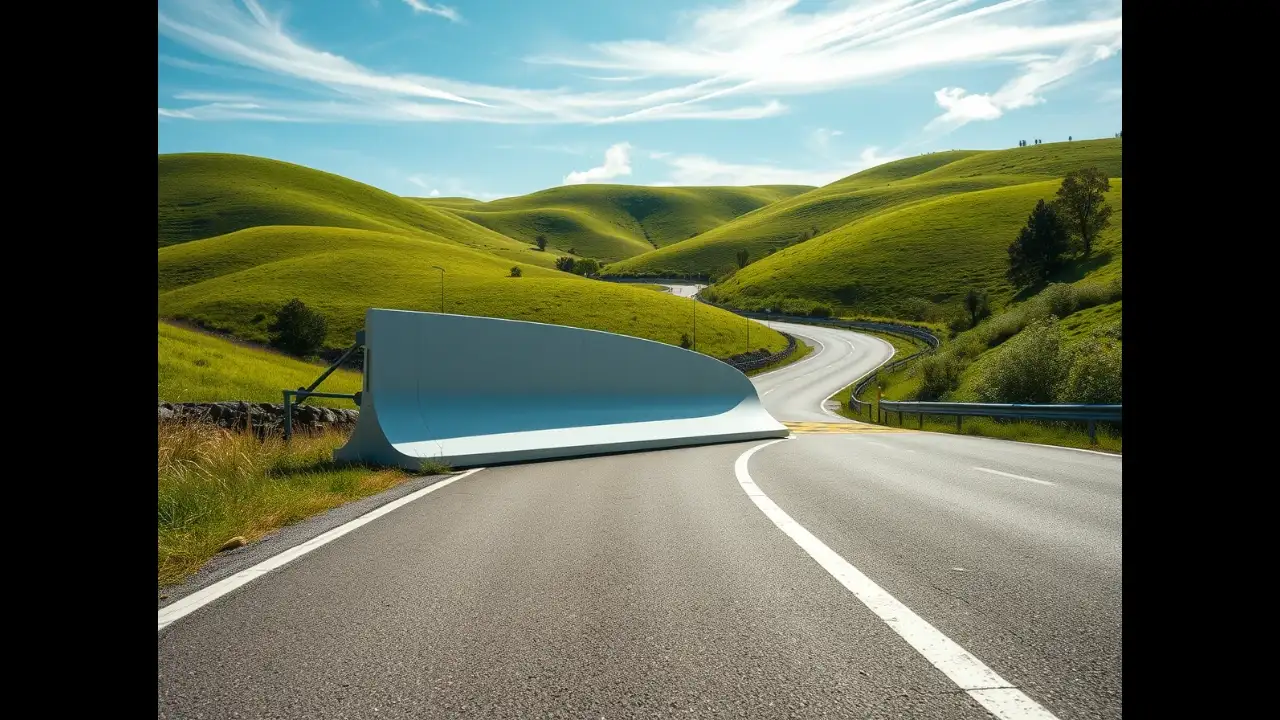
In 2025, the Netherlands turned a difficult renewable-energy waste problem into an unexpected infrastructure experiment when retired wind-turbine blades were transformed into a 60-metre highway noise barrier. Unveiled on July 2, 2025, along the A58 motorway near Oirschot, the Blade Barrier became a Dutch world first: a highway sound barrier made from discarded wind-turbine blades. Six months later, initial acoustic measurements produced an encouraging result. According to Rijkswaterstaat, the Dutch government agency responsible for the country’s roads and waterways, the experimental structure achieved noise-reduction performance comparable to that of a conventional concrete noise barrier. The project is significant because it connects two sustainability challenges—end-of-life wind-turbine blades and the environmental impact of highway infrastructure—within one circular-economy solution.
The Blade Barrier is located at InnovA58, an infrastructure testing ground operated by Rijkswaterstaat, where new approaches to sustainable road construction can be evaluated under practical conditions. The pilot structure stretches 60 metres and varies between roughly 3 and 4 metres in height. Rather than manufacturing an entirely new wall from concrete, steel and other conventional construction materials, the project uses two complete turbine blades together with a sawn blade section. Earlier project information described the two full blades as approximately 37.2 metres long, overlapping toward their tips to create the distinctive structure. The blades rest partly on an earth embankment and require substantially less foundation work than a conventional noise screen, creating another potential environmental advantage beyond simply reusing an otherwise difficult waste material.