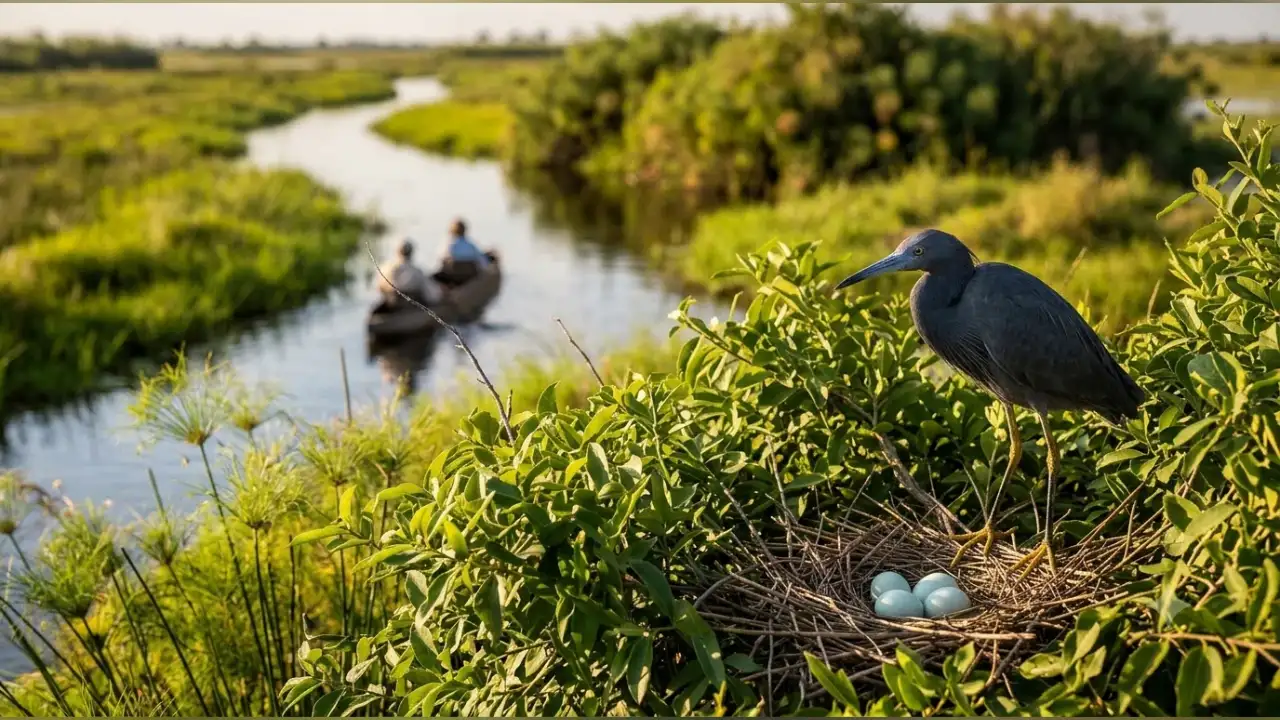
Slaty Egret Okavango Delta : The Slaty Egret is a rare waterbird, with most of its estimated population living in Botswana's Okavango Delta. But researchers are watching the species for a reason that goes beyond its rarity.
The bird is considered an important indicator species for the Delta. Changes in its distribution and presence can provide clues about habitat changes, potential pollution and other conditions affecting the wider ecosystem.

In 2024, Botswana's Department of Wildlife and National Parks worked with BirdLife Botswana and other partners to establish the National Slaty Egret Working Group. The group was created to support ongoing monitoring and conservation of the species.
Two years later, researchers searching deep inside the Delta made an encouraging discovery: three bluish Slaty Egret eggs hidden among vegetation on a small island.
Why the Slaty Egret matters to the Okavango Delta
The Okavango Delta is one of the world's few major inland deltas. Its waters never reach a sea or ocean. Instead, they either soak into the soft sands of the Kalahari Desert or cycle back into the atmosphere.
The Delta's annual flood flows down between June and August after rains in Angola's highlands. For the Slaty Egret, the arrival of the flood in August signals that it is time to breed. This also makes the period important for researchers and conservationists monitoring the bird's behaviour and population trends.
The Slaty Egret is sensitive to environmental disturbances and changes in the ecosystem. Researchers track its distribution and presence because changes in those patterns can provide clues about the wider condition of the Delta.
An estimated 3,000 to 5,000 Slaty Egrets remain, with most of them living in the Delta. The species is currently classified as vulnerable on the IUCN Red List, although its classification is being debated, as per an UNEP report.
Slaty Egret surveys reveal changes in Okavango Delta breeding sites
The latest monitoring has not produced an entirely positive picture.
At the previous year's main breeding site in the western Okavango Delta, researchers found no Slaty Egrets nesting and very few sightings of the birds.
In Jao Conservancy, two of four former nesting sites had also disappeared. One was lost to fire, while another was damaged after elephants used the area to cool off in the water following a summer heatwave.
The Delta is also under pressure from climate change, which is resulting in more erratic rainfall, as well as agriculture, livestock and other human activities. These pressures affect the habitat on which the Slaty Egret depends.