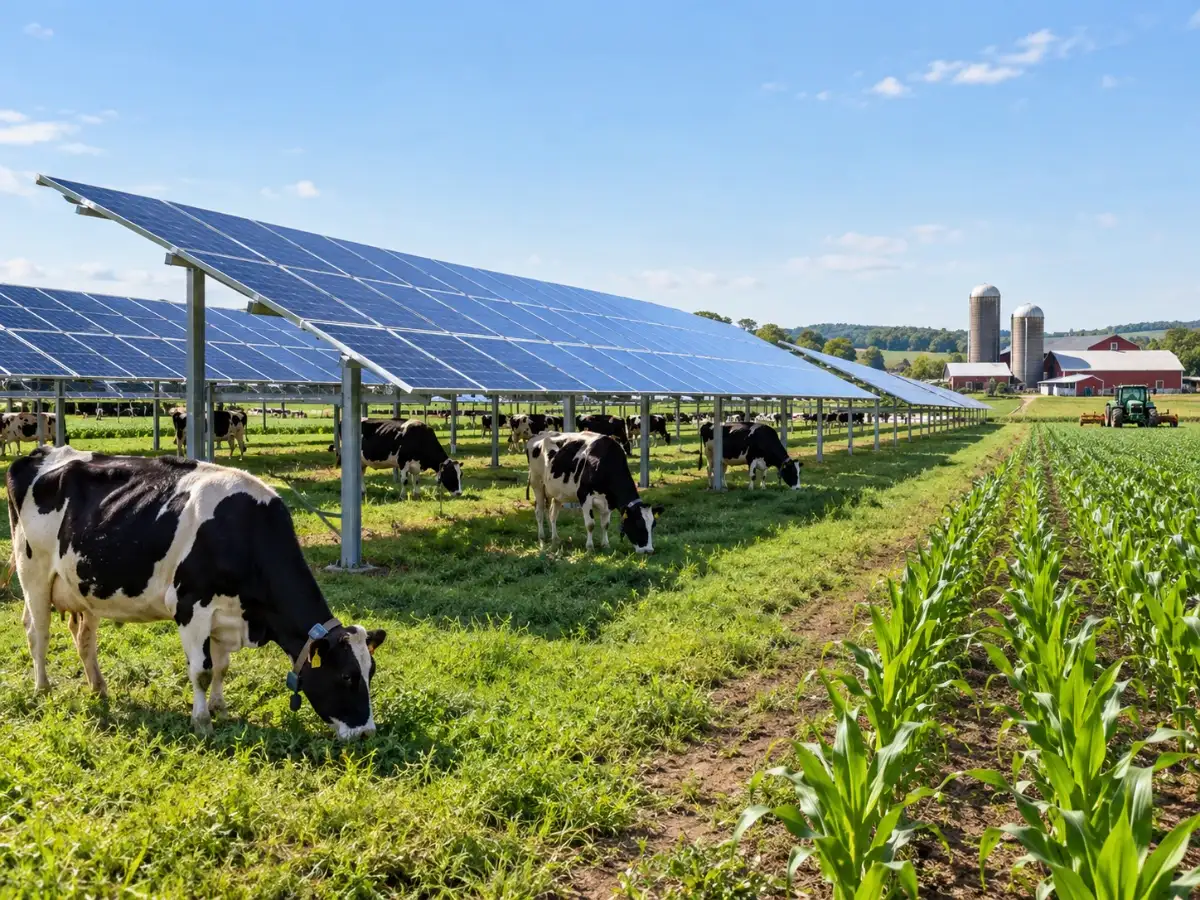
For a dairy farmer in northern New York, earning steady income from solar panels came with one condition: the land had to stay productive. Leasing fields for a conventional solar installation could provide financial security, but it also risked displacing the hay, corn and livestock operations that supported the farm. Rather than choose between agriculture and renewable energy, the farmer worked with a solar developer to design a project around his existing business.
According to Cornell University’s College of Agriculture and Life Sciences, a solar project in New Bremen, New York, was designed to generate 6.5 megawatts of electricity while allowing the farmer to continue working his fields. The project, reported in August 2024, used wider spacing between solar panels to accommodate tractors and agricultural machinery. The farmer received lease income and harvested about 85% of his normal hay yield from the first cutting that year, an early example of how solar generation and food production can share farmland.