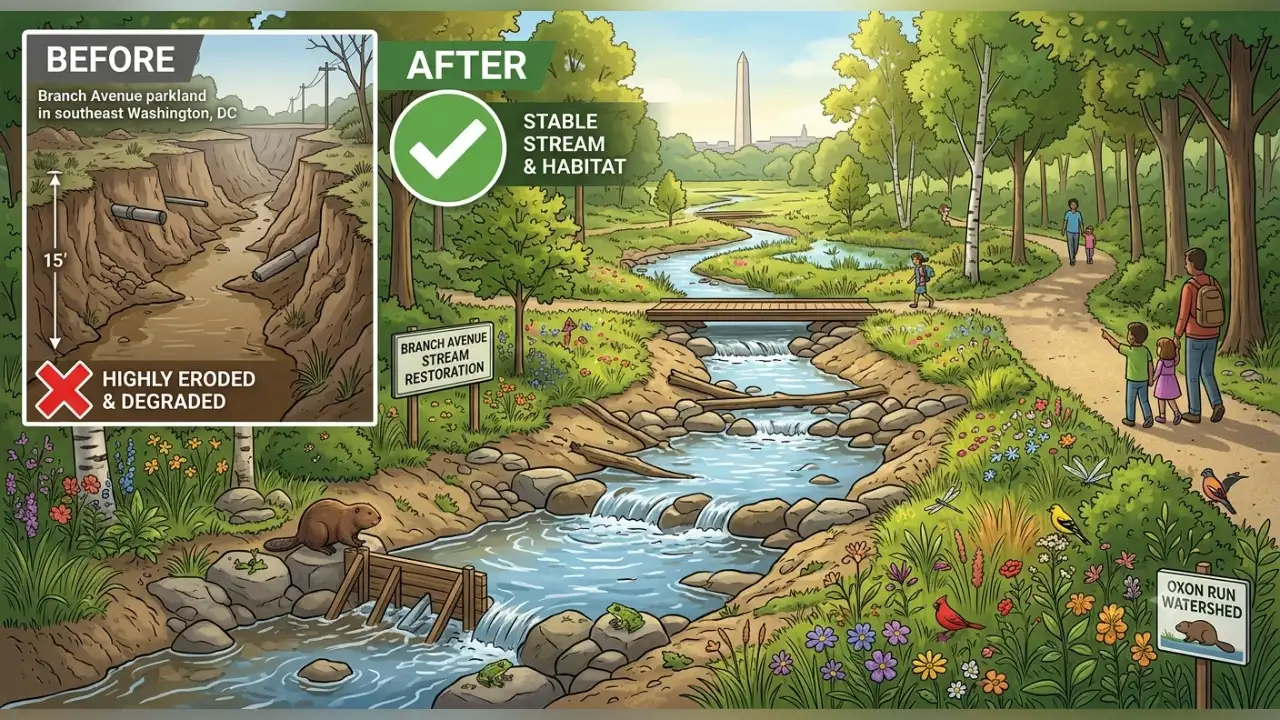
A heavily eroded section of previously inaccessible parkland in southeast Washington, DC, has been transformed through a stream restoration project that improved habitat and addressed long-standing erosion and stormwater problems.
The Branch Avenue stream restoration project, located in the Hillcrest neighborhood near the intersection of Branch Avenue and Erie Street SE, restored more than 500 feet of degraded urban stream and created a community walking trail leading to the restored area.
Years of erosion had damaged the stream
The Branch Avenue Park watershed is part of the larger Oxon Run watershed and is highly developed, with 35% impervious surfaces and slopes ranging from 6% to 10%.
Before the restoration, the streambed had eroded by more than 15 feet, while the stream banks experienced high rates of erosion.
The site also had a leaking sanitary sewer line, no accessible floodplain, a lack of riffle and pool structures, and a declining forest community affected by non-native invasive species. Visual monitoring found a complete absence of fish and macroinvertebrate populations.
A small on-site tributary fed by stormwater runoff from Erie Street SE had also developed a deep and rapidly progressing headcut.
The project reshaped the stream and surrounding landscape
The restoration raised the existing stream bed by an average of 6 to 8 feet, reducing bank heights and expanding the stream's cross-sectional area.
Parts of the stream valley bottom were expanded to provide floodplain functions and create new wetland areas. Vertical grade controls were installed to address headcutting, while lateral stormwater inflow was treated before entering the main stream.
The project restored 500 linear feet of stream channel, removed and controlled invasive species, and established native vegetation throughout the site.
A more stable stream and new wildlife habitat
Before construction, streambank erosion at the site was rated high to very high. After construction, the streambank was rated 97% stable.
The restoration created a riffle and cascade-pool stream system and a step-pool conveyance system to slow and filter stormwater from Erie Street SE before it entered the main stream.
The project also included the planting of native trees, shrubs, herbaceous plants and shallow aquatic plants.
After the project was completed, insects, birds, fish, frogs and other animals, including beavers, were anecdotally observed at the site.