Get all your news in one place.
100's of premium titles.
One app.
Start reading
The Economic Times
The Economic Times
Trending Desk

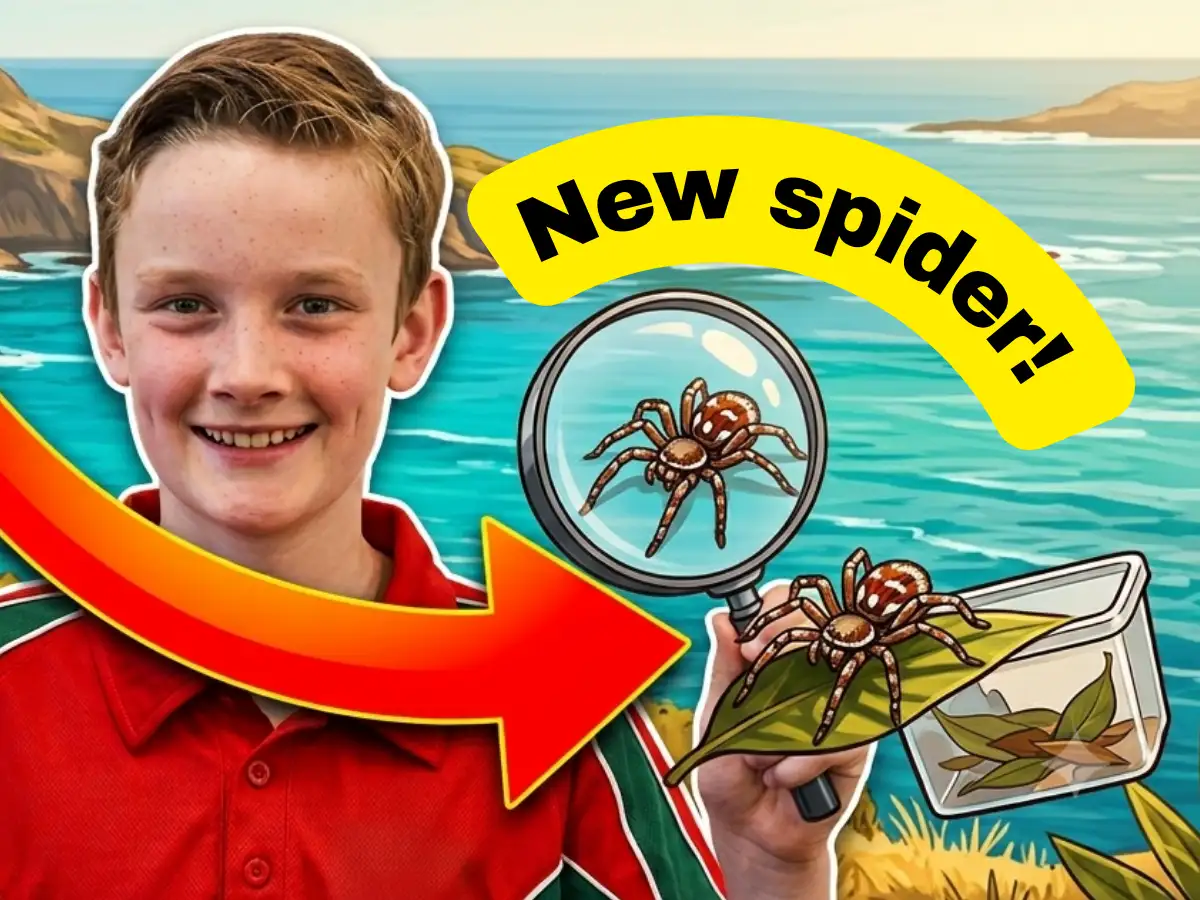
In 2020, 10-year-old Murphy picked up a tiny spider from a remote Australian island; he took it to experts, who later identified a completely new species & named it after him

Finding a spider might send many children running in the opposite direction. But when 10-year-old Murphy Widdowson came across a tiny spider on a remote Australian island in 2020, he decided to find out exactly what it was.

His curiosity eventually helped scientists identify a previously unknown species of wolf spider. The species was later named Artoriopsis murphyi in recognition of the schoolboy who brought the unusual specimen to experts.

According to a 2021 report by the Daily Mail, Murphy was staying on Deal Island, off the north-east coast of Tasmania, while his parents were working there when he came across the small spider.

Rather than simply leaving it behind, Murphy collected the specimen and contacted the Queen Victoria Museum and Art Gallery in Launceston to ask for help identifying it.

Read more - American eagle vs Canadian goose: How White House tried to portray US power over Canada, but original footage by a Goan photographer told another story

How did a 10-year-old discover a new spider species?

The spider initially proved difficult to identify. Museum arachnologist John Douglas examined Murphy's find but could not confidently match it with a known species. The specimen was subsequently sent to spider taxonomist Dr Volker Framenau in Western Australia for further examination.

After studying the spider in detail, researchers concluded that it represented a new species of wolf spider that had not previously been formally identified by science.

Read more - At just 16, he earns enough to pay his father Rs 2 lakh a month & has trained 5 lakh students: Who is this AI prodigy who has already met the UN chief?

The discovery was particularly interesting because Artoriopsis murphyi closely resembles other spiders belonging to the same genus. The differences were not obvious simply by looking at the animal.

What makes Artoriopsis murphyi different?

Scientists had to examine the spider under a microscope to identify the features that distinguished it from closely related species.

According to the Daily Mail report, one of the important differences involved the spider's reproductive structures. These characteristics helped researchers establish that Murphy's specimen was a distinct species.

The spider was subsequently given the scientific name Artoriopsis murphyi, with the species name honouring Murphy and his role in bringing it to the attention of researchers.

Where was the new spider found?

Murphy found the spider on Deal Island, a remote island off Tasmania's north-east coast.

The discovery highlights the remarkable biodiversity found across Australia, where scientists continue to identify new species. Spiders can be particularly challenging to catalogue because many closely related species look extremely similar and require detailed examination before they can be formally distinguished.

John Douglas also noted that although new species are regularly discovered, there are relatively few Australian arachnologists with the time and resources needed to formally describe them.

Murphy's spider discovery celebrated with a cake

The young discoverer's contribution was later marked with a special presentation attended by his family, teacher, museum staff and volunteers.

The celebration reportedly included a cake decorated with the spider's newly assigned scientific name, Artoriopsis murphyi.

What began as a chance encounter on a remote island had therefore turned into something much bigger: a discovery that became part of Australia's scientific record.

Is Artoriopsis murphyi dangerous to humans?

Despite its scientific significance, Artoriopsis murphyi is not considered dangerous to people.

The tiny wolf spider measures only around five millimetres. Douglas told the Daily Mail that even if the spider were to bite a person, it would be unlikely to cause any noticeable sensation if it managed to pierce the skin.

So while the discovery might sound alarming to anyone who dislikes spiders, the species is far more remarkable for what it taught scientists than for any threat it poses to humans.

Sign up to read this article
Read news from 100's of titles, curated specifically for you.
Already a member? Sign in here
Related Stories
Top stories on inkl right now
One subscription that gives you access to news from hundreds of sites
Already a member? Sign in here
Our Picks
Fourteen days free
Download the app
One app. One membership.
100+ trusted global sources.