Get all your news in one place.
100's of premium titles.
One app.
Start reading
The Economic Times
The Economic Times
Team Global

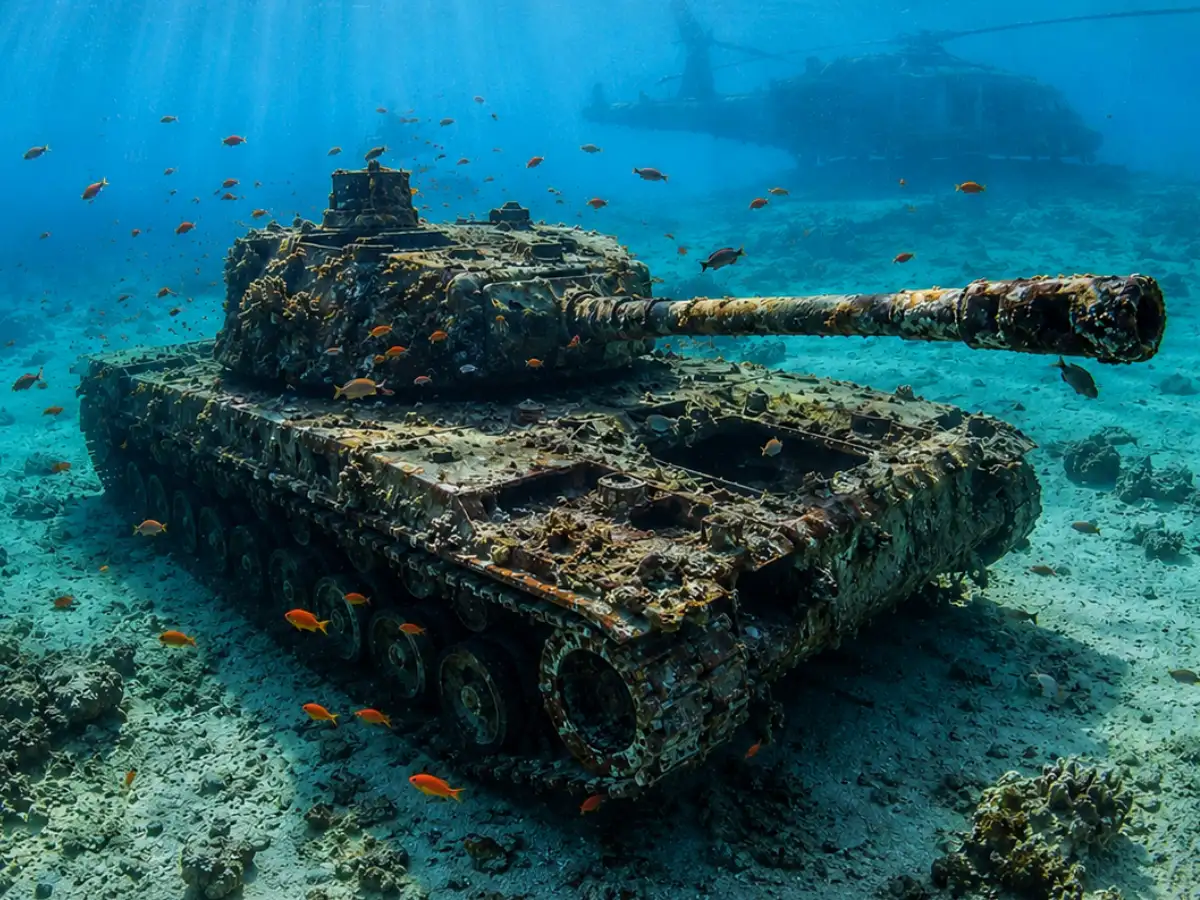
In 2019, Jordan sank 19 military machines in the Red Sea, turning retired tanks, cannons, an ambulance, and a combat helicopter into an underwater museum and artificial reef

Imagine a battle tank frozen in formation on the ocean floor, with a school of fish swimming through its open hatch. That is no movie scene. It’s real, and you can go down to see it off the coast of Aqaba, Jordan. A 2023 systematic review in PLOS ONE, 'A systematic review of artificial reefs as platforms for coral reef research and conservation,' looked at decades of projects using artificial reefs to support marine life and give divers a reason to visit the ocean without wearing down natural coral formations. One example of that idea in action is the underwater military museum in Jordan.

A tank graveyard turned tourist hotspot

On July 24, 2019, the Aqaba Special Economic Zone Authority (ASEZA) opened what it called the world’s first underwater military museum in the Red Sea, after a week of lowering decommissioned military hardware onto the seabed. At the time, CNN reported the site had 19 pieces of military machinery on display, including tanks of different sizes, an ambulance, a military crane, a personnel carrier, anti-aircraft guns, and a helicopter. Since then, more machinery has been added, and as of late 2025, there are 21 pieces in total, according to dive operators who run tours of the site.

The machines have military histories. Examples include British-made Chieftain battle tanks nicknamed Khalid Shir, an FV104 Samaritan armored ambulance, FV101 Scorpion light tanks, and an AH-1 Cobra attack helicopter, all of which previously served in the Jordanian Armed Forces. Each of the vehicles was decommissioned and stripped of its fuel and oil content to avoid any damage to the environment.

Why sink a tank in the first place?

The vehicles were not dumped at random. They were organized into battle formations at depths of up to 28 meters (about 92 feet), providing access not only to beginner snorkelers but also to experienced scuba divers. According to Jordan's official state news agency Petra, ASEZA said the project would create 'a new type of museum' combining sport, environment, and exhibits for divers, snorkelers, and visitors on glass-bottom boats.

Sign up to read this article
Read news from 100's of titles, curated specifically for you.
Already a member? Sign in here
Related Stories
Top stories on inkl right now
One subscription that gives you access to news from hundreds of sites
Already a member? Sign in here
Our Picks
Fourteen days free
Download the app
One app. One membership.
100+ trusted global sources.