Get all your news in one place.
100's of premium titles.
One app.
Start reading
The Economic Times
The Economic Times
Shreya Biswas and ET Science Desk

In 2018, CRF measured coral restoration's economic ripple across Florida Keys for 5 years. 7 years later, researchers found up to 144% local economic contribution per dollar spent

Coral restoration is usually associated with protecting reefs and marine ecosystems. But a new peer-reviewed study shows that the work can also provide immediate economic benefits to local communities.

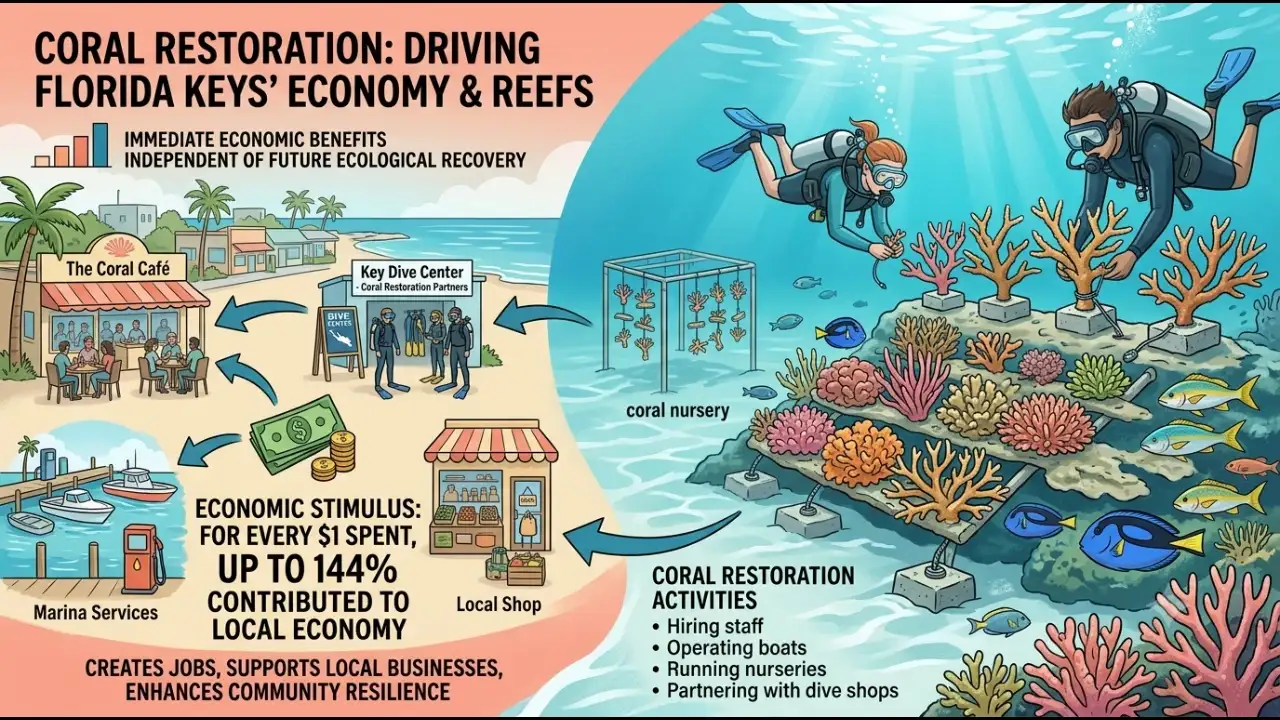
A study conducted by the Coral Restoration Foundation (CRF) and published in Restoration Ecology examined coral restoration activities in the Florida Keys between 2018 and 2022. Researchers found that for every dollar spent, restoration activities contributed between 120% and 144% to the local economy.

The paper, titled “Coral restoration as economic stimulus: a case study from the Florida Keys (United States),” was published on September 25, 2025.

Coral restoration created an economic ripple across the Florida Keys

The research was led by CRF CEO Dr. R. Scott Winters and CRF Socioeconomic Associate Madeline Rothwell.

Using economic impact modelling, the study examined how spending on coral restoration moved through the local economy. The research found that the economic benefits came from the restoration activity itself, independent of whether restored reefs deliver ecological benefits years later.

Restoration activities include hiring staff, running boats, maintaining nurseries and partnering with dive shops. The money then moves through the local economy through employee spending and further business-to-business spending.

This activity can support jobs, local businesses and community resilience.

READ ALSO: In 1921, Alaskan seamstress Ada Blackjack joined an Arctic expedition for $50 a month; nearly two years later, she was rescued as its only surviving person

Every dollar spent contributed up to 144% to the local economy

Researchers found that for every dollar spent, restoration activities contributed between 120% and 144% to the local economy.

The study also highlighted the resilience of this economic activity during the COVID-19 shutdowns in the Florida Keys, when most other industries suffered catastrophic losses.

Rothwell said, “Coral restoration isn’t just about planting corals,” adding, “It creates jobs, sustains local businesses, and keeps money flowing even in downturns. This economic resilience is a benefit that has been overlooked in policy and funding discussions,” as quoted by Coral Restoration Foundation.

The activity itself provides an immediate economic benefit

Restoration spending immediately puts money into the economy through staff, boats, nurseries, dive shops and other activities. Those funds can then ripple through the local economy through employee and business-to-business spending.

If restoration succeeds ecologically and reefs recover, the value of the reef increases. Fisheries, tourism and coastal protection can improve, while future generations can enjoy these renewed services.

The study emphasizes that both sources of benefits matter and should be considered by communities, funders and governments.

READ ALSO: Jennifer Garner joined Once Upon a Farm in 2017; 9 years later, her 7% stake was worth about $64 million after its $724 million IPO

Study highlights the importance of local goals

The researchers identified three major implications for how coral restoration should be designed, funded and evaluated.

First, local goals matter. The socioeconomic benefits of restoration can come through two pathways, which may be additive or in conflict. Because the harms caused by reef loss can differ between communities, restoration goals should be set by local communities based on their local values.

Second, beneficiaries should be clear. Economic stimulus may benefit the current community, while ecological recovery can benefit future communities. Projects should clearly identify the intended beneficiary of restoration.

Third, restoration can qualify as economic stimulus. Like road building or habitat conservation jobs programs, restoration spending should be considered when governments look at policies and actions to stimulate local economies.

Coral restoration can provide near-term benefits

Nearly one billion people globally depend on coral reefs for food, income and protection. Yet reefs face accelerating threats from climate change, pollution and overuse.

While large-scale reef recovery will ultimately require climate solutions, the study underscores that restoration projects can deliver near-term returns.

CRF hopes the findings will broaden the conversation about how and why coral restoration is funded. Governments and international development agencies that already use ecological restoration as a tool for economic stimulus may now look to coral projects as part of those strategies.

READ ALSO: Andy Warhol created digital art in 1985 and left it on obsolete floppy disks; 36 years later, 5 recovered works sold as NFTs for $3.38 million

Sign up to read this article
Read news from 100's of titles, curated specifically for you.
Already a member? Sign in here
Related Stories
Top stories on inkl right now
One subscription that gives you access to news from hundreds of sites
Already a member? Sign in here
Our Picks
Fourteen days free
Download the app
One app. One membership.
100+ trusted global sources.