Get all your news in one place.
100's of premium titles.
One app.
Start reading
The Economic Times
The Economic Times
Shreya Biswas

In 2015, a California design student launched a plantable coffee cup after raising $21,077 on Kickstarter. 11 years later, the idea still hasn’t reached shelves, but compostable coatings may finally solve its biggest problem

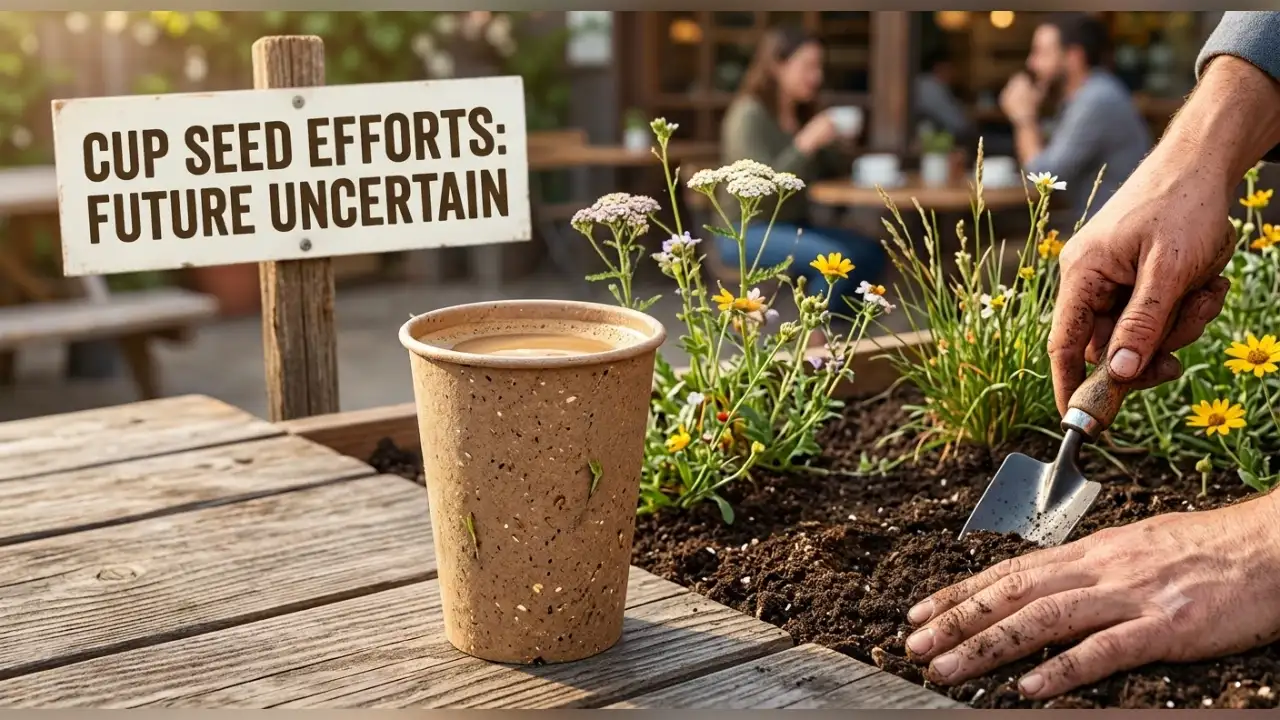
Plantable compostable coffee cup : In 2015, a California design student came up with an unusual way to rethink disposable coffee cups: make the cup itself something that could eventually grow into a plant.

The concept used biodegradable board with native seeds embedded in the material. After the coffee was finished, the cup could be pushed into soil, kept damp and left to break down as the seeds grew.

The idea attracted enough attention to raise $21,077 on Kickstarter, more than double its original $10,000 goal, as per a Foodbeast report. But turning the concept into a coffee cup that could be produced and sold proved much harder.

Eleven years later, the plantable cup still has not reached shelves. The biggest challenge has always been finding a material that can protect the cup while it holds a hot drink without preventing it from breaking down afterward.

A coffee cup has to survive what seed paper does not

Plantable seed paper is relatively straightforward. Recycled pulp is formed into sheets while seeds are pressed into the wet fibers. The material can later break down in soil, leaving the seeds behind to grow.

A coffee cup faces a much tougher test. It has to hold a near-boiling drink for about 20 minutes without becoming soft. Conventional paper cups solve that problem with a polyethylene lining, but the plastic barrier also prevents the cup from simply composting after disposal.

A plantable cup therefore needs a protective layer that can withstand the drink during use but still allow the material to decompose afterward.

READ ALSO: In 2016, Denmark opened a plant using dry separation to recycle artificial turf. 5 years later, it had processed 662 fields and recovered up to 95% of their materials

The project was designed to work beyond the customer

The student did not assume everyone who used the cup would plant it. The biodegradable cup contained native seeds, while cafes could also use a separate collection bin, as per The Pulse report. Collected cups could then be taken to restoration sites, including two national forests in California.

The business model followed the same principle: every product served was intended to result in one plant being put in at a restoration site.

That gave the project a second route for the cups after use, rather than relying entirely on customers to put them in the ground.

The Kickstarter campaign showed there was interest

The project initially sought $10,000 through Kickstarter and eventually raised $21,077 by the March deadline.

That support came against the backdrop of a much larger coffee-cup waste problem. The United States uses about 136 million paper coffee cups every day, while a peer-reviewed review estimated that less than 1% of cups are recycled worldwide, as per The Pulse report.

The cup material itself also has limits. Cup board can be pulped and reused only about three times before its fibers become too short to maintain their strength.

The project was therefore trying to rethink what happens to a product designed for a relatively short useful life.

READ ALSO: In May 2026, Hawaii wildlife crews found 10 endangered caterpillars on Lānaʻi. Weeks later, they found the same moth on Molokaʻi for the first time since the 1940s

Why the plantable cup stalled

The material challenge was only part of the problem.

A collection system works only when used cups are placed in the right bin and transported to the intended destination. A cup thrown away somewhere else never enters that system.

The seeds also introduced practical limits. They have a shelf life and require suitable growing conditions, while seeds that work in one region may not be appropriate for another.

A later project in Poland tried a different approach by placing heat-resistant seeds beneath the base of the cup. It was announced as a European first, but the effort later went quiet.

Together, those issues made the idea difficult to turn from an interesting design into a product that could be widely sold.

Compostable coatings may finally address the biggest obstacle

The material technology has since moved closer to what the original concept needed.

Water-based dispersion coatings can provide the wet strength required for paper cups while still allowing them to remain compostable. Some can break down in a backyard compost heap rather than requiring an industrial composting facility.

That could remove the biggest barrier facing the original design by allowing the cup to handle a hot drink without relying on a conventional plastic lining.

Other parts of the concept already exist separately. Seed-paper sleeves for hot cups are available because they do not have to contain the drink, while plantable paper and compostable coatings are also already possible.

What remains is combining those elements into a coffee cup that can be produced and sold at scale.

READ ALSO: In 2001, protected tropical forests entered a global wildfire study spanning 24 years. 23 years later, more than 4 million hectares had been destroyed by fire, twice the size of Wales, with annual losses roughly 9 times higher after 2016

Sign up to read this article
Read news from 100's of titles, curated specifically for you.
Already a member? Sign in here
Related Stories
Top stories on inkl right now
One subscription that gives you access to news from hundreds of sites
Already a member? Sign in here
Our Picks
Fourteen days free
Download the app
One app. One membership.
100+ trusted global sources.