Get all your news in one place.
100's of premium titles.
One app.
Start reading
The Times of India
The Times of India
World
TOI World Desk

In 2012, South Africa began airlifting black rhinos upside down from remote terrain to expand their range; the conservation program has since helped establish 17 new populations

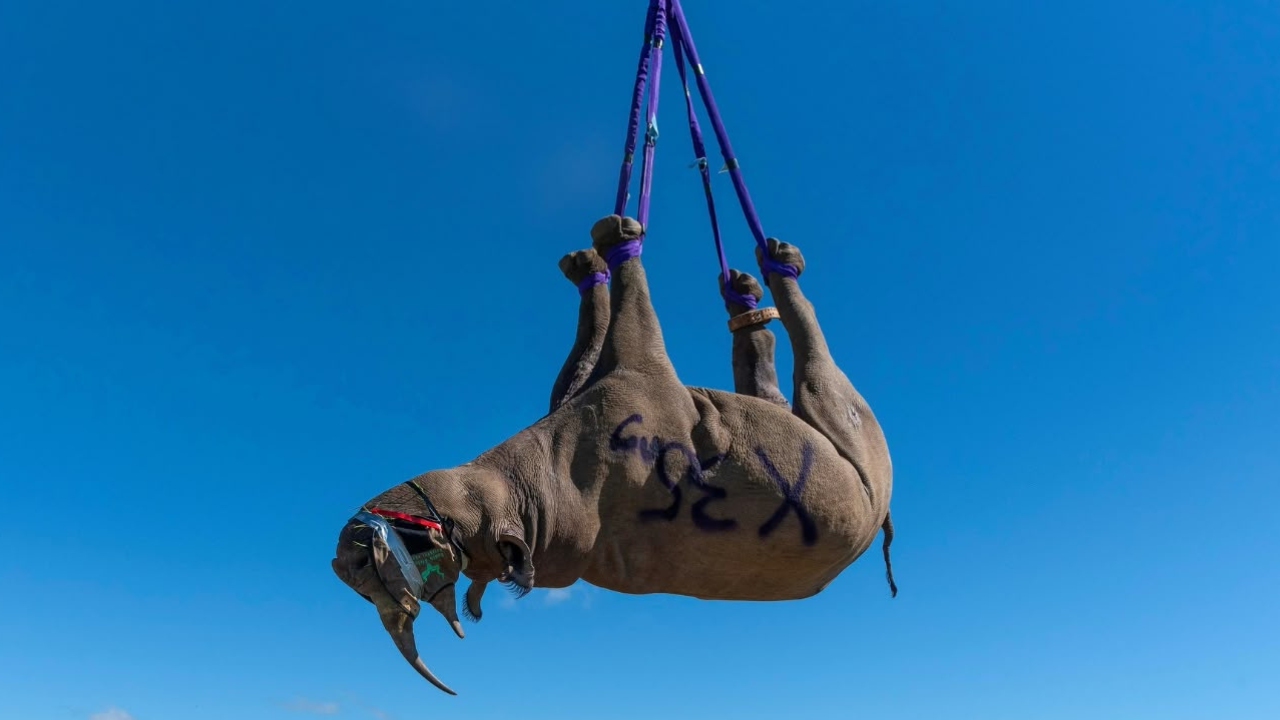
Imagine a two-tonne rhino, blindfolded and asleep, dangling from a helicopter by its ankles. It sounds like something from a comedy sketch. However, a 2021 study published in the Journal of Wildlife Diseases found that the unusual technique was an efficient way to help conserve the species. Cornell wildlife veterinarian Robin Radcliffe found that suspending a sedated black rhinoceros upside down had little effect on breathing and may even have helped slightly.

Get breaking news anytime, anywhere. Download the TOI app now!

A problem bigger than poachers

While poaching certainly gathers most media attention, there have been other challenges that pushed black rhinoceroses to the brink of extinction. Their population had already crashed from an estimated 100,000 across Africa during the 1960s to less than 2,500 animals in the mid-1990s because of poaching and habitat loss, according to WWF South Africa's Black Rhino Range Expansion Project . Despite efforts to save them, another problem emerged: the overpopulated black rhinos in the old reserves were not breeding quickly enough.

Black rhinos are what conservationists call a density-dependent species, WWF South Africa explains: when too many animals share too little land, birth rates fall. A 2017 Koedoe study titled ‘ The reproductive success of black rhinoceroses in the Hluhluwe–iMfolozi Park, KwaZulu-Natal, South Africa ’ by researcher Zoliswa Nhleko examined the reproductive success of black rhinoceroses in Hluhluwe-iMfolozi Park, KwaZulu-Natal, South Africa. In Hluhluwe-iMfolozi Park, one of the country's most important donor populations, the study found that rhinos reached maturity at around 12 years old, compared with a target age of seven years and five months. Giving rhinos more space to roam, WWF South Africa notes, is what helps reproduction rates recover.

Moving rhinos to move the needle

WWF's solution was the Black Rhino Range Expansion Project, or BRREP, established in 2003. The idea was simple, even if the execution was not. Moving rhinos from their overcrowded habitat to new land would lower the population density in both the old and new areas, easing the crowding that was suppressing reproduction and giving the moved rhinos more space to breed. Over the years, BRREP has created 17 new black rhino populations in South Africa, covering more than 360,000 hectares, according to a WWF South Africa report. Among these areas, eight are owned partially or completely by local communities rather than government reserves or private game ranches.

But the real challenge was getting rhinos out of the areas where they lived. Some of the most suitable habitats for new rhinos were in hard-to-access areas with rough terrain. For years, conservationists tried using nets or carrying the animal in a crate suspended beneath the helicopter. In both cases, there were certain issues. Crates swung dangerously in the air. Nets put uneven pressure on a rhino's heavy body and needed a large ground crew to load.

The upside-down idea from Namibia

All of this changed in 2012. That year, the project's lead doctor, Jacques Flamand, noticed pictures of rhinos in Namibia that were airlifted attached to their ankles, hanging upside down from the helicopter, according to WWF. He proposed to use this approach during the following relocation of rhinos. It was successful and is now used as the standard procedure. This approach required fewer people on the ground, reduced the time the rhino spent sedated, and allowed the helicopter to fly more aerodynamically than when carrying a bulky crate.

On average, the flight takes no longer than ten minutes. First, the veterinarian sedates the rhino with a dart fired from a specialised dart gun, a process called aerial darting. Then the ground crew attaches the rhino's four legs to a single rope beneath the helicopter, which may be an Airbus AS350 Astar or an old Vietnam-era Huey. Within minutes, the rhino is airborne, flown to a spot a truck can reach, then driven the rest of the way to its new home.

Was it actually safe?

For many years, this remained something conservationists believed worked, without hard proof. That changed with Radcliffe's Journal of Wildlife Diseases study, where he compared rhinos on their sides to other rhinos suspended from their legs upside down. Surprisingly, rhinos suspended upside down had better airflow into their lungs than rhinos lying on their sides. The result was unexpected enough that the team won an Ig Nobel Prize in 2021, awarded to research that first makes people laugh and then makes them think. But the underlying message was serious. A technique developed for practical use in rugged terrain also proved gentle on the animal.

Why this quiet fix matters

Today BRREP looks after more than 400 black rhinos across its project sites, or about 15 per cent of South Africa's black rhino population, according to a 2025 WWF South Africa update. Much of this would not have been possible without a technique for relocating rhinos from places no road could reach. Besides being an effective way to transport rhinos, the flying rhino method allowed conservationists to relocate breeding animals onto new territories even faster, which is precisely what a slow-breeding and critically endangered animal needed.

It may be quite funny to think of a rhino hanging upside down from a helicopter. But behind the odd-looking image are years of scientific research and a simple solution learned from Namibia that helped create 17 new opportunities for the species to survive.

Sign up to read this article
Read news from 100's of titles, curated specifically for you.
Already a member? Sign in here
Related Stories
Top stories on inkl right now
One subscription that gives you access to news from hundreds of sites
Already a member? Sign in here
Our Picks
Fourteen days free
Download the app
One app. One membership.
100+ trusted global sources.