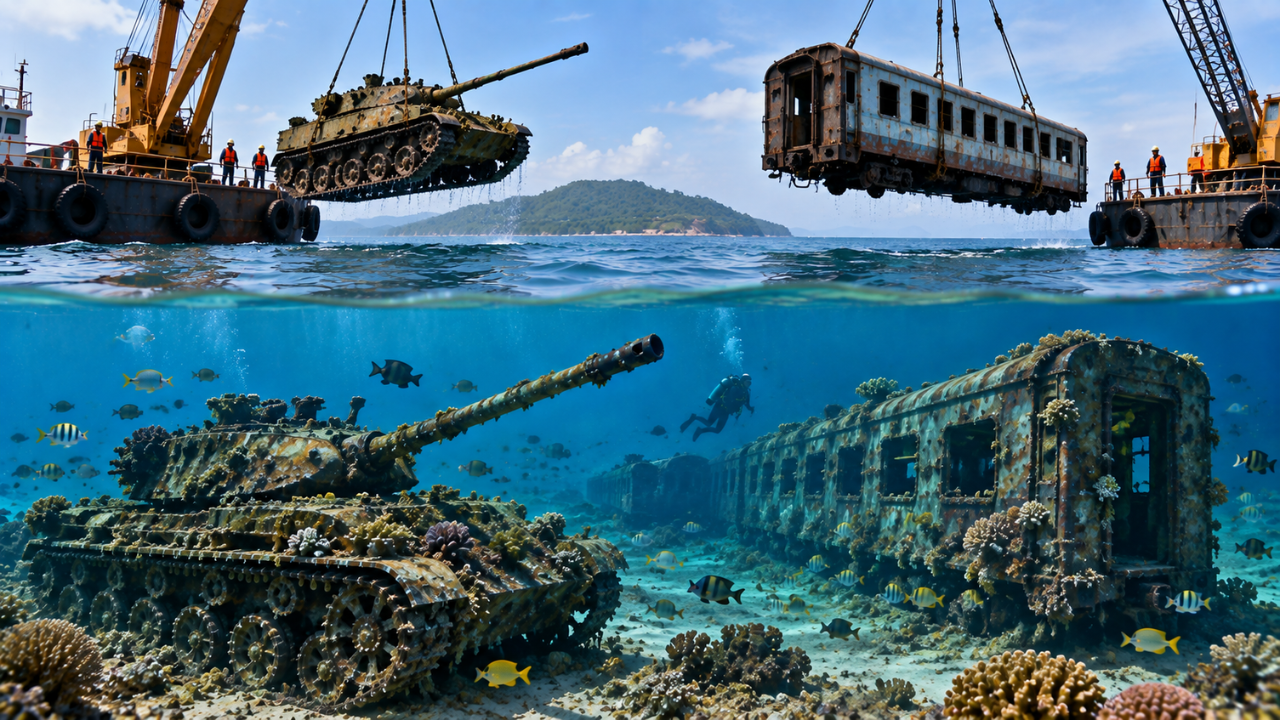
In 2010, the Thai government carried out an unlikely piece of coastal engineering off Narathiwat province, sinking 25 retired army tanks, 273 disused train carriages and 198 rubbish trucks into the southern Gulf of Thailand. The plan, backed by Thailand's queen, was meant to answer a request from local fishermen, who had watched stocks thin out after years of heavy fishing in the area. Rather than commission purpose-built reef structures, officials turned to hardware already sitting idle, using it to form the skeleton of 72 new reefs across the region. Years on, marine researchers returned to the site to see what had taken hold on the wreckage. Their survey, carried out across a cluster of tanks and a separate group of train wagons, set out to record which fish species had settled there and in what numbers, offering a detailed picture of how a reef assembled from military surplus develops over time. The research also provided insight into whether different types of submerged structures attract distinct marine communities. By comparing the habitats formed around tanks and train carriages, scientists could examine how reef shape, available shelter and surface area influence the species using these artificial environments.
Get breaking news anytime, anywhere. Download the TOI app now!