Get all your news in one place.
100's of premium titles.
One app.
Start reading
The Economic Times
The Economic Times
Team Global

In 2001, NASA sent the science behind toothpaste and salad dressing into space; the research later helped produce three P&G patents

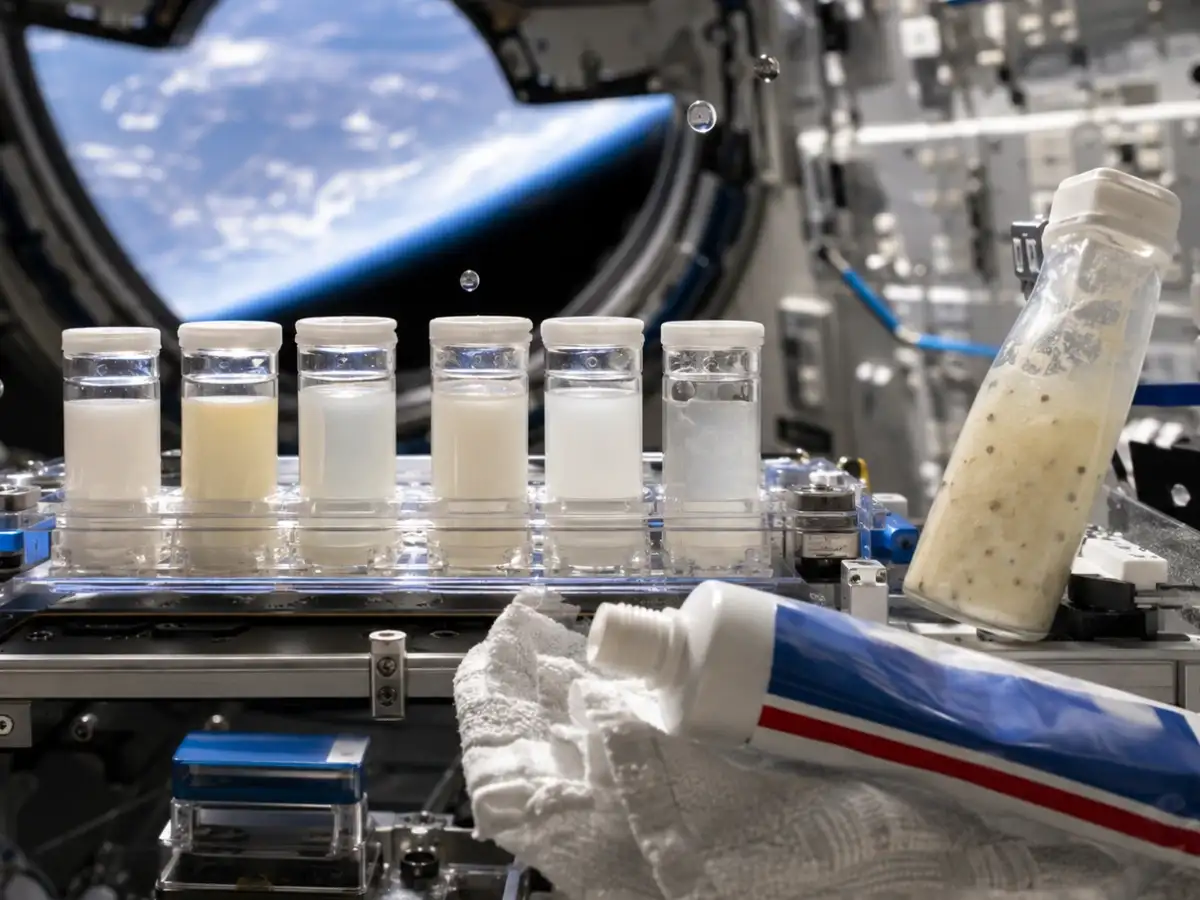
Your toothpaste and salad dressing have more in common than you might think, and NASA has spent more than two decades studying why. Ever since 2001, NASA has been sending its experiments to the International Space Station to investigate the properties of colloids, a wide range of mixtures including everything from shampoo to vinaigrette, because gravity makes them difficult to study properly. According to NASA Science, Procter & Gamble received three patents based on the ISS experiments. The partnership between NASA and P&G is unusual but scientifically useful.

What is a colloid, and why does gravity ruin the experiment

Colloids are mixtures in which small particles are suspended in another substance without dissolving. Examples of colloids include paint, milk, lotions, and salad dressing. Toothpaste is one of them too. On Earth, gravity can cause particles to settle, oil to separate from water, and products to spoil sooner. That is why salad dressing often needs to be shaken before use. Scientists needed a way to study colloids without gravity affecting the results. The microgravity aboard the space station was ideal for their needs. According to a NASA summary of two decades of research on the space station, the absence of gravity enables researchers to analyze particle settling and separation.

The 2001 experiment that opened the door

According to NASA, in 2001, NASA's colloid physics work got a boost when the Physics of Colloids in Space experiment flew to the station aboard Space Shuttle flight STS-100. The experiment operated for thirteen months within the Destiny laboratory aboard the station, collecting information about such colloidal suspensions as paints, milk, cosmetics, and salad dressings, the same physics that govern how toothpaste stays consistent on a store shelf. Although P&G was not involved, the experiment showed that space could be used to study the same physics that affect consumer products on Earth.

Sign up to read this article
Read news from 100's of titles, curated specifically for you.
Already a member? Sign in here
Related Stories
Top stories on inkl right now
One subscription that gives you access to news from hundreds of sites
Already a member? Sign in here
Our Picks
Fourteen days free
Download the app
One app. One membership.
100+ trusted global sources.