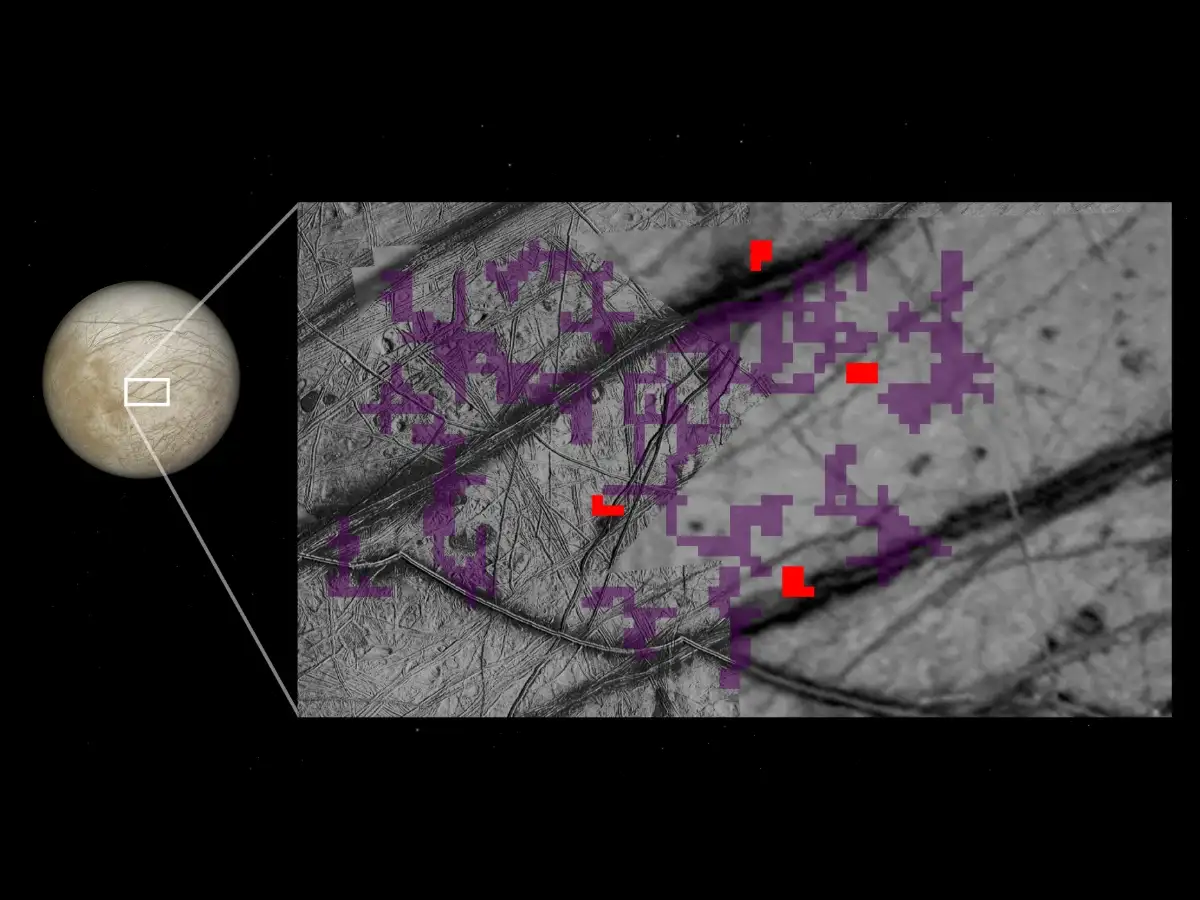
Europa appears plain when viewed from afar. It is a small and icy moon in orbit around Jupiter, appearing like a pale ball cracked with fissures, smaller even than our own moon. Below the icy crust lies a hidden ocean of liquid water, kept liquid by Jupiter’s tidal forces. This makes Europa an important target in the search for signs of habitability.
This image is based on imagery captured by NASA’s Galileo spacecraft in 1997 during its 11th orbit around Jupiter. The dataset covers an area about 250 miles (400 kilometres) wide on Europa. Galileo’s Solid-State Imaging camera supplied the black-and-white surface imagery, while its Near-Infrared Mapping Spectrometer provided spectral data that could be used to identify ammonia-bearing compounds. A later analysis of the Galileo data, reported by NASA in 2026, combined the imagery and spectral data to show where the compounds were detected in relation to Europa’s fractures. The Galileo spacecraft was launched on October 18, 1989, aboard Space Shuttle Atlantis and was managed by NASA’s Jet Propulsion Laboratory. It entered orbit around Jupiter in December 1995, and its extended mission continued until September 21, 2003, when Galileo was deliberately plunged into Jupiter’s atmosphere.