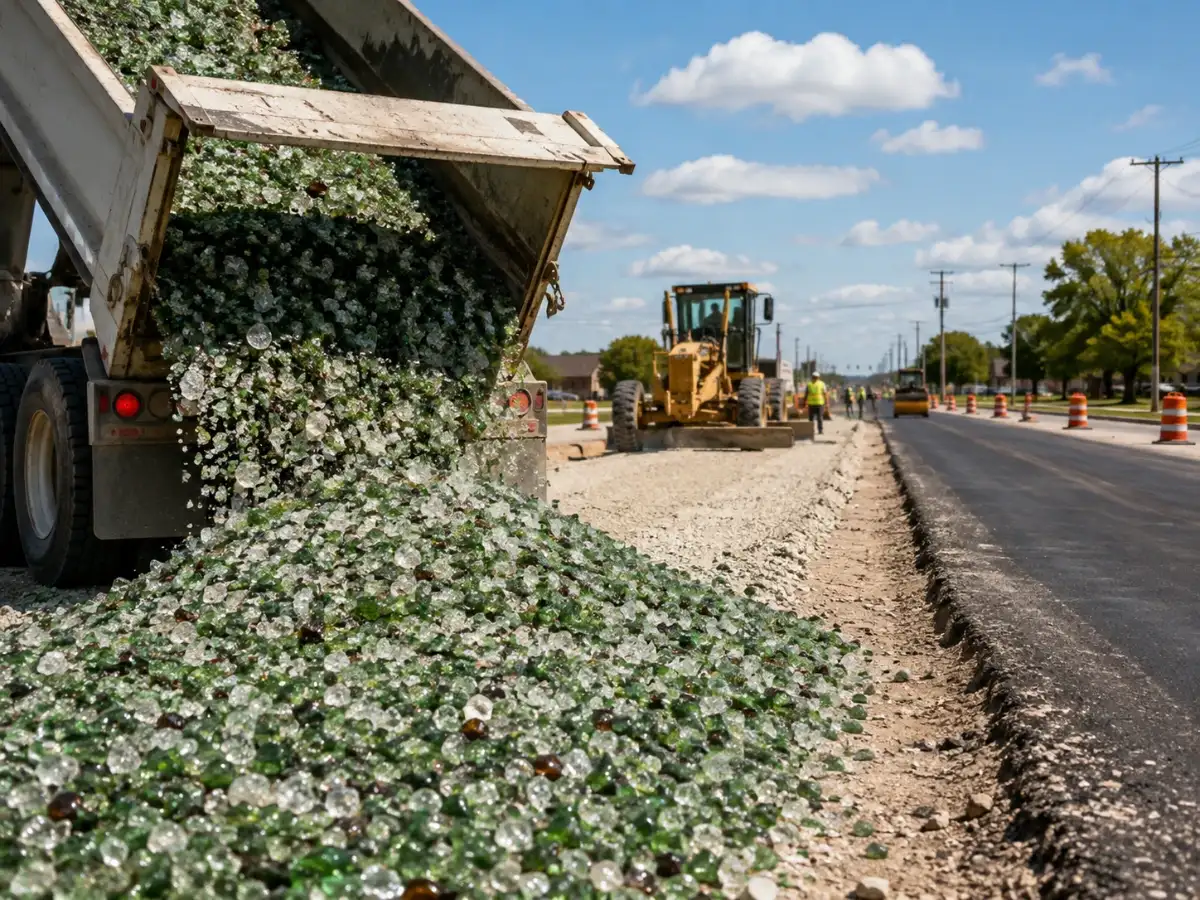
At a construction site in Abilene, Texas, trucks delivered crushed soda bottles and jam jars instead of regular gravel, and that glass became part of a real road. According to a Texas Department of Transportation research packet on glass cullet in roadway construction, engineers widened Antilley Road in Abilene in May 1997 by blending crushed limestone and glass. It may seem farfetched, but the project was successful enough that the city continued using the approach.
A road built from bottles and jars

The project widened Antilley Road from two lanes to five lanes with a turn lane. The construction team used 12 inches of crushed limestone mixed with glass cullet, compacted it into a flexible base, and then laid 1.5 inches of hot-mix asphalt on top. It was done following draft specifications made by Texas Tech University for the state, according to which glass could be used in a flexible road base, provided that its quantity remained below a certain limit by weight, the same TxDOT packet explains.
Where the glass came from, and how it was tested
Abilene collected 240 tons of glass for the project over one year. Not all of it went into the Antilley Road test segments. The two experimental sections used roughly 150 tons combined, with the surplus collected as part of the city's broader glass-recycling push before the project's own crusher was purchased. Of that total amount, 75 percent came from a local salvage company called Pine Street Salvage. The remaining 25 percent came from Dyess Air Force Base outside the city. TxDOT personnel transported the salvage-company glass to Dyess, where base equipment crushed all of the collected material, both the Pine Street Salvage glass and Dyess's own, into cullet. The TxDOT packet notes the process took about 120 hours and cost $9 per ton. According to the TxDOT packet, this figure is in line with the average cost range of $7 to $12 per ton in the industry. The test itself was carried out in two parts, each 750 feet long and 12 feet wide. The eastern segment was paved using base containing 10 percent glass cullet. The western segment was paved using base with 15 percent glass cullet. Both segments were run simultaneously to compare the performance of the two blends.