Get all your news in one place.
100's of premium titles.
One app.
Start reading
The Times of India
The Times of India
World
TOI World Desk

In 1973, Icelanders pumped more than 6 million cubic metres of seawater onto lava to protect a fishing harbour, creating a new breakwater

When a volcano erupted on the Icelandic island of Heimaey in January 1973, the immediate concern was not only the homes and streets in its path but also the harbour that supported the island's fishing industry. If lava reached the harbour entrance, it could have disrupted the community's main source of income long after the eruption ended. As molten rock advanced across the landscape, authorities and engineers searched for ways to reduce the risk to this vital piece of infrastructure.

Get breaking news anytime, anywhere. Download the TOI app now!

One solution made use of the island's location. Surrounded by the cold waters of the North Atlantic, Heimaey had access to an abundant source of cooling water. According to the US Geological Survey Open-File Report 97-724 , crews began pumping seawater directly onto advancing lava flows to cool them more rapidly. Over the course of the eruption, workers pumped about 6.2 million metric tonnes of seawater onto the advancing lava flows.

The cooling effort was not meant to stop the eruption itself. Instead, it focused on slowing lava flow in areas where it threatened critical infrastructure, particularly around the harbour. After the eruption, part of the cooled lava formed a rocky barrier that provided additional shelter from the sea and became a new breakwater.

How an emergency response turned into an engineering experiment

The USGS report states that the eruption began in the early hours of 23 January 1973, when a volcanic fissure opened on Heimaey in Iceland's Vestmannaeyjar archipelago. Lava fountains, ash and volcanic gases quickly spread across the area, while molten rock flowed towards parts of the town.

Most residents were evacuated soon after the eruption began, but protecting the harbour became a major priority. The harbour was central to the island's fishing industry, and officials recognised that significant damage to it could have serious economic consequences.

The USGS report explains that the cooling project was based on a simple principle. As lava cools, it thickens and hardens into solid rock. Engineers believed that applying large amounts of cold seawater to advancing lava could increase the rate at which the outer layers cooled, making it more difficult for the flow to continue moving in the same way.

Initial trials used smaller pumping systems to assess whether the approach could work under field conditions. As these efforts showed that cooling could influence the lava locally, the operation expanded. Larger pumps were installed, pipelines were extended across newly formed lava fields, and crews worked around the clock to direct seawater onto selected sections of the advancing flows.

The work was challenging. Fresh lava remained extremely hot, producing dense clouds of steam where seawater came into contact with it. Equipment had to operate close to active lava, and pipelines frequently had to be extended or repositioned as the eruption continued and the lava field expanded.

What the seawater achieved

According to the USGS report, more than 6 million cubic metres of seawater were pumped onto the lava during the months-long operation. Continuous cooling caused the surface of the lava to harden, forming solid crusts while molten material continued moving beneath them. The report says this process helped slow the lava in some areas by increasing the amount of solid rock at the flow front.

The report concludes that the cooling operation helped keep lava from closing off the harbour. Although the eruption permanently altered the coastline, the lava that cooled near the harbour later formed a substantial rocky barrier that provided additional protection from wave action, effectively creating a new breakwater.

The eruption lasted until 3 July 1973 and emitted large volumes of lava and volcanic ash. By the end of the event, the island had increased in area because of the new volcanic deposits. Many buildings had been buried or destroyed, and the landscape had been dramatically reshaped.

The USGS report also notes that the Heimaey project relied on conditions that may not exist at other volcanoes. According to the USGS report, the lava was basaltic and relatively fluid, the threatened area was close to the sea, and there was sufficient time to establish and expand an extensive pumping system. These conditions made the cooling operation possible, but they should not be assumed to occur during every volcanic eruption.

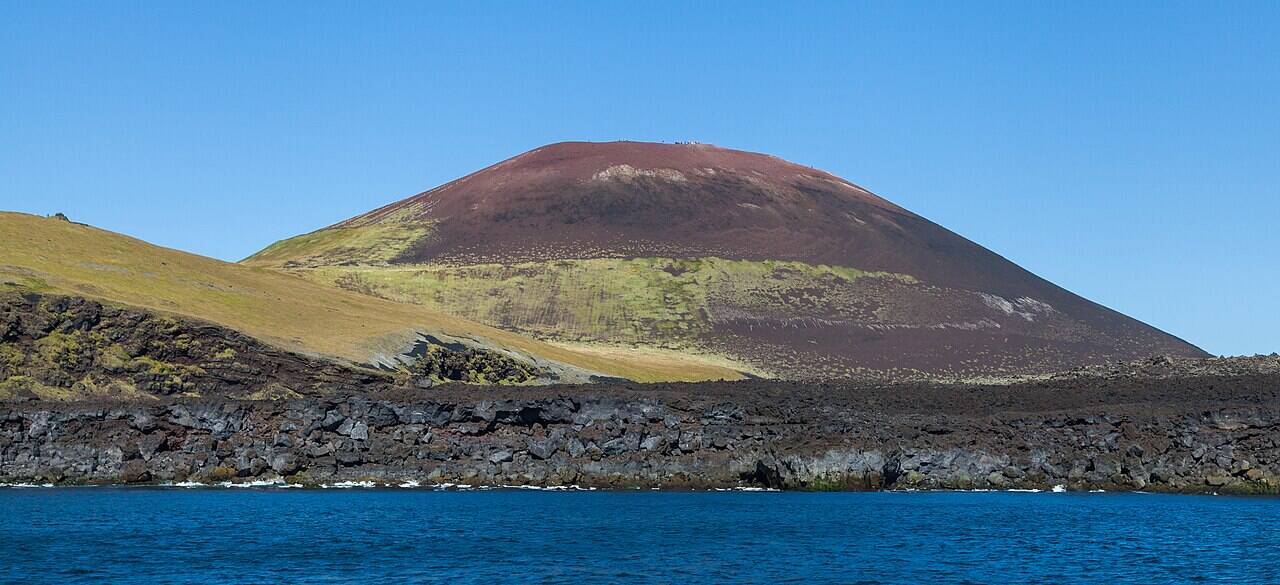
Today, the volcanic landscape created in 1973 remains visible across Heimaey. The USGS report describes the project as a rare example of targeted cooling that influenced an active lava flow and helped protect an important harbour during one of Iceland’s most significant volcanic events.

Sign up to read this article
Read news from 100's of titles, curated specifically for you.
Already a member? Sign in here
Related Stories
Top stories on inkl right now
One subscription that gives you access to news from hundreds of sites
Already a member? Sign in here
Our Picks
Fourteen days free
Download the app
One app. One membership.
100+ trusted global sources.