
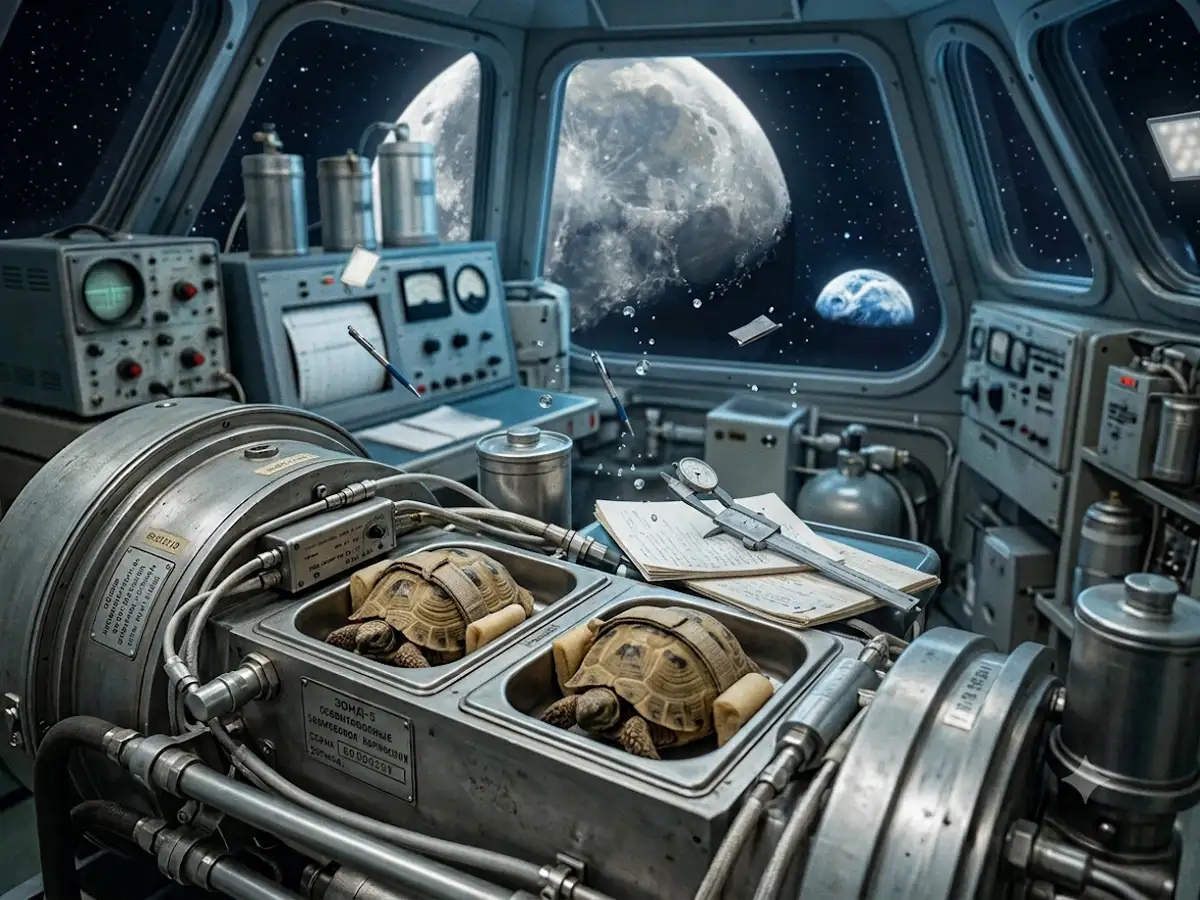
In 1968, two tortoises made spaceflight history by becoming the first animals to circle the Moon and return safely to Earth. The animals, identified as Central Asian tortoises, also known as Afghan tortoises or the steppe tortoises, traveled aboard the Soviet Union’s Zond 5 spacecraft in September 1968. The mission lasted about a week and carried the tortoises around the Moon before bringing them back alive. During the journey, they lost roughly 10% of their body weight but survived the demanding flight. Their mission came about three months before NASA’s Apollo 8, which became the first crewed spacecraft to orbit the Moon. The remarkable Zond 5 mission demonstrated that living organisms could survive a journey around the Moon and helped pave the way for future human spaceflight.
The Soviet Union’s Zond 5 mission carried more than just a spacecraft around the Moon. Launched on September 15, 1968, the uncrewed vehicle traveled around the Moon, passed behind its far side and returned to Earth, splashing down in the Indian Ocean on September 21. The tortoises became the first vertebrates known to travel around the Moon and return alive - a more precise description than simply calling them the first animals to make the journey. Along with the tortoises, the spacecraft carried fruit flies, worms, plants, algae, bacteria and a variety of other biological samples.














