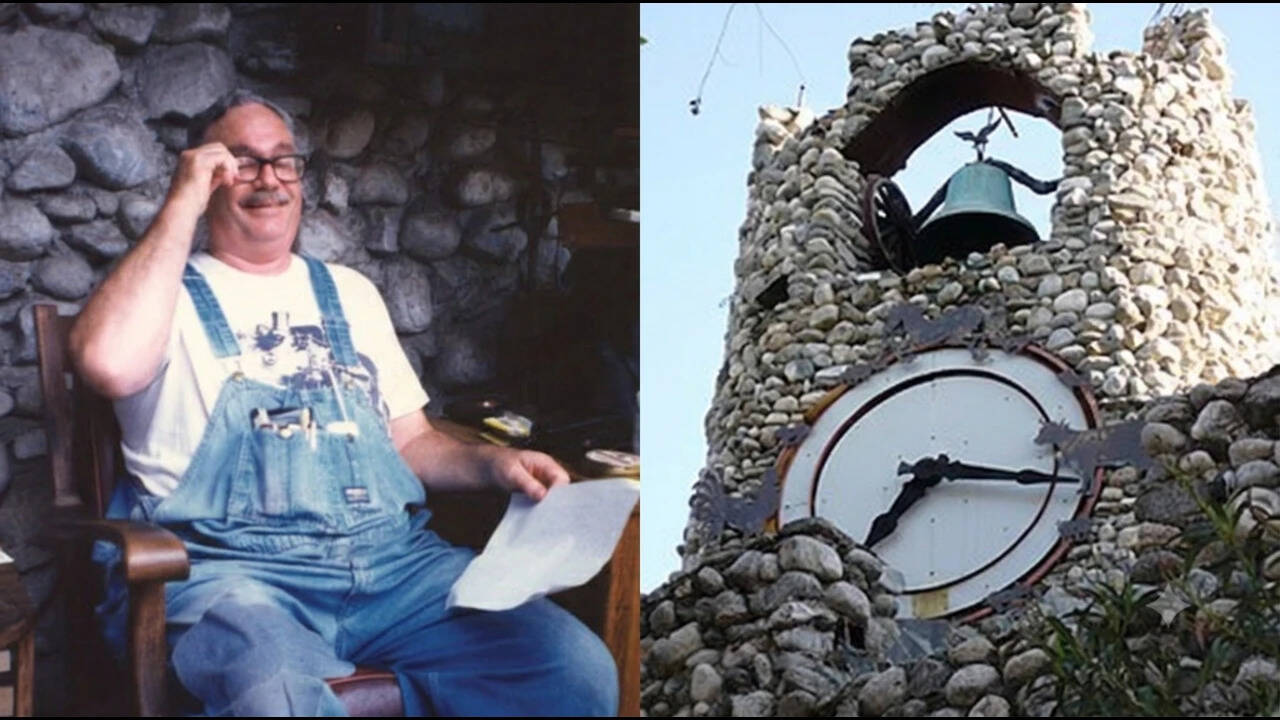
In 1968, Michael Rubel began building something that was never meant to be an ordinary home. On his family’s 2.5-acre citrus farm in Glendora, California, Rubel had already started constructing a private retreat from discarded bottles he collected from parties held by his mother. But the project kept growing until it became Rubel Castle, an extraordinary structure assembled from materials most people would have thrown away. Over the next 18 years, Rubel transformed salvaged concrete, stones, broken bottles and motorcycle parts into a sprawling hand-built complex. Its most recognisable feature eventually rose 74 feet into the California sky, a towering clock tower that gave the homemade castle an unmistakable silhouette. The project also attracted hundreds of volunteers, who helped Rubel cement and construct the unusual structures.
Get breaking news anytime, anywhere. Download the TOI app now!
How Michael Rubel turned discarded bottles into a California castle
Rubel’s unusual building project began partly as an escape from the social life surrounding his family’s citrus farm. His mother hosted parties attended by Hollywood figures and other prominent guests, but Rubel disliked the noise and constant visitors. He began collecting discarded bottles from those gatherings and used them to construct a private residence on the property. The bottle collection was only the beginning. In 1968, Rubel expanded his ambitions and began constructing what he called Rubel Castle, or “Rubelia”. Rather than buying conventional building materials, he relied heavily on objects and materials that had already been discarded. Salvaged concrete, found stones, broken bottles and motorcycle parts became part of the structure. Piece by piece, these unrelated objects were incorporated into walls, towers and other elements of the growing complex.
The castle grew for 18 years
Rubel did not build the castle according to a conventional construction schedule. The project evolved over time as he continued adding to it and experimenting with different materials. What began as a private residence gradually became a much larger artistic environment. The scale of the finished project was remarkable. According to Smithsonian magazine, Rubel worked on the castle for 18 years, while the entire complex eventually stretched across more than 22,000 square feet. Its highest point was the Clock Tower, which reached 74 feet. The unusual construction also attracted attention from the surrounding community. Once word spread that Rubel was building a castle from salvaged materials, hundreds of volunteers came to help. Their involvement turned the project into something larger than one man's eccentric construction experiment, with members of the community helping cement and build the structures.